Companies speak to their customers with growing care and curiosity. The tools may change over time, the platforms may evolve with speed, yet the question remains simple and steady. How can businesses connect with people in a way that feels natural and complete without causing friction? The debate often comes down to omnichannel vs multichannel messaging, a topic that looks similar but carries very different truths. The terms sound similar to most, yet they describe two very different worlds of customer engagement and support.
This is not just theory at work; it affects how customers remember brands with emotion, how they trust companies with intention, and how they stay with businesses with patience. The difference is not small at all; it is about customer engagement strategies that last and about building an integrated marketing strategy that can survive constant change in markets. Let us move carefully here and see what both models mean in practice.
What is multichannel messaging?
Businesses often begin with multichannel before growing into more advanced strategies. It is the natural first step taken, and it is when a company decides to be present on many channels at once. Email works here every day, SMS works there with speed, social posts work elsewhere with reach. That is the multichannel marketing strategy that drives early growth for many, and often starts with a bulk SMS service provider to cover scale.
How does multichannel messaging work?
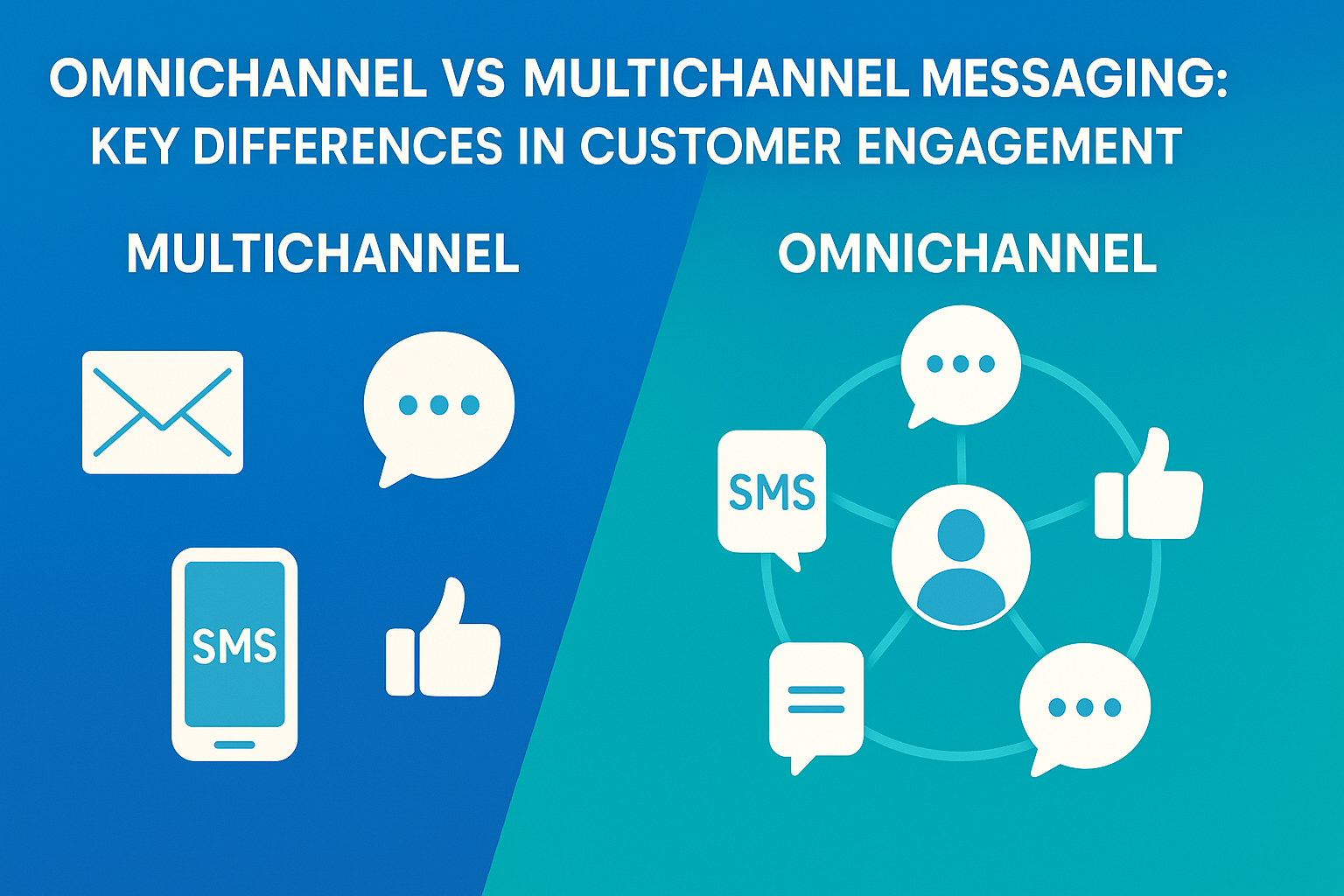
Each channel works in its own space with independence. One team manages email with care, another team runs chat with focus, and another one posts on social media with energy. The systems do not talk to one another at all. There is no shared center that ties them. That is how cross-channel marketing looks without integration or depth.
What are the main drawbacks of multichannel?
The flaws reveal themselves slowly but clearly over time.
-
- Data sits in different silos and cannot connect with meaning.
- The customer journey mapping feels broken and full of gaps, with pain.
- Personalized messaging becomes weaker without context or insight.
- Customers often repeat themselves and lose patience quickly.
This is the heart of the challenges of multichannel marketing, and it shows why it struggles. It is not that multichannel is bad in itself; it simply cannot keep pace with modern expectations and rising needs.
Can you give a real-world example of multichannel?
Picture a customer who tweets about a lost package during stress. Later, they called for support for help. The agent asks them to explain everything again in detail. The tweet and the call live in separate systems without unity. This is multichannel in customer service. Useful, yes, in many ways, but not unified.
What is omnichannel messaging?
Now the shift becomes clear in practice. Omnichannel messaging is not just about being everywhere at once. It is about being everywhere with a memory that flows. It ties each channel together with care. It allows a brand to see the whole picture with clarity.
How does omnichannel messaging work?
All conversations flow into one connected hub with ease. The email a customer sends appears alongside their chat record with accuracy. The SMS message adds context to their social complaint with clarity. The CRM becomes the central view that holds all. This is what is called marketing automation for omnichannel that sustains. It is where tools like RCS (Rich Communication Services) also play a role.
What makes omnichannel different from multichannel?
The difference lies in the connection that lasts. Multichannel spreads out but does not unite deeply. Omnichannel unites and creates seamless communication with balance. It offers a unified brand experience where every touch feels part of one story together.
Can you give a real-world example of omnichannel?
A customer chats on a site in the morning with urgency. In the afternoon, they received an email that continued the same conversation directly. Later, they get an SMS update without repeating a word once. That is omnichannel customer experience in action everywhere. Smooth, consistent, and human at scale.
How do omnichannel and multichannel compare?
The comparison is not abstract or vague. It shapes customer trust, support costs, and marketing returns in reality.
Which is more integrated?
Omnichannel is more integrated than others. It draws all channels into a central system with care. Multichannel is less integrated and weaker. Each channel stands apart without unity.
Which gives a better customer experience?
Omnichannel gives a better customer experience with flow. It feels seamless and whole at once. Multichannel feels fragmented and scattered with flaws. Customers notice the cracks quickly and leave.
Which manages data more effectively?
Omnichannel manages data well because all flows into one CRM with control. It supports clean customer journey mapping with ease. Multichannel leaves data in silos without depth. Insights remain hidden and lost.
Which ensures more consistent communication?
Omnichannel builds a unified brand experience for all. The tone and the message feel steady throughout. Multichannel cannot always keep that balance steady. Messages vary across platforms without design.
Why does omnichannel often outperform multichannel?
The question of performance is not complex at all. It is simple to answer once the details are studied with care.
Does it improve customer satisfaction?
Yes, it does improve satisfaction always. Customers want memory and recognition. They want to feel recognized and valued. Omnichannel messaging improves customer engagement by meeting this desire directly.
Does it increase engagement and retention?
Yes, it does consistently. Customer retention through messaging works when people feel heard and valued. Engagement grows when no detail is lost.
Does it help support teams work faster?
Yes, very much indeed, always. A shared system means no repeated questions. Agents see context at once with clarity. Omnichannel in customer service reduces friction and cost.
Does it offer better personalization?
Yes, it does personalize deeply. Personalized messaging needs context for strength. Omnichannel provides that context by linking data strongly. Multichannel cannot deliver at the same depth today.
This is why many people ask Multichannel vs omnichannel, which is better, and the answer is always clear. The answer is not hidden from view. Omnichannel is the stronger path to take.
When does multichannel still make sense?
There is honesty in admitting that not all companies can start omnichannel quickly. Multichannel marketing strategy has its place for now.
Is multichannel good for small businesses?
Yes, sometimes it is enough. A small business can use email and social media without needing full integration systems. The complexity may not justify the cost here.
Can startups begin with multichannel before scaling?
Yes, and many do with sense. Startups often use a lean model first. They test channels before investing in marketing automation for omnichannel at a cost.
When should a company not invest in omnichannel yet?
If budgets are tight and teams are small, the shift may be premature for them. It is better to plan a steady path forward. Omnichannel is powerful, but it requires readiness overall.
How can businesses move from multichannel to omnichannel?
The move is gradual, never sudden or rushed. The journey itself is a strategy and discipline.
Where should a transition start?
Start with an audit always. Map all active channels with clarity. Look for weak points in the customer journey mapping at scale. See where customers feel the break clearly.
What tools help connect all channels?
The tools matter very much here. A good CRM, a smart messaging hub, and marketing automation for omnichannel are critical today. Integration platforms serve as the glue always.
How can teams adapt to an omnichannel approach?
Teams must learn to see the whole picture. They must practice customer engagement strategies that rely on context deeply. Training is essential and ongoing.
Should businesses begin with key channels first?
Yes, always and without fail. Start with the channels that matter most to customers. Email and chat often come first now. Later, bring in SMS and social media carefully. Growth works best step by step, especially when new channels like WhatsApp marketing are included in an omnichannel WhatsApp marketing strategy.
What can be learned from real-world examples?
Theory is not enough on its own. Practice shows the truth with clarity.
How do retail brands use omnichannel well?
Retail often leads the way with skill. A customer buys online and picks up in the store later. They get an SMS reminder and an email receipt as well. This is cross-channel marketing tied through omnichannel communication strategies with strength. It works because it feels complete every time.
Why do some businesses stick with multichannel?
Some businesses stay with multichannel because their scale is still small. For them, the challenges of multichannel marketing are lighter than expected. They can live with silos for now. Yet as they grow, the cracks widen with time.
What’s the key takeaway?
The essence of this debate is not hard to see. It is about memory and recognition. It is about trust and respect.
Which approach should a business choose today?
The short answer is simple enough. Omnichannel messaging improves customer engagement in a way that multichannel messaging cannot reach. The benefits of omnichannel messaging are real and proven. They include seamless communication, stronger customer retention through messaging, and a lasting unified brand experience without fail.
So, when the question is asked, what is the difference between omnichannel and multichannel messaging, the answer is this and only this. Multichannel means speaking on many platforms, but they stand apart still. Omnichannel means speaking on many platforms, and they always connect as one.
This is why many experts say businesses should switch from multichannel to omnichttps://www.blog.turaingrp.com/omnichannel-marketing-customer-experience/hannel with urgency. It is not just about technology and systems. It is about respect and memory. Customers should never repeat themselves with frustration. They should never feel like strangers to a brand they trust deeply.
If a business seeks depth, choose omnichannel always. If a business seeks scale, choose omnichannel clearly. If a business seeks a true integrated marketing strategy, the choice is already clear to see, and it belongs within the broad practice of digital marketing.