

Search is evolving faster than ever. Today’s user queries aren’t just filtered by search engines like Google but by large language models (LLMs) such as ChatGPT, Perplexity and Gemini that deliver conversational answers on the fly. This seismic shift is forcing marketers and website owners to rethink traditional SEO and focus on AI search optimisation, often called answer‑engine optimisation (AEO) or generative‑engine optimisation (GEO). In this blog, we’ll explore how to adapt your strategy as Google tests AI‑generated meta descriptions, while cracking down on thin content, and how to optimise for ChatGPT‑style queries.
Why AI Search SEO Matters?
AI search engines now process millions of queries daily. ChatGPT alone handles over 30 million searches per day, and Google’s AI Overviews appear in roughly 30 % of U.S. search results. Users are increasingly asking direct questions and receiving immediate answers without ever clicking a website. This shift to zero‑click experiences means you must become the source LLMs trust and cite, rather than merely ranking on the first page.
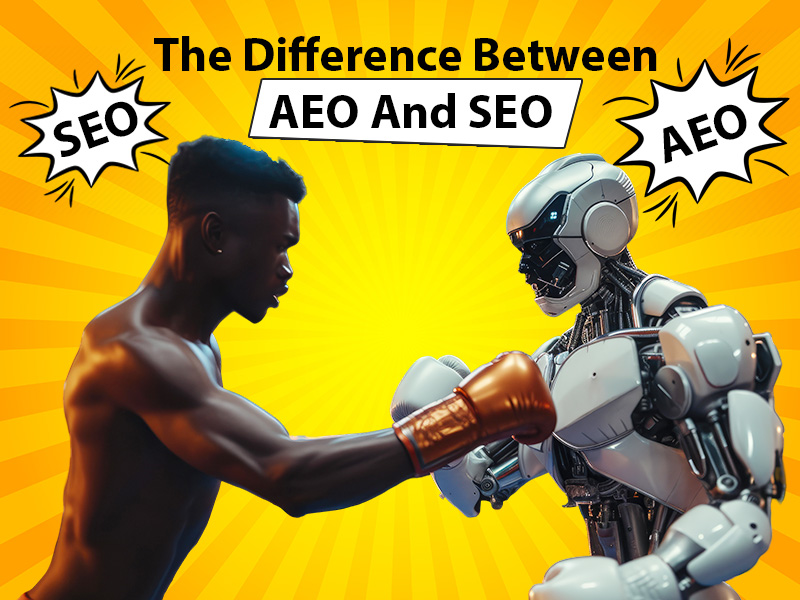
Traditional SEO vs. AI Search SEO
| Traditional SEO | AI Search SEO / AEO |
|---|---|
| Ranks web pages to increase organic clicks | Seeks to be cited in AI answers and voice responses |
| Optimises for keywords | Optimises for authority, context and semantic relevance |
| Success = clicks and traffic | Success = mentions, citations and brand authority inside AI answers |
| Focus on backlinks and metadata | Focus on E‑E‑A‑T (experience, expertise, authoritativeness, trustworthiness) and structured data |
Google’s AI‑Generated Meta Descriptions: Opportunity & Risk
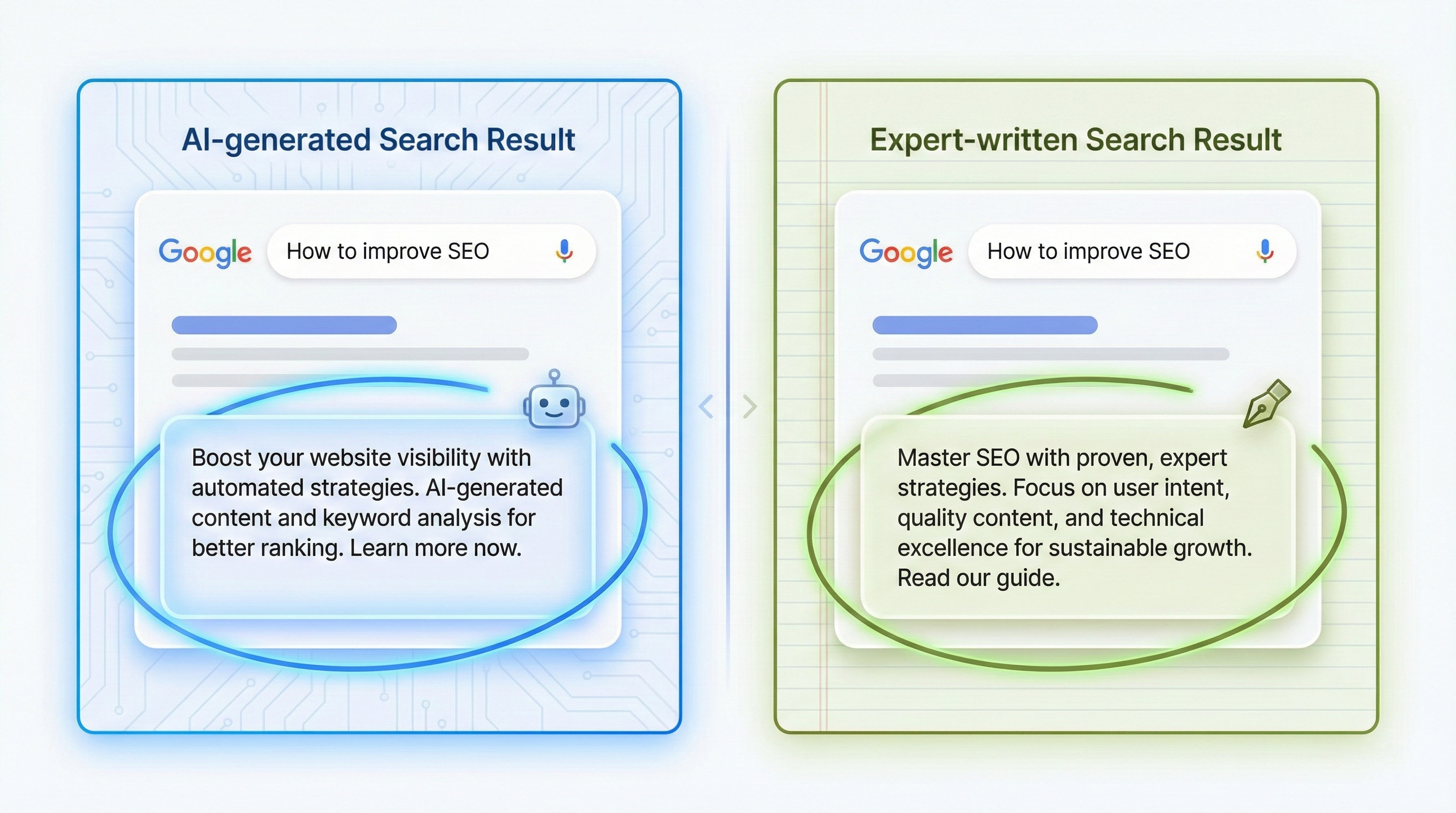
In October 2025, Google Search began testing AI‑generated descriptions for some results, replacing publishers’ meta descriptions with AI‑generated text or summaries. These snippets appear with a small Gemini logo and summarise the page using artificial intelligence. The goal is to provide clearer context for users, but for website owners it raises two concerns:
-
Loss of control over SERP snippets – Your carefully crafted meta description might be overwritten by AI, potentially altering how users perceive your page.
-
Content quality scrutiny – If your meta description or on‑page copy is deemed thin, Google’s AI may rewrite it or ignore it entirely.
How to optimise your meta descriptions for AI search?
- Write meaningful, people‑first summaries. Meta descriptions still influence click‑through rates and now serve as semantic anchors for LLMs. Keep them concise (under 155 characters) yet clear about the page’s purpose.
- Highlight unique value and entities. AI models parse descriptions for relationships between entities and topics. Use your primary and secondary keywords naturally while signalling intent (e.g., “AI search SEO strategies for 2025”).
- Align with on‑page content and schema. Google’s Gemini uses meta descriptions alongside structured data, like FAQ or How‑To schema, to understand context. Consistency reduces the likelihood of AI rewriting your snippet.
- Test and refine. Monitor how often Google rewrites your meta descriptions. If AI‑generated snippets appear, adjust your content to satisfy search intent more clearly.
Google’s Crackdown on Thin Content
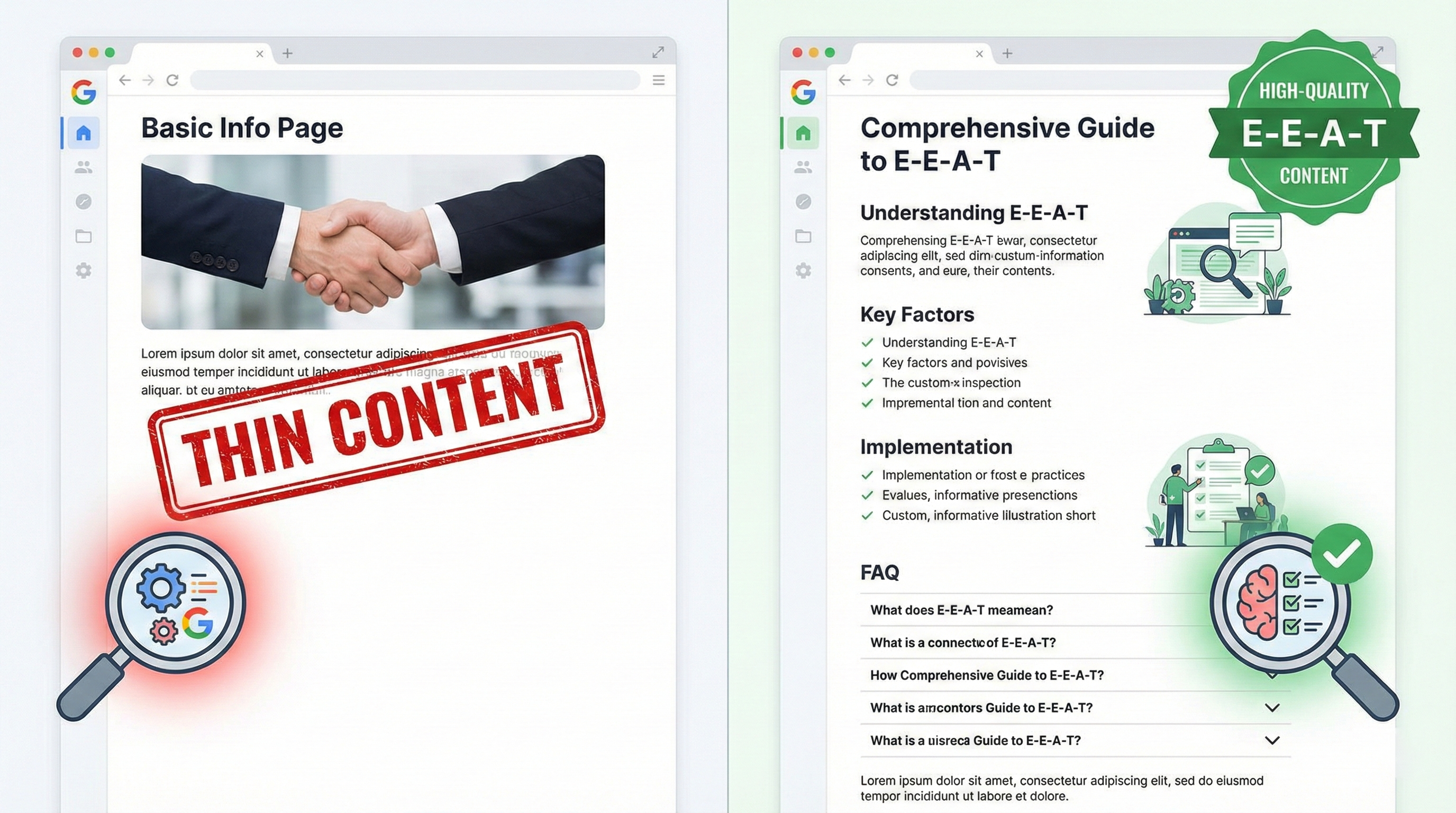
Since the Panda update, Google has penalised thin content—pages offering little or no value. Low‑quality AI‑generated text and duplicate pages are prime examples. Google’s SpamBrain system and helpful content update continue to identify and de‑rank sites that publish content solely for ranking manipulation.
E‑E‑A‑T & People‑First Content
Google explicitly states that high‑quality content demonstrating experience, expertise, authoritativeness and trustworthiness (E‑E‑A‑T) is rewarded in search rankings. This applies equally to human‑ or AI‑produced content. To satisfy E‑E‑A‑T:
- Show experience and expertise. Provide original insights, cite studies or data and ensure the author is a credible source.
- Build authoritativeness. Acquire mentions or backlinks from reputable sites in your industry and maintain consistent branding.
- Earn trust. Use transparent author bylines, update content regularly and adhere to ethical guidelines.
Avoiding thin content
- Focus on depth and relevance. Address user questions comprehensively, answer follow‑up questions and include references.
- Remove or merge duplicate pages. Consolidate thin or similar articles to improve topical depth and reduce cannibalisation.
- Use AI responsibly. Automation is acceptable for generating helpful content, but using AI solely to manipulate rankings violates Google’s spam policies.

Optimising for ChatGPT‑Style Queries
LLMs such as ChatGPT interpret search queries differently from traditional engines. ChatGPT queries are longer, conversational and intent‑rich. Users type full questions (e.g., “How do I rank on ChatGPT search?”) instead of short keywords. To become a trusted source in AI answers, optimise your content for these patterns:
- Use long‑tail, natural language keywords. Incorporate “how,” “why” and “what” phrases in headings and text to match common question formats. For instance, answer “What is AI search SEO?” clearly at the start of a section.
- Implement answer‑first structures. Provide a concise, direct answer within the first 50–100 words of a section, then elaborate with details. LLMs favour content that surfaces key information quickly.
- Use structured data and schema. FAQPage, HowTo and QAPage schema help AI parse your content. Use bullet lists and tables to highlight key facts; LLMs extract information more easily from structured elements.
- Target diverse query types. Address informational (“What is thin content?”), navigational (“Where can I find AI search SEO best practices?”) and transactional queries (“How do I optimise my meta description?”).
- Align with user intent. Understand why someone asks a question. Are they looking for a definition, actionable steps or a tool? Tailor your response to meet that intent.
Integrating GEO/AEO & Thin Content Avoidance
Combining these strategies requires a holistic approach:
- Perform a content audit. Identify thin pages and consolidate or expand them with relevant information, case studies and practical guidance.
- Map content to user questions. Create a list of common ChatGPT‑style queries in your niche and build in‑depth pages or sections that answer those questions. Use your primary and secondary keywords naturally.
- Update meta descriptions for AI. Ensure every page has a unique, descriptive meta description aligned with your content and user queries. Include primary keywords (“AI search SEO”) and secondary phrases (“generative engine optimisation,” “meta description optimisation”).
- Track AI citations. Tools like ChatGPT plug‑in dashboards, Perplexity analytics or SEO tools can help you monitor how often your site is cited in AI search results. Use this data to refine your strategy.

Conclusion
AI search SEO represents a paradigm shift. As Google tests AI‑generated meta descriptions and intensifies its crackdown on thin content, the balance between technical optimisation and high‑quality, people‑first content becomes paramount. By embracing long‑tail, conversational queries, prioritising E‑E‑A‑T principles, and leveraging structured data, you can not only survive but thrive in an era where LLMs serve as primary gatekeepers of information.
References
- Google Search’s guidance about AI-generated content
- Combating Thin Content: How to Identify and Fix It
- AI Search Optimization: How to Rank in ChatGPT, Perplexity, and Google’s AI Overviews
- How to Write Meta Descriptions for Google, ChatGPT, and AI Search
- ChatGPT’s Search Queries and SEO in 2025 Explained
- Google testing AI-generated descriptions for search snippets
Frequently Asked Questions (FAQ)
What is AI search SEO?
AI search SEO (also known as answer‑engine optimisation) is the practice of optimising your content, site and brand so that large language models like ChatGPT, Perplexity and Google’s Gemini cite your content in their answers. It focuses on authority, context and structured data rather than keyword stuffing.
Why is Google replacing meta descriptions with AI‑generated snippets?
Google is experimenting with AI‑generated descriptions to provide more accurate summaries of web pages. This helps users quickly understand a page’s relevance. To maintain control of your snippet, write clear, concise meta descriptions that align with your on‑page content.
How does thin content affect my AI search rankings?
Thin or low‑value content is penalised by Google’s ranking systems. AI search engines favour authoritative sources that demonstrate experience and trustworthiness. Removing thin content and prioritising in‑depth, well‑structured pages improves your chances of being cited.
What are ChatGPT‑style queries?
ChatGPT‑style queries are conversational, full‑sentence questions that AI models process to deliver real‑time answers. They often begin with “how,” “why” or “what” and contain explicit intent. Optimising for these queries helps your content appear in AI‑generated responses.
How can I see if my site appears in AI answers?
Some tools monitor AI citations by tracking mentions in ChatGPT’s responses or by analysing Perplexity/Gemini outputs. You can also manually test prompts related to your content and look for your brand in the answers. Monitoring organic traffic and conversions remains important to measure overall impact.













It’s fascinating to see AI playing such a central role in meta description generation. I wonder how Google will continue to differentiate between genuinely helpful AI-generated content and content that just fills space without real substance.