
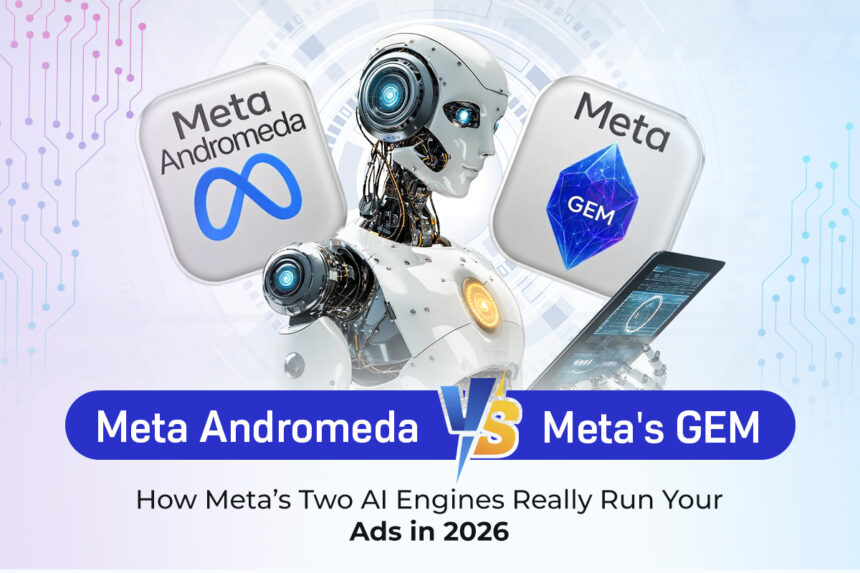
Are You Still Trying to Hack an Algorithm That No Longer Exists?
You are managing a massive campaign for a new SaaS product launch, and the cost per acquisition is slowly creeping up. Your immediate instinct is to duplicate the ad set, manually narrow down the age demographic, and aggressively tweak the bidding cap. You desperately hope that forcing the system into a tighter box will somehow trick the algorithm into delivering cheaper leads.
That manual, hyper-segmented approach was highly effective five years ago. Today, doing that is the fastest way to completely destroy your own return on ad spend. You are actively fighting against a multi-billion-dollar infrastructure that was specifically designed to handle those micro-decisions better than any human media buyer ever could.
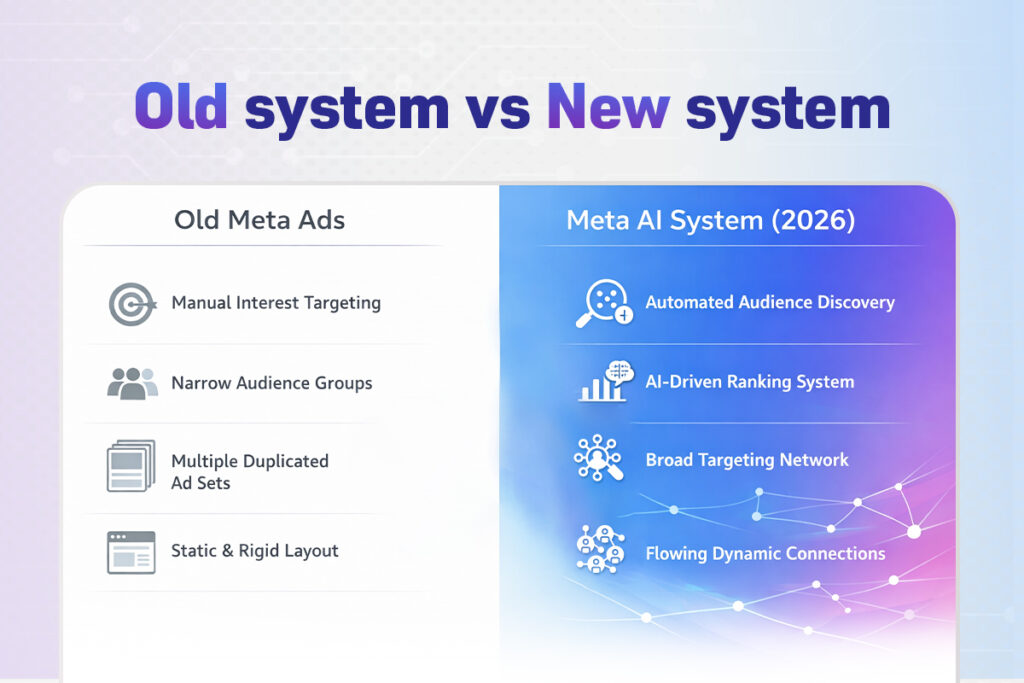
To survive the current media buying landscape, you must completely update your mental model of how Facebook and Instagram actually process data. The platform is absolutely no longer a simple matching engine that pairs your selected interests with user profiles. Because of that profound change, understanding the exact mechanics of Meta Andromeda vs GEM is the ultimate key to mastering paid acquisition today.
Advertisers who deeply understand how this dual-layered Meta AI ads system functions are aggressively scaling their businesses, while those who still rely on manual hacks are being priced out of the auction entirely. That is precisely why mastering the reality of Meta ads automation 2026 is not just a technical advantage; it is a fundamental requirement for business survival.
What Exactly Is the difference between Meta Andromeda vs GEM?
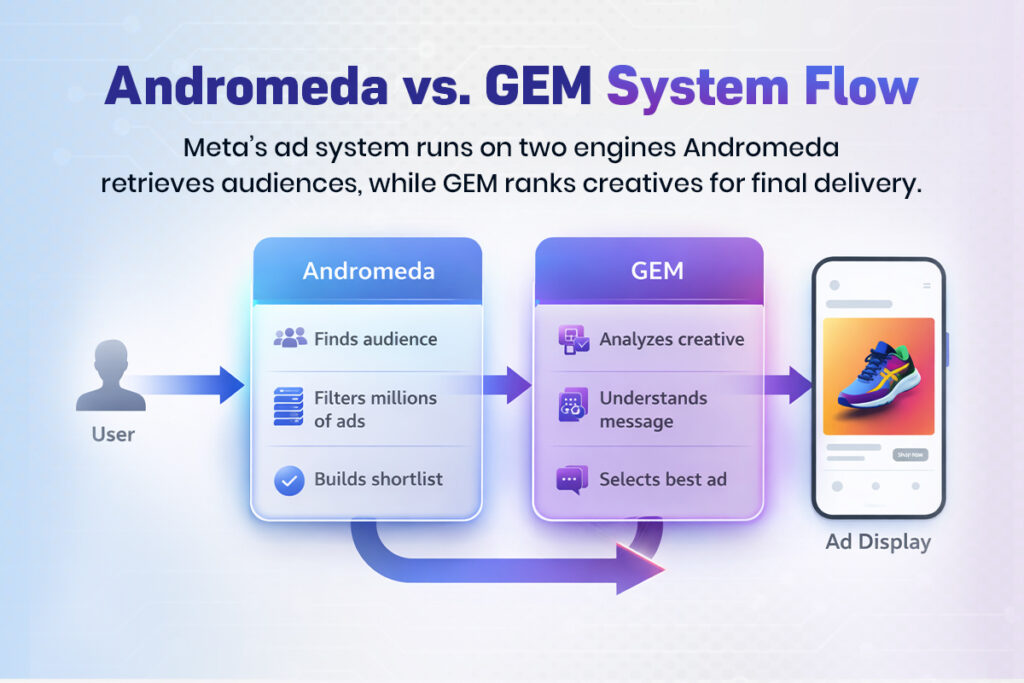
The biggest structural misunderstanding in modern media buying is treating Meta’s artificial intelligence as one giant, invisible brain. When your ad performance suddenly drops, you cannot simply blame “the algorithm” anymore. Instead, you need to view the platform as two highly specialized, collaborative systems operating in a matter of milliseconds. The Meta AI ads system relies on a massive retrieval engine to find potential buyers, and a separate generative brain to rank the creative relevance of your ads.
This is exactly where the internal architecture of Meta Andromeda vs GEM fundamentally reshapes your campaigns. You must stop thinking of them as competing algorithms and start treating them as two halves of the same sophisticated assembly line.
Here is how the modern Meta ads automation 2026 ecosystem divides the labor:
- Meta Andromeda: This is the ultimate heavy-lifting retrieval engine. When a user opens Instagram, Andromeda instantly scans tens of millions of active ads and rapidly whittles them down to a highly relevant shortlist based on predictive math and massive hardware power.
- Meta GEM (Generative Ads Model): This acts as the deep-thinking, central brain. GEM takes the shortlist provided by Andromeda and deeply analyzes the actual context, visual hooks, and messaging of the ad to rank which specific creative will trigger the highest user engagement.
How Andromeda Completely Rebuilds the Delivery Funnel?
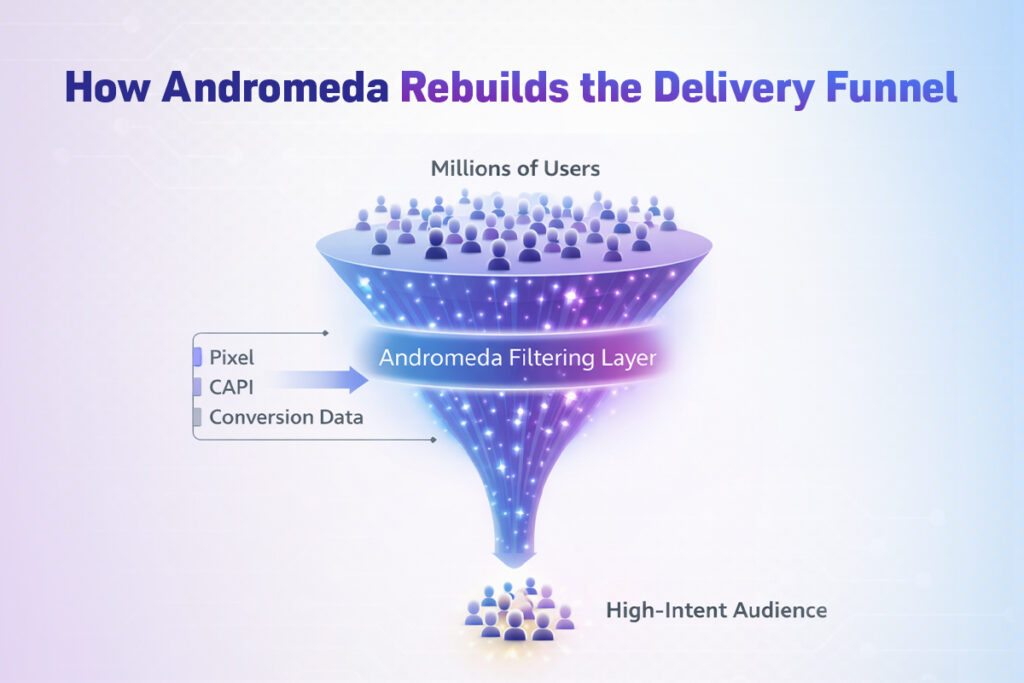
If you look at the platform purely through a data engineering lens, Andromeda is the side of the machine responsible for sheer scale. In the past, advertisers restricted the system by selecting narrow interests, essentially doing the retrieval work manually. Andromeda forcefully removes that requirement. Powered by massive neural networks and extreme hardware acceleration, it analyzes historical conversion data, user behavior, and predictive patterns to decide who actually belongs in your target pool.
Because Andromeda handles the retrieval phase, the most critical variable in your Meta AI ads system is now the quality of your conversion tracking. If your Meta Pixel and Conversions API (CAPI) are feeding the system duplicate, delayed, or low-quality purchase events, Andromeda will successfully retrieve the exact wrong type of customer at incredible speed. Therefore, succeeding with Meta ads automation 2026 means completely trusting Andromeda to find the audience, provided you are rigorously feeding it flawless backend business data.
How GEM Actually Understands Your Ad Creative?
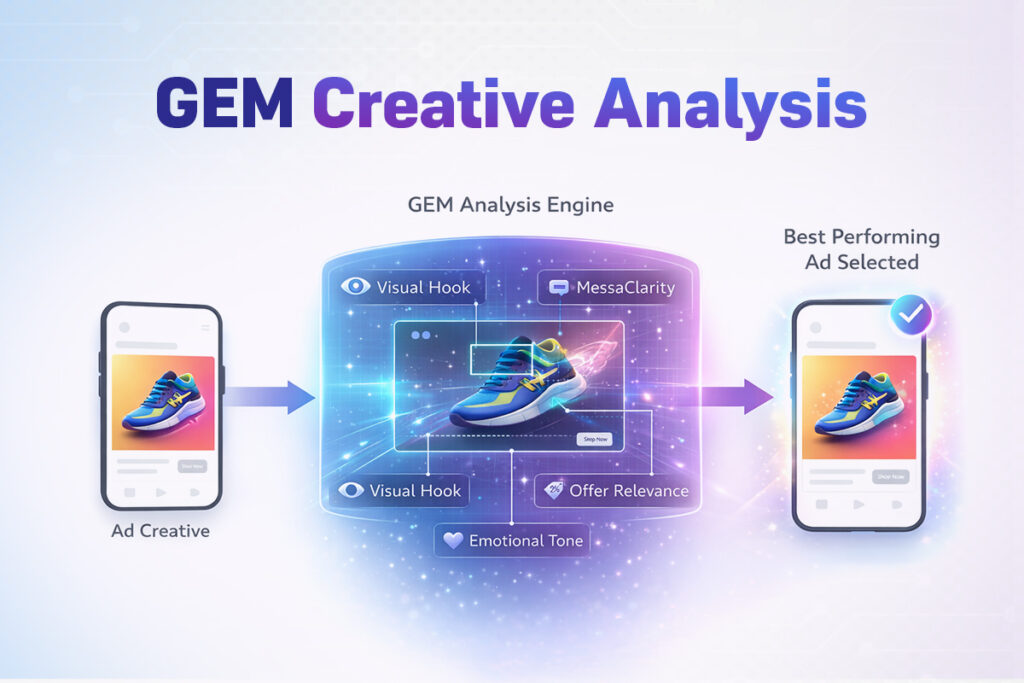
While Andromeda focuses on predictive math, the introduction of GEM completely changes how the platform views your actual videos and images. Historically, the algorithm simply looked at past click-through rates to determine if an ad was “good.” GEM, however, functions very similarly to a massive Large Language Model (LLM) built specifically for advertising. It does not just look at past performance; it actively interprets the context of your creative assets.
This means the GEM side of the Meta AI ads system literally understands what is happening in your video. It recognizes if the tone is urgent, if the product is a luxury item, or if the headline offers a massive discount. Consequently, understanding Meta Andromeda vs GEM is absolutely critical for your creative team. You can no longer trick the system with irrelevant clickbait. If your creative messaging closely aligns with the actual desires of the user profile Andromeda retrieved, GEM will rank your ad higher in the auction, effectively lowering your CPMs. This deep contextual understanding is the core driving force behind the success of Meta Ads Automation 2026.
The Strategic Shift for Founders and Agency Owners
This highly advanced, dual-engine environment is certainly not just theoretical engineering talk. It fundamentally dictates how SaaS founders, e-commerce brand owners, and performance marketing agencies must operate their ad accounts today. Attempting to micromanage your campaigns actively sabotages both engines.
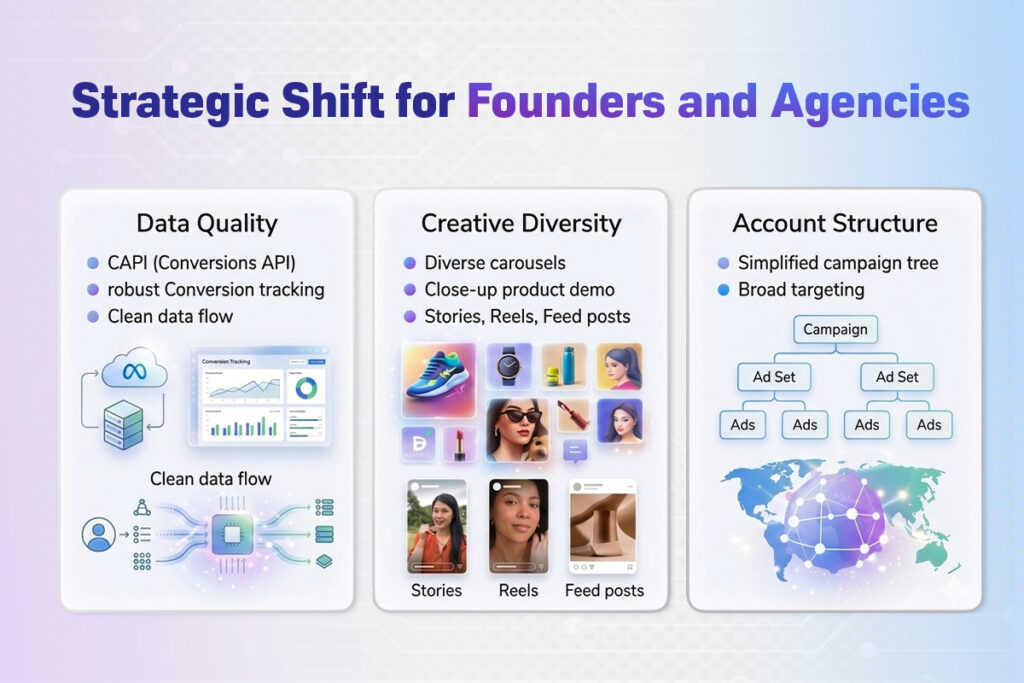
- Account Consolidation: Stop building complex campaigns with fifty different ad sets. You must consolidate your budgets into broad, Advantage+ campaigns, allowing the massive Meta AI ads system enough liquidity to let Andromeda effectively retrieve data without artificial budget constraints.
- Creative Diversity: You must aggressively feed the machine highly distinct creative angles. Because GEM deeply understands content, giving it five identical videos with slightly different text overlays limits its ranking power; instead, give it entirely different visual concepts to test against different psychological triggers.
- Business Signals: Agency owners must forcefully pivot their value proposition away from “media buying tricks” and toward robust data architecture, ensuring the backend tracking perfectly trains the Meta ads automation 2026 ecosystem on what a high-value customer actually looks like.
The Real Limitations You Must Accept
This incredible machine-learning upgrade definitely sounds like an unstoppable revenue generator. Still, it is absolutely not instant magic. And, frankly, a sophisticated dual-layer algorithm will definitely not fix a fundamentally broken business model.
- This advanced Meta AI ads system absolutely cannot save a terrible product offer. If your landing page conversion rate is abysmal or your pricing is uncompetitive, neither Andromeda nor GEM can force a user to pull out their credit card.
- Securing peak performance definitely takes serious financial patience. The Meta ads automation 2026 infrastructure requires heavy data to exit the learning phase, meaning low-budget accounts will struggle significantly to train the retrieval engine properly.
- Blindly trusting the system without monitoring your actual business profit is highly risky. Because the platform heavily optimizes for the easiest available conversions, you must actively audit your CRM to ensure the leads GEM is recommending are actually turning into paying customers, rather than just cheap, low-intent clicks.
Disclaimer:
This article is based on official engineering documentation and publicly available industry analysis regarding Meta’s internal advertising architecture, specifically Andromeda and GEM, as of early 2026. Meta frequently updates its machine learning models, delivery mechanics, and backend algorithms. Readers should continually consult Meta’s official business help center and rely on live, account-specific testing data before committing massive advertising budgets or entirely restructuring their media buying strategies.
FAQ
1) What is Meta Andromeda?
Andromeda is Meta’s personalized ads retrieval engine used in the retrieval stage to improve efficiency and performance, backed by major infrastructure upgrades.
2) What is Meta’s GEM?
GEM (Generative Ads Recommendation Model) is Meta’s ads foundation model built on an LLM-inspired paradigm, designed to improve ad recommendations and performance at scale.
3) How do Andromeda and GEM work together?
In simplified terms: Andromeda helps fetch likely relevant ads, and GEM helps improve ranking/recommendation quality so the best creative can be served for that moment and user context.
4) Do advertisers need to “choose” between Andromeda and GEM?
No—these are internal parts of Meta’s ad system. You don’t toggle them on/off; you influence outcomes indirectly through your data signals, setup, and creative quality.
5) Why are Pixel + CAPI (Conversions API) so important in this system?
Because Meta uses event signals to optimize delivery. Conversions API is designed to create a direct connection between your marketing data and Meta’s optimization systems.
6) What should agencies/founders change in account structure for 2026?
Meta’s direction of travel is toward automation + broader delivery systems; overly fragmented ad sets can restrict learning and reduce signal quality. Consolidate where it makes sense and let the system learn.
7) How does GEM change creative strategy?
Because GEM is built as an ads foundation model (LLM-inspired), creatives should be clear, on-message, and meaningfully different in concept—not five near-identical versions with minor text changes.
8) What are the limitations advertisers must accept?
Even with stronger automation, Meta can’t “fix” a weak offer or poor landing page. And lower data volumes can make optimization harder—so measurement, funnel health, and testing discipline still matter. (Practical guidance aligned with the article’s positioning.)













Does your blog have a contact page? I’m having trouble locating it
but, I’d like to send you an e-mail. I’ve got some ideas
for your blog you might be interested in hearing. Either way,
great website and I look forward to seeing it improve
over time.