Are You Still Manually Bidding on Keywords?
You log into your Google Ads account daily. You carefully adjust manual bids for specific exact-match keywords. Still, despite all that effort, your cost per acquisition keeps rising steadily. That frustration is definitely not a random platform glitch. Rather, it is the direct result of a massive, structural shift in digital advertising. Today, paid search is being rebuilt around automation. As a result, relying mainly on manual keyword tweaks is no longer a winning approach for most advertisers. To survive this immediate shift, a completely new approach is required. Brands must actively adapt to true AI PPC automation. At the same time, account structures must prioritize strict AI ad optimization. Because, increasingly, the actual entity finding your customers is a machine. That is exactly why upgrading your Performance Max strategy is the ultimate competitive advantage for 2026.
- Are You Still Manually Bidding on Keywords?
- What Exactly Is Changing in PPC in 2026?
- Why Your Performance Max Strategy Needs an Upgrade Now?
- Here is how to use AI ads optimization to get real leverage, not just to check a box:
- Also, you must actively avoid the most common automation mistakes:
- The AI-First Growth System (How It Actually Works)
- Who Should Use This Approach?
- Practical Examples
- The Real Limitations (So Expectations Stay Real)
- The Final Takeaway for March 2026
- FAQs about AI‑First PPC in 2026
- 1. What is AI PPC automation in 2026?
- 2. Why is the Performance Max strategy so important now?
- 3. What is Demand Gen, and how is it different from PMax?
- 4. How do AI ads show up in AI Overviews?
- 5. Can you target AI Overviews directly with a special setting?
- 6. Does manual bidding still have a role in 2026?
- 7. How does AI PPC automation impact smaller advertisers?
- 8. What data is critical for AI ads optimization?
- 9. Why pair Demand Gen with Performance Max?
- 10. How should creatives change for AI‑First PPC?
- 11. Are keywords still relevant in an AI‑First world?
- 12. How do ads in AI Overviews affect CTR?
- 13. What’s the PPC manager’s job in 2026?
- 14. How long should you let AI‑driven campaigns learn before judging?
- 15. Does AI‑First PPC work for both lead gen and e-commerce?
What Exactly Is Changing in PPC in 2026?
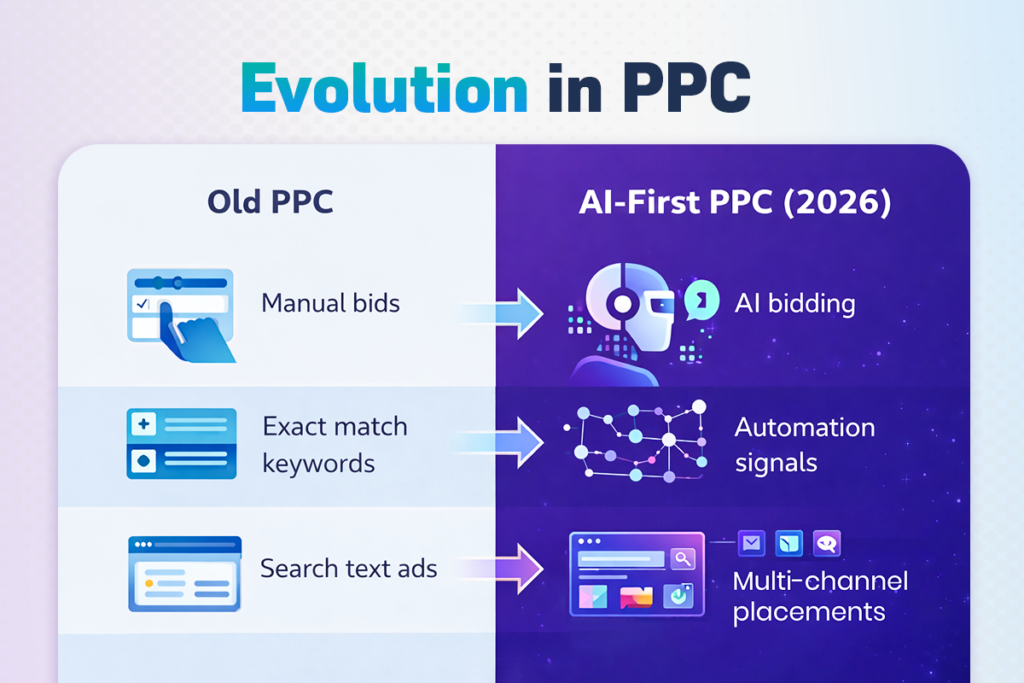
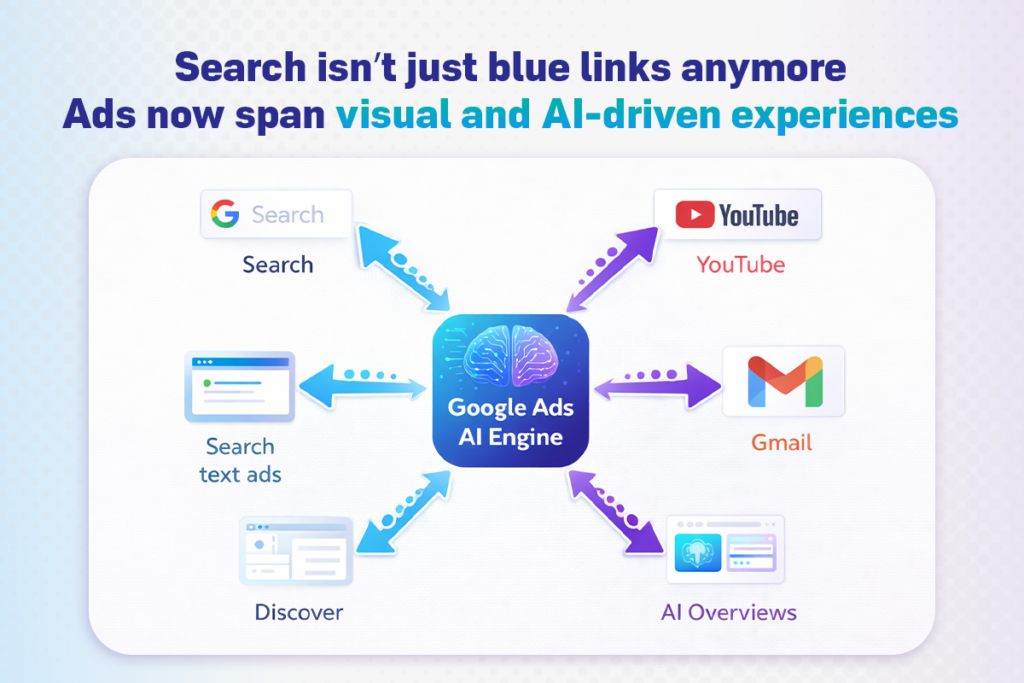
The biggest structural shift in paid media is shockingly simple. Search is absolutely no longer just a static list of text links. Instead, search is now highly visual, highly conversational, and deeply predictive. Furthermore, Google is now placing ads directly inside its chat-based AI Overviews. Consequently, optimizing only for traditional text queries is a failing game.
The advertiser with the longest negative keyword list no longer wins by default. In many accounts, a smarter mix of automation and carefully chosen negatives outperform heavy, hands-on control. Instead, the brand with the best creative assets wins consistently. Brands that match Google’s relevance signals are more likely to show up in AI Overviews, even though you cannot aim ads at those placements directly. And, crucially, the brand that seamlessly appears inside new AI Overviews wins. That is precisely why modern AI ad optimization is definitely not about simple bid caps. Rather, it is entirely about deep algorithm training.
Here is exactly what the new paid reality looks like in daily practice:
- Autonomous algorithms evaluate campaigns heavily by their offline conversion data quality, not just their click-through rates.
- Highly restrictive manual campaigns often lose badly, while broad, consolidated AI PPC automation often wins.
- Real revenue growth is increasingly driven directly by a flawless Performance Max strategy, meaning how well you guide the machine’s learning phase.
Because intelligent systems now place ads inside complex AI Overviews, advanced AI ad optimization inevitably becomes a massive necessity.
Why Your Performance Max Strategy Needs an Upgrade Now?
Platform automation keeps evolving incredibly fast. Meanwhile, the margin for poor campaign structures keeps shrinking rapidly. So, inevitably, if your Performance Max strategy remains completely static, your overall ROAS usually drops. And, conversely, if your conversion tracking lacks clarity, your AI PPC automation efficiency usually drops too. That exact tension forcefully pushes modern performance marketers toward aggressively adopting deeper AI ad optimization.
But naturally, there is a very right way to implement it. And, dangerously, there is a very lazy way to run it. The right method definitely makes your brand highly profitable. The lazy method simply wastes your budget on garbage placements.
Here is how to use AI ads optimization to get real leverage, not just to check a box:
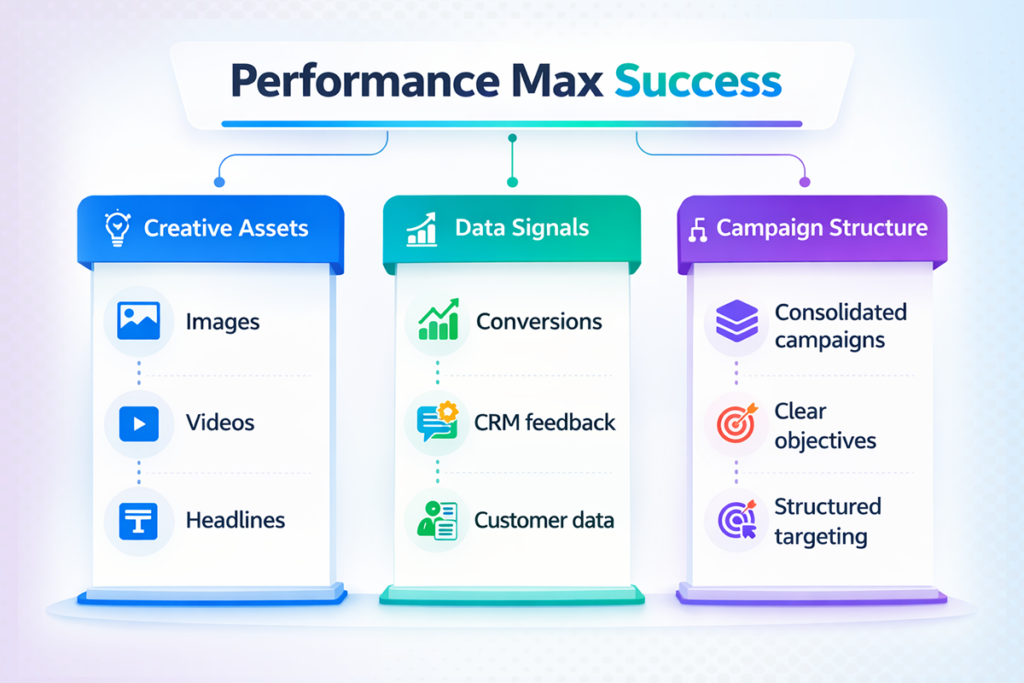
- Instantly restructure your core conversion actions using value-based bidding so your AI PPC automation clearly understands exactly who your most profitable customers are.
- Quickly create diverse, high-quality video assets for Demand Gen, and then carefully keep them refreshed to prevent creative fatigue.
- Easily convert your scattered, fragmented ad groups into one consolidated Performance Max strategy that the algorithm can instantly use to gather meaningful data faster.
- Always keep your offline CRM data highly synced with Google, while still aggressively pushing for strict AI ads optimization regarding lead quality.
Also, you must actively avoid the most common automation mistakes:
- Do not ever flood your asset groups with incredibly generic stock photos that strongly confuse the AI PPC automation
- Do not falsely assume that a basic Performance Max strategy will automatically secure your pipeline without requiring new, specific audience signals.
- Do not carelessly leave your location and language settings too broad, because AI PPC automation absolutely loves spending money on cheap, irrelevant clicks.
Even if you cannot choose AI Overview inventory explicitly, the strength of your creatives and how you structure campaigns still affects how often your current ads are eligible to appear there.
The AI-First Growth System (How It Actually Works)
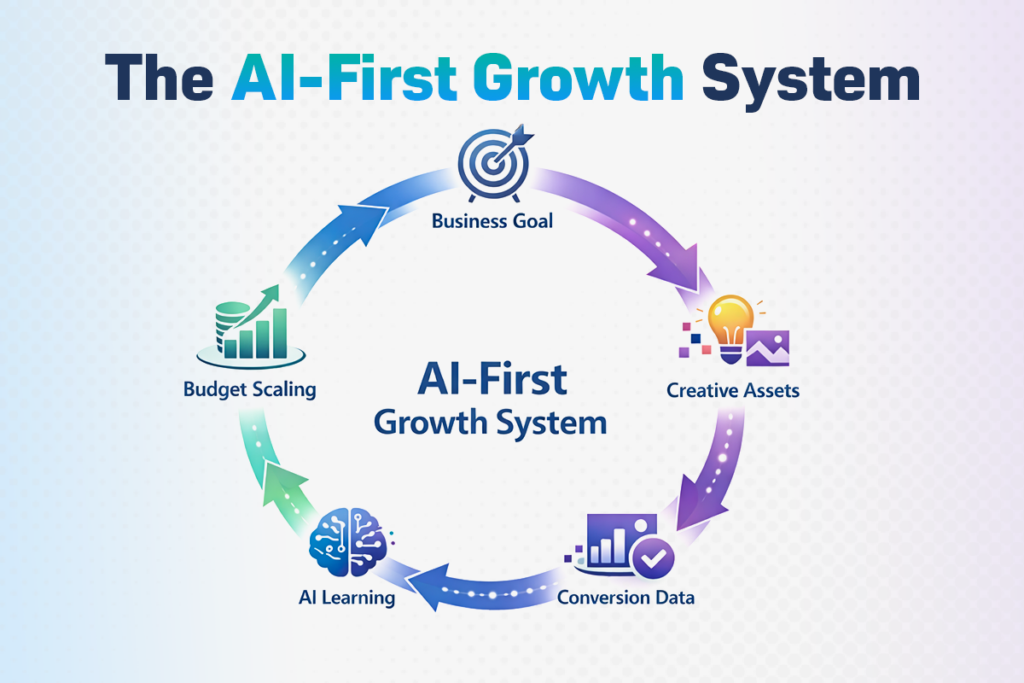
True AI PPC automation is absolutely not just turning on auto-bidding and walking away. It is, instead, a continuous data loop. It is a powerful creative-testing loop. It is also an endless audience-signaling loop. And, most importantly, it is a compounding AI ads optimization loop.
When that specific loop is built strongly, intelligent agents actually help find the right buyers instantly. The algorithm naturally scales you. It eagerly tests your new Demand Gen videos. It constantly refines your Performance Max strategy. And, incredibly, it even proactively shifts budgets between Search, YouTube, and Gmail, entirely without human prompting.
Here is a simple AI-first loop that consistently works across various digital industries:
- Step 1: Pick a very clear business objective. Choose exactly what specific ROAS target your campaign genuinely needs. Make it instantly obvious to the AI PPC automation exactly what success looks like.
- Step 2: Consistently publish creative assets that aggressively earn attention. Provide deep visual hooks. Simplify complex offers. Use your Performance Max strategy to test these variations fairly across all networks.
- Step 3: Actively structure your data on purpose. Use strict offline conversion tracking. Provide real-time CRM feedback. Then, crucially, ensure the AI ads optimization focuses only on highly qualified leads.
- Step 4: Deliberately monitor your search themes. Smoothly track how often the system bids on irrelevant terms. Identify exactly where the AI PPC automation gets confused about your offer, and then actively apply account-level negatives.
- Step 5: Quickly turn those algorithmic insights into fresh creative updates. Use your placement reports directly as your upcoming video production calendar. Use AI ads optimization to rapidly speed up the creative scaling process.
- Step 6: Publicly verify your ad copy. Secure high-quality messaging that deeply resonates with human buyers. Because algorithms strongly trust high engagement, that external validation strongly reinforces your entire Performance Max strategy.
Who Should Use This Approach?
This highly dynamic strategy is certainly not just for massive enterprise brands. It is, in fact, for absolutely anyone who desperately needs consistent leads in a machine-driven world. It is also highly effective for anyone who actively runs a complex Performance Max strategy.
- SaaS founders: Rapidly build algorithmic credibility with deeply integrated CRM data and consistent AI PPC automation that Google easily understands.
- Performance marketers: Safely test new visual hooks and fresh Demand Gen angles organically, then aggressively scale the proven assets using strict AI ads optimization.
- Agency owners: Confidently sell a proven conversion system, not just a generic media buying package, because executing a flawless Performance Max strategy matters significantly more than mere manual bid adjustments.
- E-commerce brands: Powerfully drive high-intent automated purchases by deliberately making product catalogs seamlessly integrated with AI PPC automation
- B2B sales teams: Easily turn complex product education into highly accessible video ads that AI ad optimization can confidently distribute to top-tier decision-makers.
Practical Examples
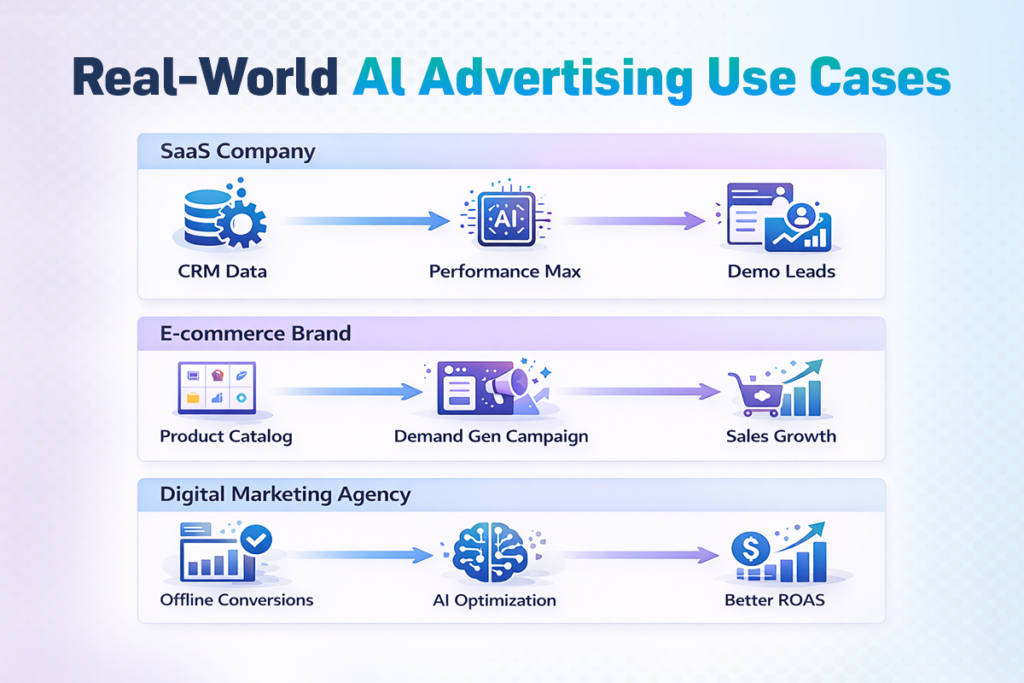
Example 1 — A SaaS launch successfully using AI PPC automation: A software founder completely rewrites their tracking protocol to send only paying customers back to Google. Then, that single, clean data feed quickly gets attached to a new Performance Max strategy. With aggressive AI ad optimization, the learning phase by major algorithms happens significantly faster. Because of that increased data clarity, the product starts appearing natively in AI Overviews. And because the generated leads perfectly match the ideal customer profile, casual clicks quickly turn into booked demo calls.
Example 2 — An e-commerce brand successfully securing scale: A specialized retailer completely stops hiding their best creative behind manual Search campaigns. Instead, they regularly launch Demand Gen campaigns paired with a robust Performance Max strategy. They frequently update very simple, engaging video assets for their AI PPC automation. With that genuine focus on AI ads optimization, autonomous bidding bots start actively prioritizing their products. As a direct result, automated return on ad spend becomes incredibly steady.
Example 3 — An agency effectively aligning with AI ads optimization: A B2B marketing agency repeatedly notices its clients losing pipeline to cheap, unqualified clicks. So, they quickly built a highly targeted offline conversion workflow to fuel their AI PPC automation. Each specific campaign clearly uses value-based bidding within a strict Performance Max strategy. Consequently, the entire account pivots toward extreme profit clarity. Return on investment increases dramatically. Client revenue increases significantly, too. That approach works beautifully because it perfectly matches exactly how modern buying behavior operates inside current AI ads optimization ecosystems.
The Real Limitations (So Expectations Stay Real)
This exact system definitely works. Still, it is absolutely not instant magic. And, frankly, it is definitely not a cheap, overnight fix.
- AI PPC automation absolutely cannot fix a genuinely terrible product offer. If the core landing page is highly confusing, scaling the traffic simply makes that bad conversion rate much more expensive.
- Securing a profitable Performance Max strategy definitely takes serious budget and time. Algorithmic learning compounds rather slowly, but it ultimately scales incredibly strongly once the data is highly accurate.
- Blindly trusting the machine is highly risky. Without genuine human oversight for negative placements, poor AI ad optimization quickly makes a serious brand waste thousands on mobile game clicks.
- Campaign attribution gets increasingly messy. Real AI PPC automation impact often simply shows up as untrackable cross-device conversions, not perfectly clean, click-by-click analytics dashboards.
These limits are definitely not deal-breakers. Instead, they are simply the new rules of paid media. Learn the actual rules. Then, just build intelligently inside them.
The Final Takeaway for March 2026
Winning consistently in March 2026 is absolutely not about optimizing entirely for outdated manual bids. It is, instead, entirely about building a highly predictable, machine-trained engine. Use strategic AI PPC automation to rapidly scale your reach and easily secure algorithmic trust. Embrace a genuine Performance Max strategy to reliably earn consistent conversions and secure repeat placements inside AI Overviews. In an AI-led world, algorithms handle most bidding and placement choices, while you decide the objectives, signals, and creatives—so your main job is giving the system the cleanest, strongest data possible.
Disclaimer:
This blog is for informational and educational purposes only and does not constitute media buying, financial, or business advice. Google Ads features like AI Max, Performance Max, Demand Gen, and ads in AI Overviews evolve frequently, and results will vary based on your industry, budget, tracking setup, and creative quality. Always test changes in a controlled way, follow Google’s official policies, validate your data and attribution, and consult qualified PPC and analytics professionals before making significant advertising or budgeting decisions.
FAQs about AI‑First PPC in 2026
1. What is AI PPC automation in 2026?
It is the use of Google’s AI (Smart Bidding, Performance Max, Demand Gen, AI Max) to handle bids, audiences, and placements based on real‑time signals instead of manual tweaks.
2. Why is the Performance Max strategy so important now?
Performance Max often acts as the core campaign type, and its results depend heavily on your goals, conversion data, and creative inputs.
3. What is Demand Gen, and how is it different from PMax?
Demand Gen focuses on visual, upper‑ and mid‑funnel prospecting on YouTube, Discover, and Gmail, while Performance Max is full‑funnel and more “black‑box” across all Google inventory.
4. How do AI ads show up in AI Overviews?
Existing eligible campaigns (Performance Max, Shopping, broad‑match Search, AI Max, etc.) can be placed within or around AI Overviews based on relevance and intent, not via a separate campaign type.
5. Can you target AI Overviews directly with a special setting?
No, there is no dedicated AI Overview campaign; you optimize inputs (relevance, formats, and AI‑first campaign types) and Google decides placements.
6. Does manual bidding still have a role in 2026?
Yes, manual or hybrid setups can still help in certain niches and testing phases, but automation is dominant for scale and efficiency.
7. How does AI PPC automation impact smaller advertisers?
It lets smaller accounts access enterprise‑level optimization, but only if they have clean tracking and realistic budgets for the learning phase.
8. What data is critical for AI ads optimization?
Accurate conversions, enhanced conversions, offline imports, and value‑based bidding signals are essential for guiding the algorithms.
9. Why pair Demand Gen with Performance Max?
Demand Gen builds attention and feeds qualified traffic that PMax can then convert more efficiently, often lifting ROAS 15–30% in case studies.
10. How should creatives change for AI‑First PPC?
Short, clear hooks, vertical and horizontal video assets, and offer‑led messaging are needed to let AI test variations across surfaces.
11. Are keywords still relevant in an AI‑First world?
Yes, but broad match and intent signals play a larger role, with exact control shifting from individual keywords to campaign design and negatives.
12. How do ads in AI Overviews affect CTR?
Publishers and tools have reported CTR drops on affected queries, making AI placements important for recapturing lost impressions.
13. What’s the PPC manager’s job in 2026?
To design goals, structure accounts, supply creative, and police data and attribution, while AI handles the auction‑level micro‑decisions.
14. How long should you let AI‑driven campaigns learn before judging?
Typically, at least one to two learning cycles with stable budgets and conversion data before making big changes.
15. Does AI‑First PPC work for both lead gen and e-commerce?
Yes, with e-commerce leaning heavily on PMax + Demand Gen and lead gen relying more on clean CRM feedback and tight qualification signals.