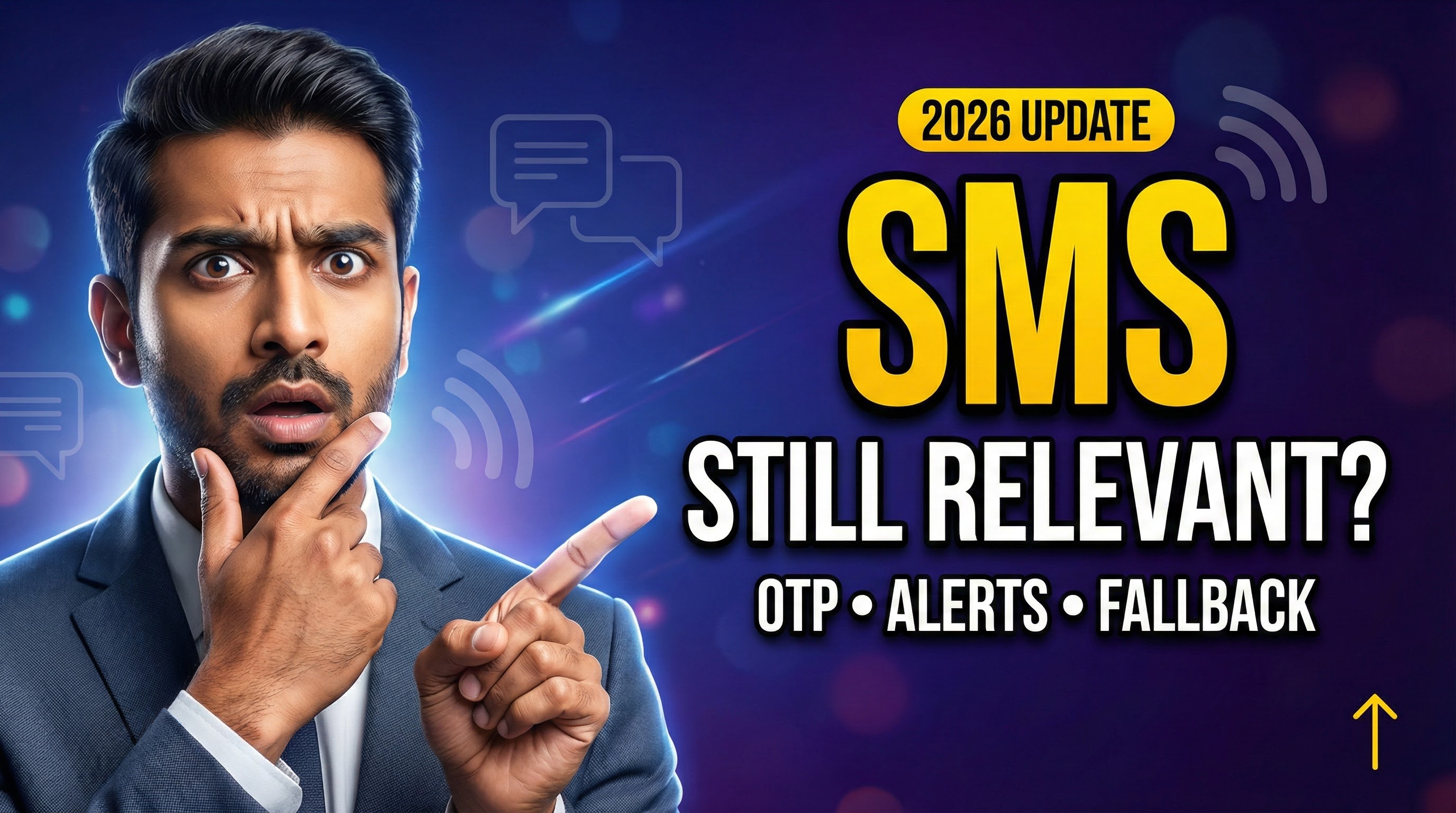
- SMS remains the most universal channel for urgent, short, and delivery-critical communication (alerts, OTPs, transactional updates).
- Modern enterprise SMS is largely A2P (application-to-person) and governed by compliance and carrier policies—not casual P2P texting.
- In India, DLT-based registration, consent, and template governance are mandatory for commercial communications.
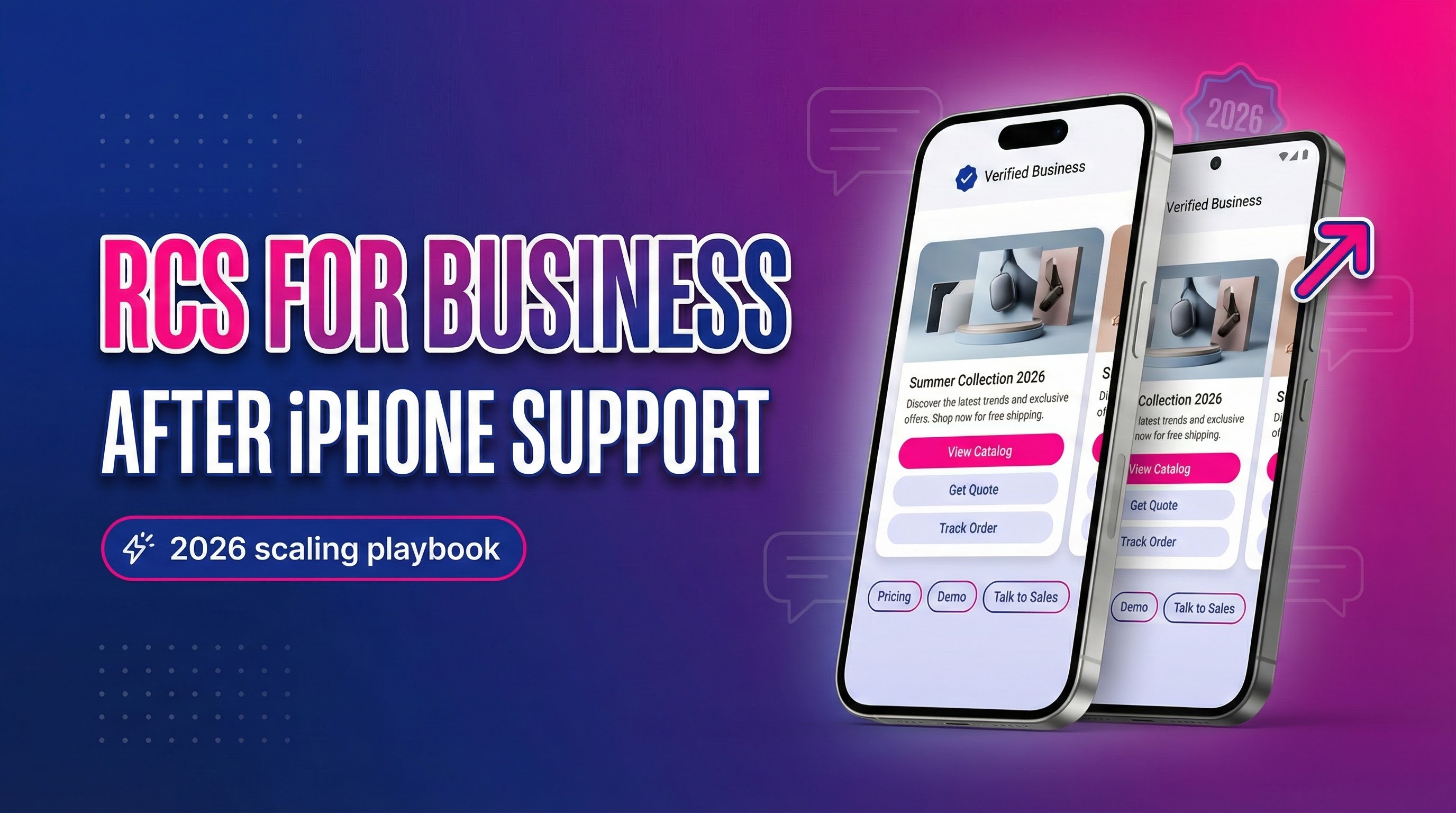
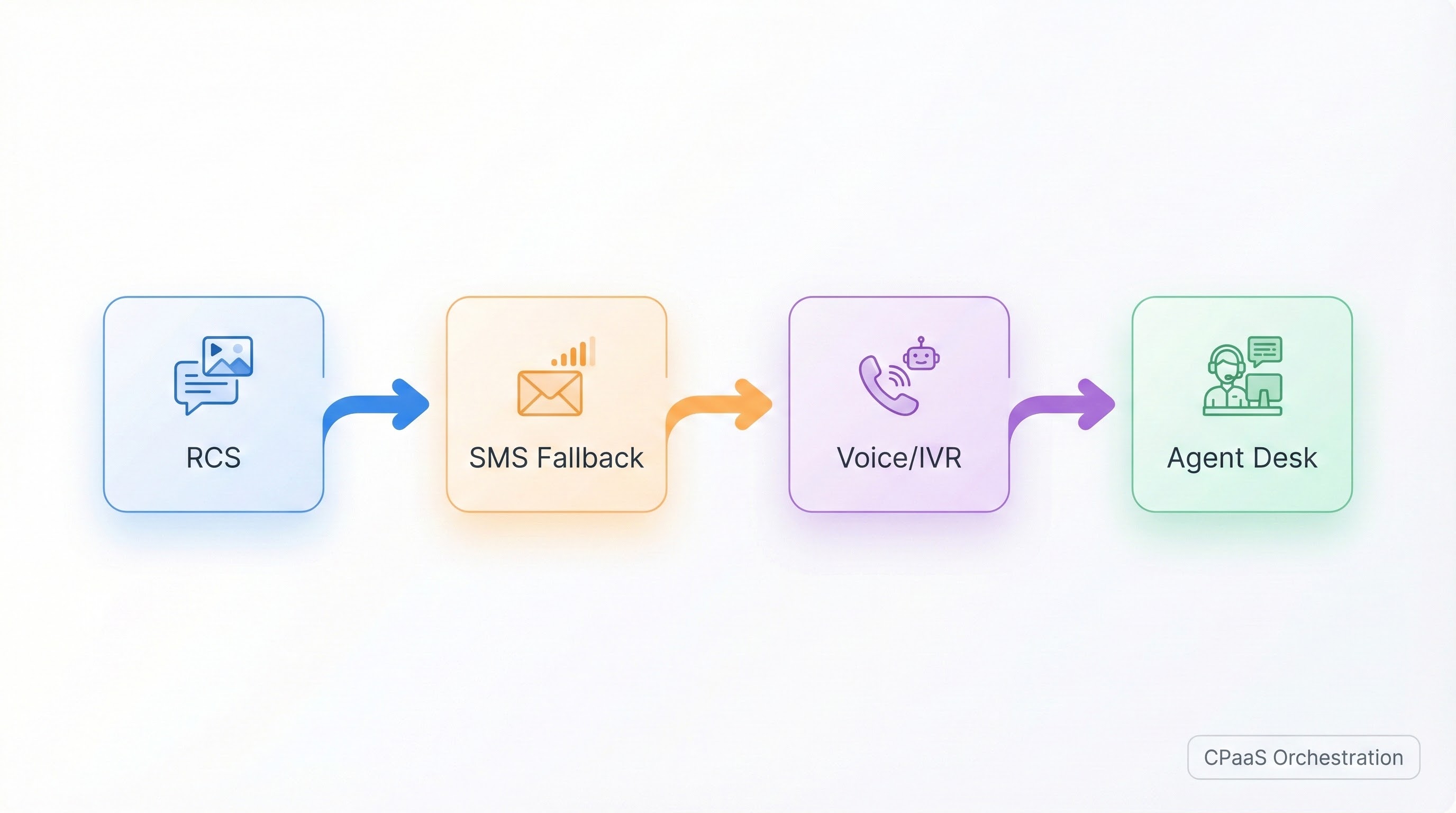
- RCS and WhatsApp complement SMS with rich media and interactivity; smart teams build fallbacks (RCS → SMS, WhatsApp → SMS, SMS → Voice).
- For authentication, SMS OTP offers strong reach but should be used with risk-based controls for higher-risk actions.
What SMS is in 2026 (and what it isn’t)?
In 2026, SMS is less about person-to-person chat and more about business workflows. Most enterprise traffic is application-to-person (A2P): messages generated by systems (apps, CRMs, banks, logistics platforms) and delivered through carrier networks. This makes SMS a utility channel—built for certainty, not creativity.
- What SMS is in 2026 (and what it isn’t)?
- The 2026 reality check: compliance + deliverability matter more than ‘open rates’
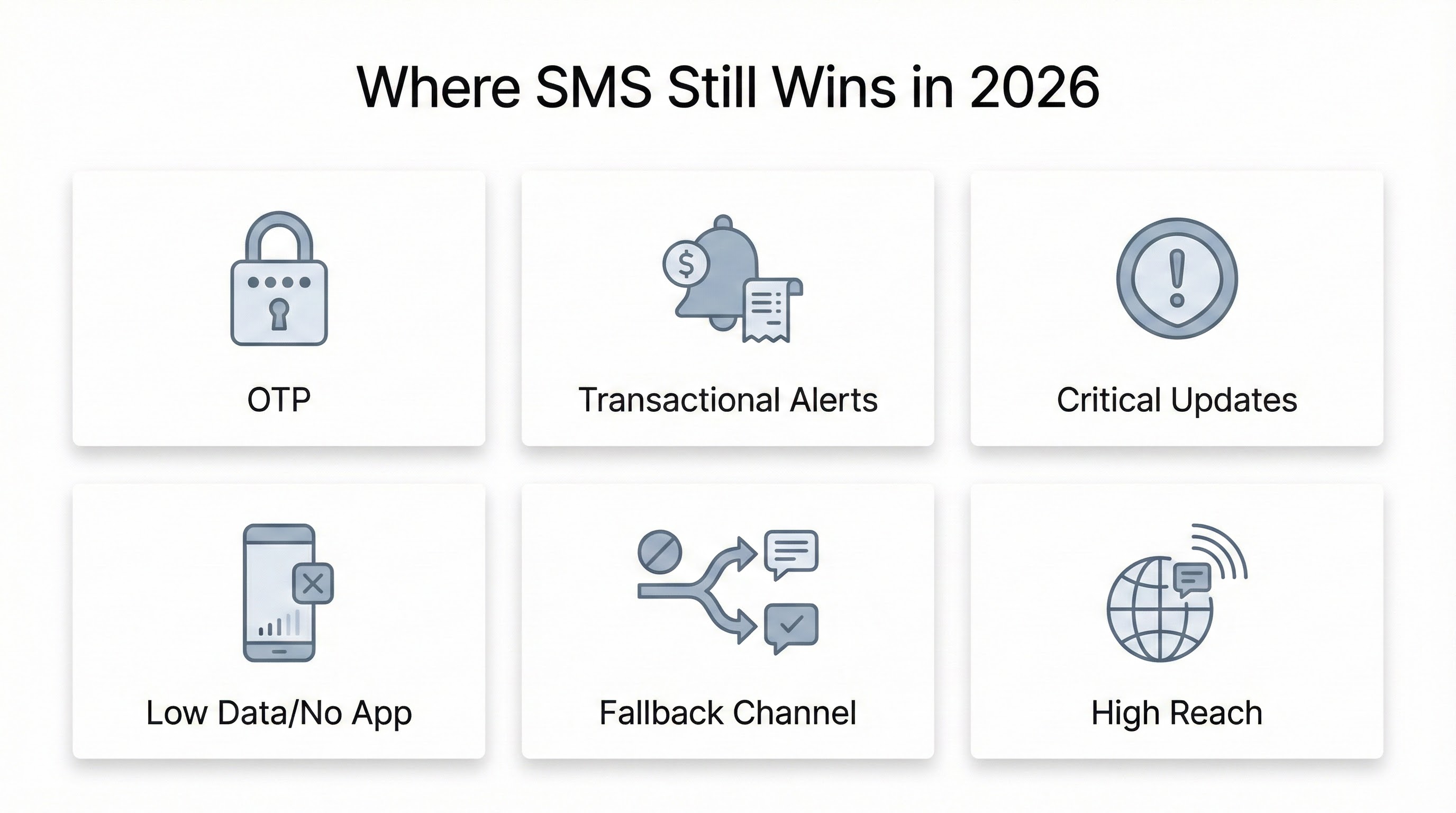
- Where SMS still wins (best-fit use cases)?
- Transactional alerts and notifications
- OTP and authentication messages
- Operational broadcasts (service & safety)
- Where SMS is not the best channel?
- SMS vs RCS vs WhatsApp vs Voice: what to use in 2026
- Best practices to keep SMS effective in 2026
- Security note: SMS OTP is about reach, not maximum assurance
- How Turain CPaaS can support your 2026 messaging mix?
- Conclusion
- FAQ’s
What hasn’t changed
-
- Ubiquity: SMS works on virtually every mobile phone without requiring a new app.
- Speed: delivery is typically fast for short alerts and OTP-style messages.
- Simplicity: minimal format means less rendering risk across devices.
What has changed
-
- Governance: A2P SMS is increasingly regulated and monitored to reduce spam and fraud.
- Routing: messaging ecosystems use vetting, sender IDs, and policies that can throttle or block non-compliant traffic.
Orchestration: SMS is now one node in a multi-channel journey (RCS/WhatsApp/Voice).
The 2026 reality check: compliance + deliverability matter more than ‘open rates’
Many blogs repeat one-liners like “SMS has 98% open rates”. In practice, performance depends on your audience, content, compliance posture, and carrier rules. In 2026, the most accurate way to think about SMS is: deliverability and trust are earned.
India-specific note: DLT is not optional
If you message Indian consumers at scale, you must plan for DLT-based registration, consent management, and content template governance. Without completing the required steps, commercial communications can be blocked.
Carrier policies exist everywhere
Across markets, carriers and industry bodies publish messaging rules and best practices to reduce spam and abuse. Sender identity, consent, content, and traffic patterns affect delivery.
Where SMS still wins (best-fit use cases)?
SMS performs best when the message is short, urgent, and must reach almost everyone.
Transactional alerts and notifications
-
- Order confirmations, shipping updates, payment alerts, appointment reminders, outage notifications—these are classic SMS wins. When timing matters, predictable delivery beats rich design.
OTP and authentication messages
-
- OTP SMS remains common because it reaches users without requiring app setup. However, it should be used thoughtfully (see the security section below).
Operational broadcasts (service & safety)
-
- Utilities, schools, healthcare providers, and logistics teams use SMS for time-sensitive information that must cut through app fatigue.
Where SMS is not the best channel?
SMS has clear constraints that make it a poor fit for certain experiences:
-
- Rich product storytelling (images, carousels, browseable catalogues).
- Complex support conversations (multi-step troubleshooting).
- High-frequency marketing where users expect interactive preference control.
SMS vs RCS vs WhatsApp vs Voice: what to use in 2026
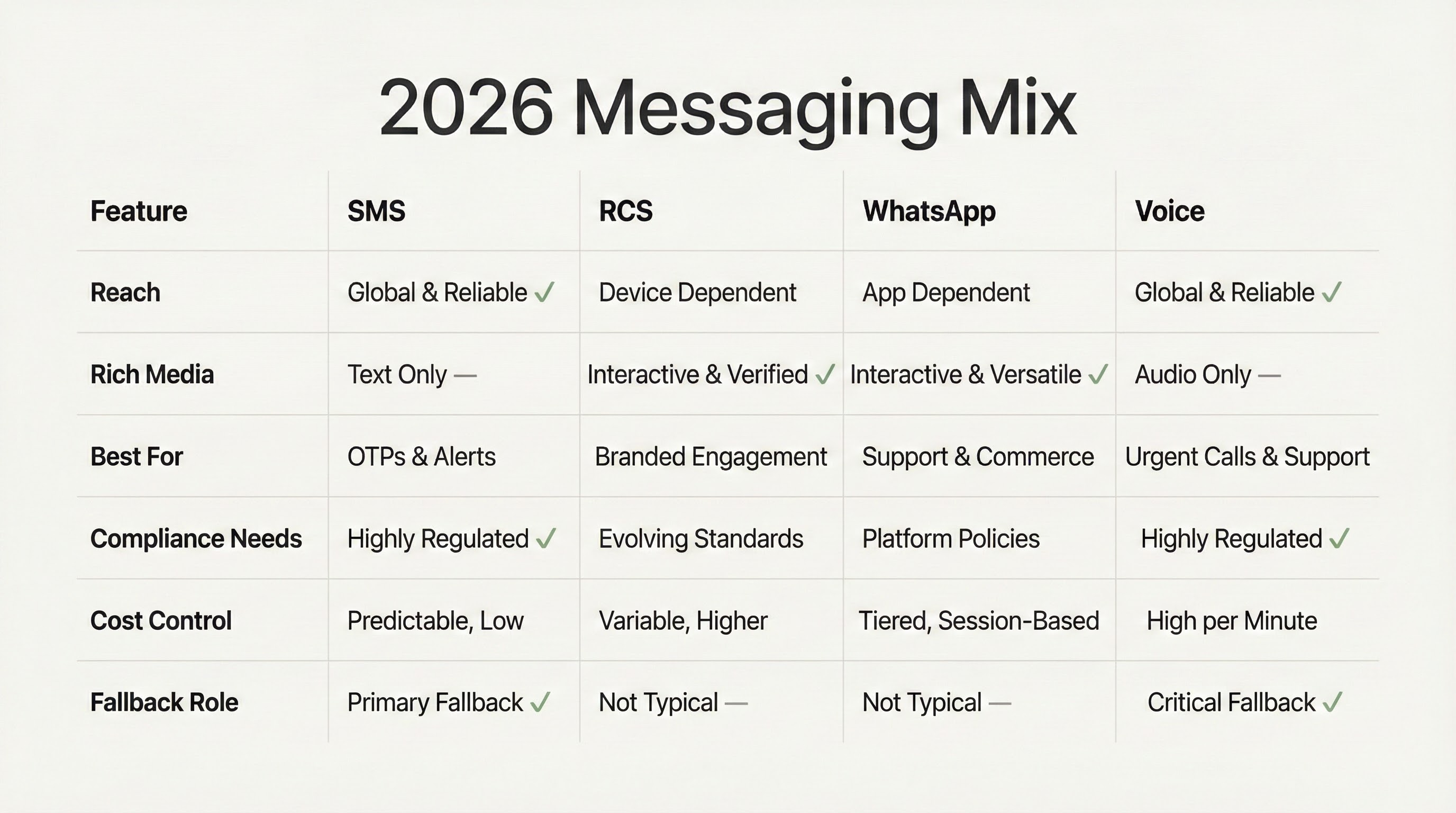
The winning strategy is not choosing one channel. It’s choosing the right channel per step, and building fallbacks when a user can’t receive the preferred format.
|
Channel |
Best for |
Strength |
Watch-outs |
|
SMS |
OTPs, alerts, short transactional updates |
Max reach, simple, fast |
Limited interactivity; compliance + filtering matters |
|
RCS |
Rich cards, buttons, product journeys in the native inbox |
Better UX, branded experience |
Coverage varies (device/app/carrier); design needs fallback |
|
|
Conversational commerce, catalogs, support threads |
High engagement; media + automation |
Policy/compliance; templates; user expectations |
|
Voice/IVR |
Urgent escalation, verification, high-intent leads |
Human confidence; handles complex issues |
Cost; needs scripting and routing |
Best practices to keep SMS effective in 2026
These practices reduce blocks, complaints, and wasted spend:
Consent-first messaging
-
- Capture explicit opt-in and store evidence (timestamp, source, purpose).
- Offer easy opt-out instructions for promotional messages where applicable.
- Match message frequency to user expectations.
Template and sender governance (especially India)
-
- Register sender identity (headers) and content templates where required.
- Keep templates consistent; avoid sudden content changes that resemble spam patterns.
- Use a CPaaS layer to manage routing, compliance, and reporting.
Design for clarity
-
- Put the key info in the first 90 characters (lock-screen preview).
- Use links only when necessary; avoid link-heavy spam-like patterns.
- Include a clear brand identifier so users recognize the sender.
Security note: SMS OTP is about reach, not maximum assurance
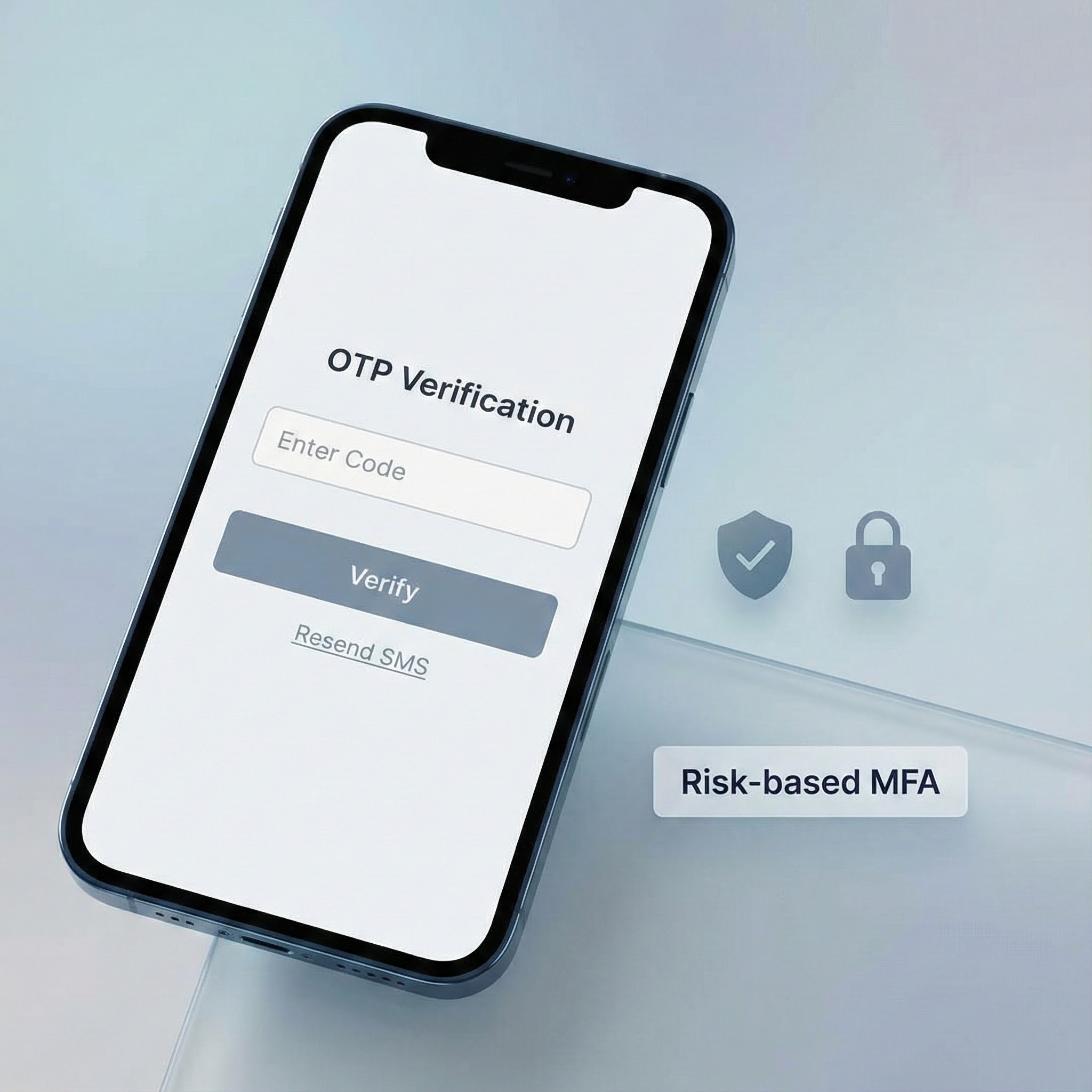
SMS OTP can be appropriate for low-to-medium risk scenarios, but for high-risk account actions, consider step-up factors (app-based methods, device binding, passkeys) and strong fraud monitoring. Treat SMS OTP as a practical channel—then mitigate its weaknesses with risk-based controls.
How Turain CPaaS can support your 2026 messaging mix?
If you’re building an orchestrated communication stack, CPaaS helps you connect channels, enforce compliance, and measure outcomes. Here are relevant Turain services you can link internally from this blog:
- Bulk SMS Marketing:
- Transactional SMS:
- OTP SMS:
- DLT Registration:
- Rich Communication Services (RCS):
- Bulk WhatsApp Marketing:
- Voice SMS:
- Toll-Free Number with IVR:
- Cloud Call Center Solution:
- Contact Center:
Conclusion
SMS is still relevant in 2026 because reliability still matters. The most effective teams treat SMS as the backbone of critical communication—then layer richer channels like RCS and WhatsApp on top, with clear fallbacks and compliance-first operations.
Disclaimer:

SMS, RCS, and OTT messaging capabilities and rules vary by country, carrier, and platform. This article is for general informational purposes and is not legal or security advice. Always validate local regulations, carrier policies, and your organization’s risk requirements before launching messaging campaigns.
FAQ’s
Q1. Is SMS messaging ‘dead’ in 2026?
No. Its role has shifted. SMS is now primarily used for A2P use cases like alerts, OTPs, and service updates, and as a fallback when richer channels are unavailable.
Q2. Is SMS OTP secure enough for login and verification?
SMS OTP offers broad reach and low friction, but it isn’t the strongest method against threats like SIM swap. Use risk-based controls and step-up authentication for high-risk actions.
Q3. How does RCS on iPhone affect SMS strategy?
RCS support on iPhone expands the potential reach of rich messaging, but availability can still depend on carrier support. In practice, teams use RCS when available and keep SMS as fallback.
Q4. Do businesses in India need DLT for SMS?
For commercial communications, yes. DLT-based registration, consent management, and content template governance are part of the compliance process.
Q5. What’s the best ‘stack’ for customer communication in 2026?
A practical mix is: RCS/WhatsApp for rich engagement, SMS for reach and reliability, and Voice/IVR for urgent escalation—stitched together through CPaaS orchestration.