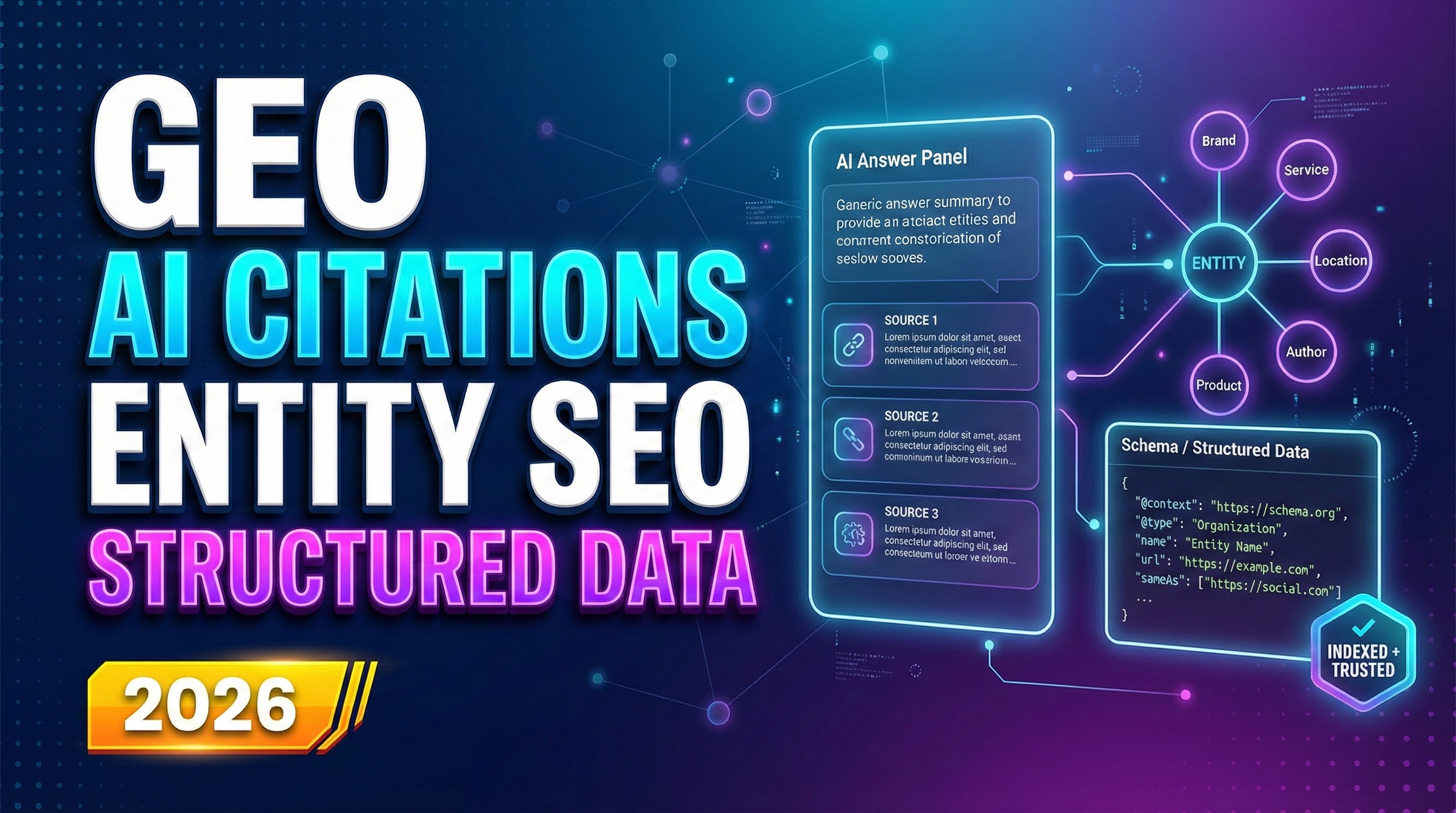
What “AI citations” really mean in 2026?
In practical terms, “AI citations” usually mean your page appears as a supporting link (source link) inside AI-generated answers—especially in Google’s AI Overviews and AI Mode experiences. Google’s own site-owner documentation explains how AI features relate to websites and clarifies eligibility requirements.
The GEO lens
Generative Engine Optimization (GEO) is the practice of optimizing so generative systems can confidently extract, summarize, and reference your content. The research paper “GEO: Generative Engine Optimization” frames this shift as generative engines becoming a major interface for information discovery.
The hard truth (and the opportunity)
-
- You can do everything “right” and still not get cited—AI features are algorithmic and contextual.
- But GEO gives you a controllable path: align your entities, build structured clarity, and publish high-confidence answers with verifiable trust signals.
GEO Beyond Basics starts with eligibility (don’t skip this)
Before tactics, lock eligibility. Google states: to be shown as a supporting link in AI Overviews or AI Mode, your page must be indexed and eligible to be shown with a snippet—and there are no additional technical requirements just for AI features.
GEO technical baseline checklist
-
- Page is indexable (no accidental
noindex, blocked resources, or crawl traps). - Page can earn a normal snippet (clear title, relevant content, accessible).
- Fast, usable, trustworthy experience (page experience supports helpfulness).
- Page is indexable (no accidental
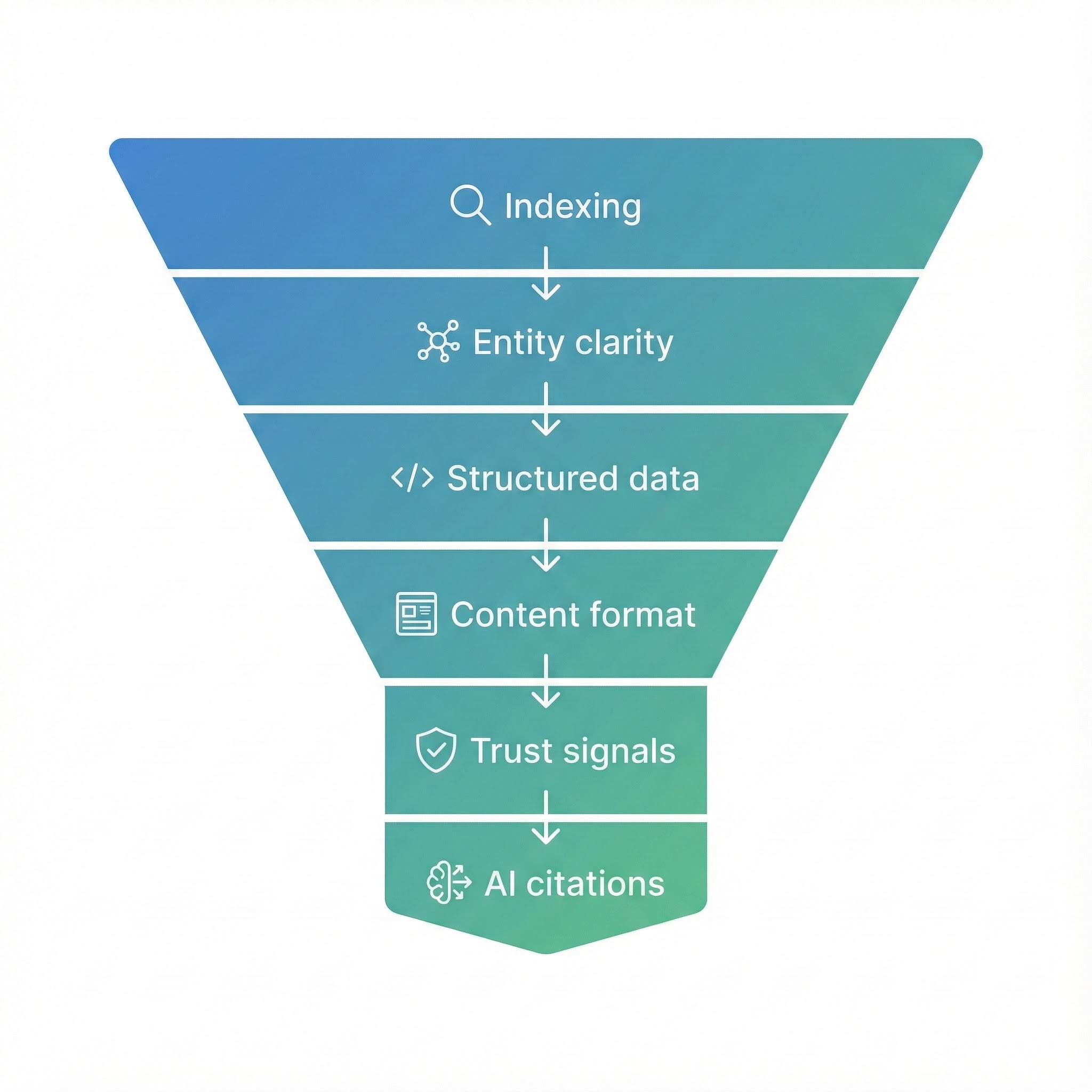
GEO “visibility stack” (order matters)
- Indexing + snippet eligibility
- Entity clarity
- Structured data correctness
- Content format that AI can quote and verify
- Trust / E-E-A-T reinforcement
Entity SEO is the heart of Generative Engine Optimization (GEO)

If classic SEO is “keywords → pages,” entity SEO is “things → relationships → evidence.”
Search engines use entity understanding and knowledge graph concepts to connect people/ places/ brands/ services and their attributes. Search Engine Land’s Knowledge Graph resources explain entities and relationships as foundational to modern search understanding.
What entity SEO does for GEO (and AI citations)?
When your site describes entities consistently, AI systems have an easier job:
-
- identifying what you are (Organization)
- what you offer (Service/Product entities)
- where you operate (Place/Service area)
- why you’re credible (proof + author + references)
Entity consistency rule (the “one name” principle)
Entity-first SEO guidance stresses aligning visible and “invisible” signals (titles, headings, schema fields) so Google doesn’t get conflicting identity cues.
Apply this to GEO:
Use the exact same entity naming across:
-
- H1 + intro definition
- internal link anchors
- schema
name,sameAs,mainEntityOfPage - author/about pages
Structured data: your “machine-readable clarity” layer for GEO
Structured data helps search engines understand content, but Google warns that it enables eligibility and does not guarantee a feature. That’s still powerful for Generative Engine Optimization (GEO) because it reduces ambiguity.
Structured data policies that matter for AI citations
-
- Don’t mark up content that isn’t visible or doesn’t match the page’s main content.
- Use JSON-LD where possible (Google supports it and recommends it widely).
Author + Publisher schema = E-E-A-T reinforcement
Google’s Article structured data documentation recommends using author details and linking identity via url or sameAs to help Google understand who the author is. That’s directly aligned with GEO’s credibility goal.
Entity linkage fields you should understand
-
mainEntityOfPageindicates the main entity described by the page.sameAscan connect your entity to authoritative profiles (official social pages, Wikidata, etc.), strengthening entity reconciliation (use responsibly).
GEO reminder
Structured data is not a cheat code. It’s a clarity layer—your content still has to be the best answer.
The 2026 “AI Citation Page” blueprint (GEO-ready)
Use this blueprint for your most important pages (service pages, hub pages, and high-intent FAQs).
Page layout (human-first, AI-friendly)
-
- Above the fold: one-sentence definition + who it’s for + outcome
- Quick answer box: 5–8 bullet “what it is / how it works / when to use / risks”
- Entity section: clear definitions of the entities on the page (service, compliance, pricing model, limitations)
- Process section: step-by-step workflow with decision points
- Proof section: case studies, screenshots, client logos (where allowed), measurable results
- References: reputable sources and official documentation
- FAQ: short, direct answers (avoid fluff)
Google’s guidance for success in AI search experiences stresses creating unique, satisfying content that fulfils needs—this blueprint is designed to do exactly that.
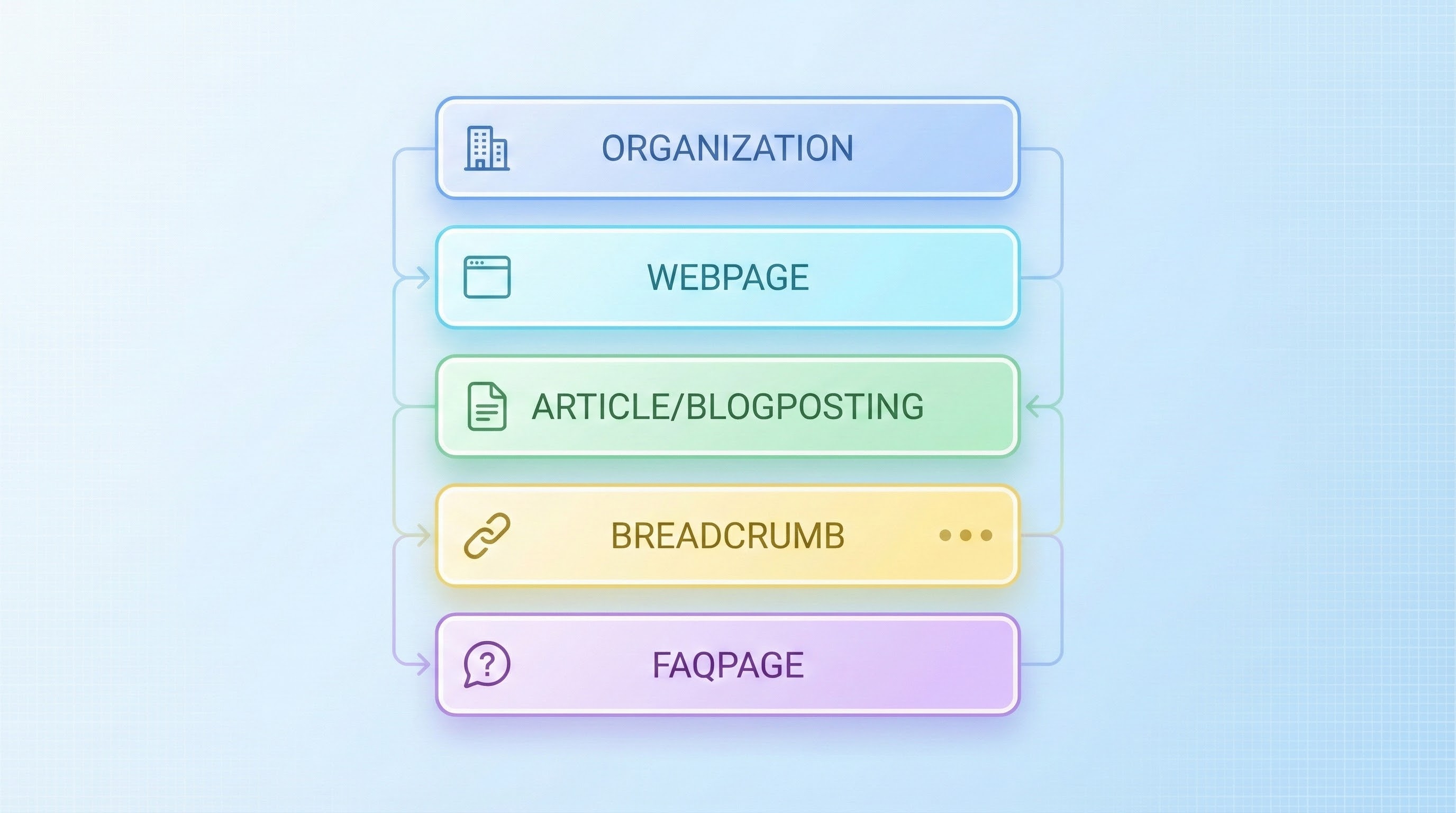
Structured data stack (minimum viable)
-
- Organization (publisher identity)
- WebPage (page identity)
- Article/BlogPosting (for posts + author identity)
- BreadcrumbList (site structure clarity)
- FAQPage (only if FAQs are present and visible)
“GEO hygiene rule”
If the FAQ isn’t visible to users, don’t mark it up.
Content patterns that earn AI citations (GEO playbook)
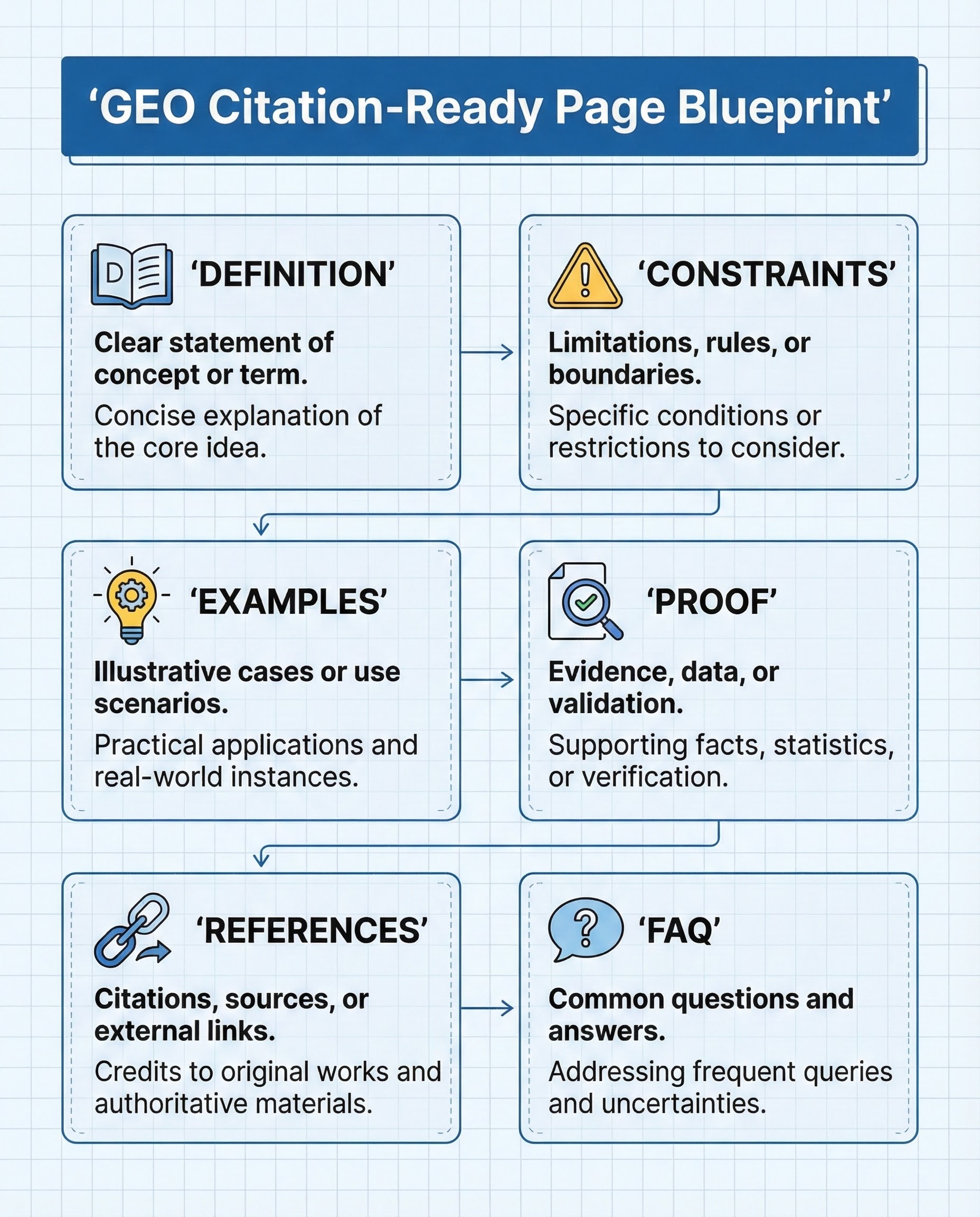
Pattern 1 — “Definition + constraints + examples”
AI systems cite pages that reduce uncertainty. Your sections should read like:
-
- definition
- when it applies
- exceptions
- examples
- sources
Pattern 2 — Evidence-first E-E-A-T
-
- named authors, bios, credentials (where relevant)
- editorial policy / update logs
- citations to official docs and primary sources
Google highlights E-E-A-T as a useful self-assessment lens and references the quality rater guidelines.
Pattern 3 — Non-commodity insights
Add what the internet doesn’t already have:
-
- checklists
- templates
- “mistakes we see in audits”
- real-world SOPs
Google explicitly recommends creating unique, non-commodity content for AI search success.
What NOT to do (GEO risks that kill trust)?
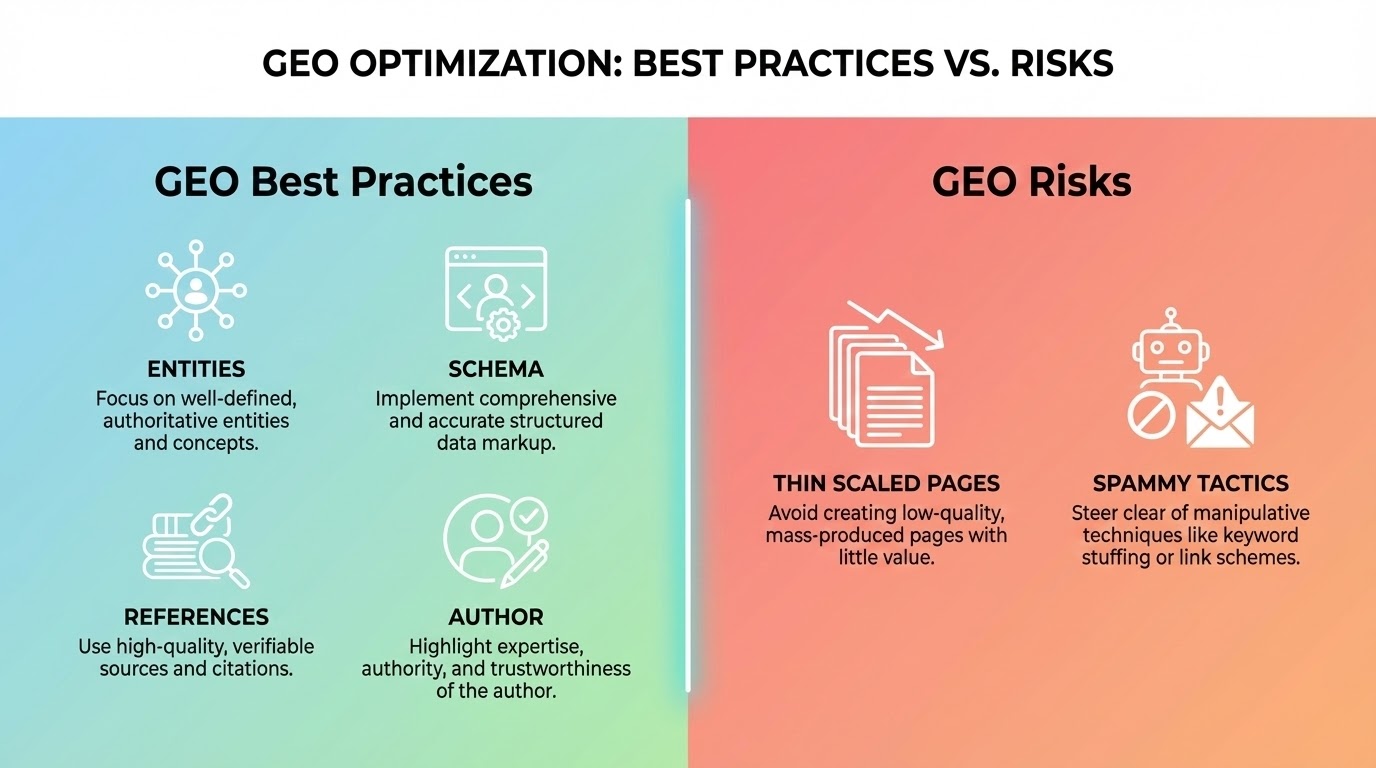
Don’t scale low-value pages for “AI visibility”
Google’s spam policies and March 2024 update target scaled content abuse and other manipulative practices. If your GEO approach becomes “mass-produce thin pages,” it can backfire.
Don’t do parasite / site reputation abuse tactics
Publishing unrelated third-party content on high-authority domains to manipulate rankings is explicitly addressed in Google’s spam policy updates.
Don’t hide behind AI-written content
Google’s stance is not “AI is banned,” but content must be helpful and aligned with quality principles.
GEO implementation plan (30–45 day rollout)
Week 1 — Entity foundation
-
- Decide your core entities (Brand + Services + Locations + Compliance topics)
- Standardize naming and internal anchors
- Build / improve About, Author, Editorial policy pages (E-E-A-T assets)
Week 2 — Structured data and site clarity
-
- Fix Organization + Article + Breadcrumb + FAQPage where applicable
- Validate with Rich Results Test + monitor Search Console errors
Week 3–4 — GEO content upgrades
-
- Rewrite top 10 pages using “definition + constraints + examples + references”
- Add first-party proof, screenshots, SOPs
- Add internal links to entity hubs
Week 5–6 — Measure “AI citation share”
-
- Track changes in impressions/clicks (Search Console)
- Manually test key queries and record whether you appear as a supporting link (not perfect, but directional)
FAQ’s
What is Generative Engine Optimization (GEO)?
Generative Engine Optimization (GEO) is optimizing content so generative AI search experiences can understand, summarize, and cite your pages as supporting sources.
Does structured data guarantee AI citations?
No. Google says structured data can enable eligibility for features but does not guarantee they’ll show.
Do I need special markup for AI Overviews / AI Mode?
Google states there are no additional technical requirements specific to AI features beyond being indexed and eligible to appear with a snippet.
What’s the fastest GEO win?
Clarify your entities (consistent naming + internal linking), add author/publisher trust signals, and rewrite top pages into direct answers + constraints + examples + references.
What GEO tactics are risky?
Scaled thin content and manipulative practices violate spam policies and can harm long-term visibility.
Conclusion
Generative Engine Optimization (GEO) in 2026 is not about chasing hacks—it’s about becoming the most understandable and verifiable source on your topic. If you align entities across your site, implement structured data correctly, and publish non-commodity, evidence-backed answers, you increase your odds of earning AI citations across AI Overviews / AI Mode—while also improving classic SEO performance.
Disclaimer:
This article is for educational purposes and reflects publicly available guidance and research at the time of writing. AI search features change frequently, and Generative Engine Optimization (GEO) outcomes (including AI citations) are not guaranteed. Always follow Google Search Essentials and spam policies when implementing GEO tactics.