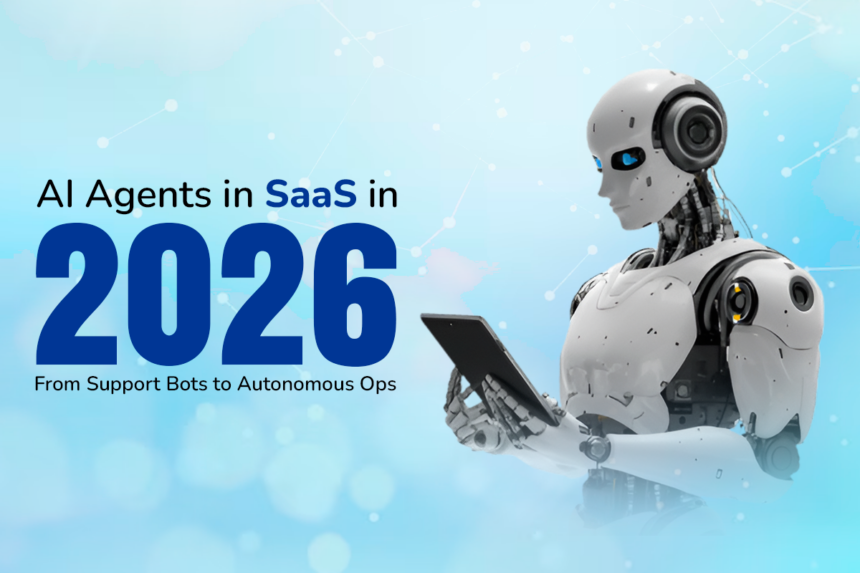
You spend hours building a great software product and acquiring new users. Then your customers face a complex issue, and they are greeted by a frustrating, rigid chatbot. Sound familiar? The gap between user expectations and traditional support is a massive bottleneck. Basic scripts lose context, misread intent, and stall your product timelines. In the fast-paced software market, user retention is everything. You cannot afford to let your customers wait days for a human agent to handle a simple billing error or a permission upgrade. That is exactly the problem AI agents in SaaS are built to solve in 2026. We are moving far beyond simple chat boxes. The industry is stepping directly into the era of autonomous business operations.
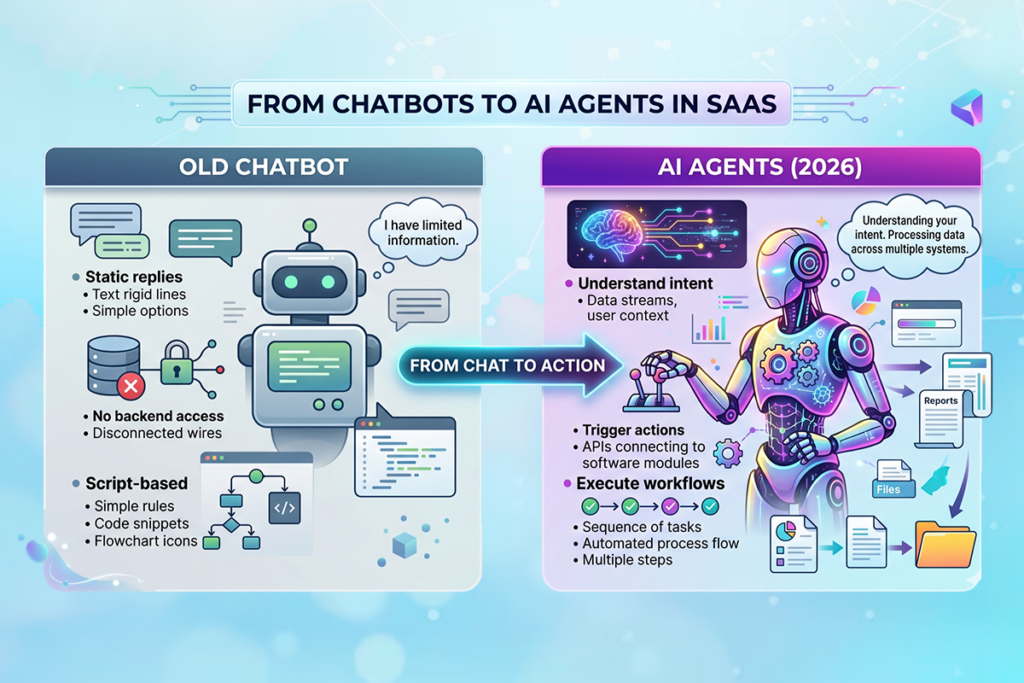
What Exactly Are AI Agents in SaaS?
The current generation of AI agents in SaaS acts as a dynamic, intelligent workforce inside your software. They do not just fetch help center articles. They take actual actions. They use advanced language models to understand context, access your databases securely, and execute multi-step workflows without human intervention.
Here is what AI agents in SaaS enable:
-
- They read user intent and instantly trigger backend API calls to resolve issues directly
- They manage complete AI customer support automation by processing refunds, upgrading plans, or resetting server configurations
- They power true autonomous business operations by running background health checks and reaching out to users proactively
This is not just a conversational tool. It is a live operational pipeline between your users and your software backend.
Why Does AI Customer Support Automation Matter So Much Now?
The gap between user frustration and issue resolution has always been expensive. Implementing deep AI customer support automation directly attacks that gap.
-
- It removes the wait time barrier. Users do not need to wait for business hours to get their complex technical issues resolved
- It preserves operational bandwidth. Every routine task handled by AI customer support automation frees your engineering and success teams to focus on high-value strategy
- It accelerates the product lifecycle. High-quality AI agents in SaaS gather direct feedback, instantly tagging and categorizing feature requests for your product development team
Using AI customer support automation fundamentally shifts how digital businesses scale. You can double your user base without endlessly hiring more support staff.
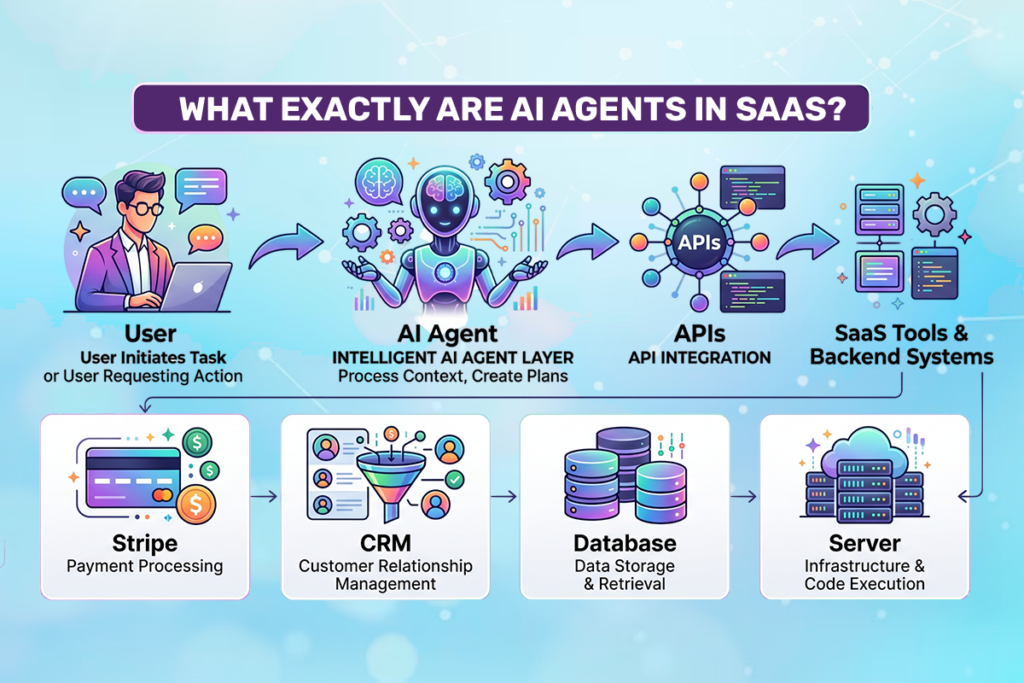
How Do Autonomous Business Operations Actually Work?
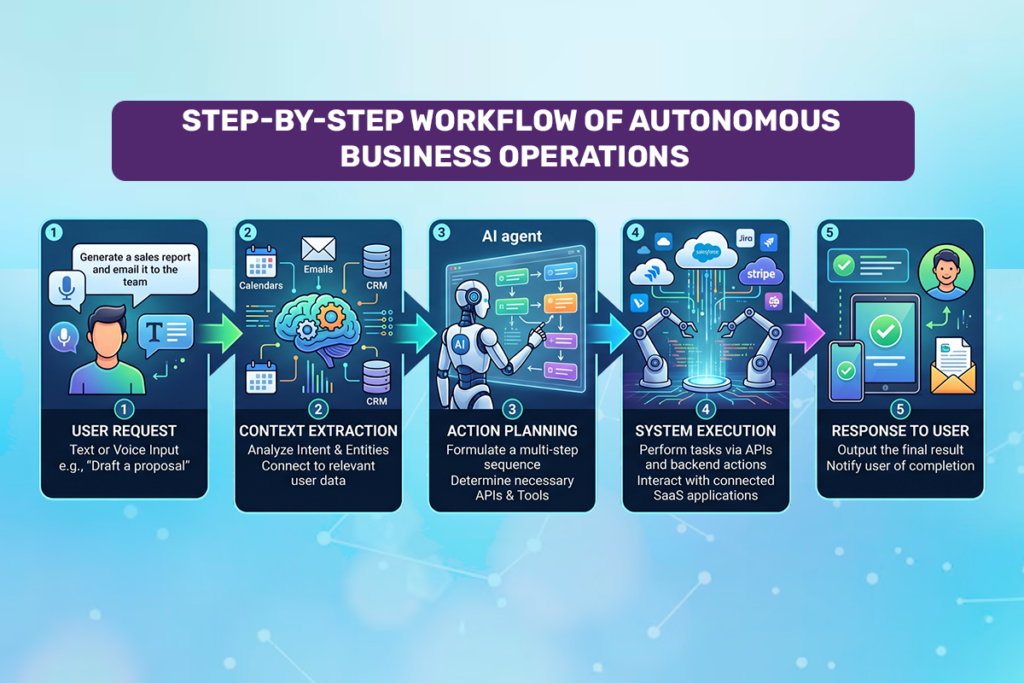
The magic behind autonomous business operations lies in granting AI models secure access to your internal tools. Here is how the process flows:
- Step 1 — Context Extraction: A user submits a complex request. The system extracts all critical metadata, including account history, recent errors, and billing status.
- Step 2 — Action Planning: The AI agent analyzes the data. Instead of just replying with text, it maps out a multi-step execution plan to solve the root cause.
- Step 3 — System Execution: This is the core of autonomous business operations. The agent interacts directly with your CRM, payment gateway, or server architecture to make the necessary changes.
- Step 4 — Verification and Communication: The agent verifies the action was successful and dynamically generates a personalized response to the user.
Important note: True autonomous business operations require strict permission guardrails. You must define exactly what the AI can and cannot modify to prevent accidental data changes or security breaches.
What Are the Key Features of This AI Evolution?
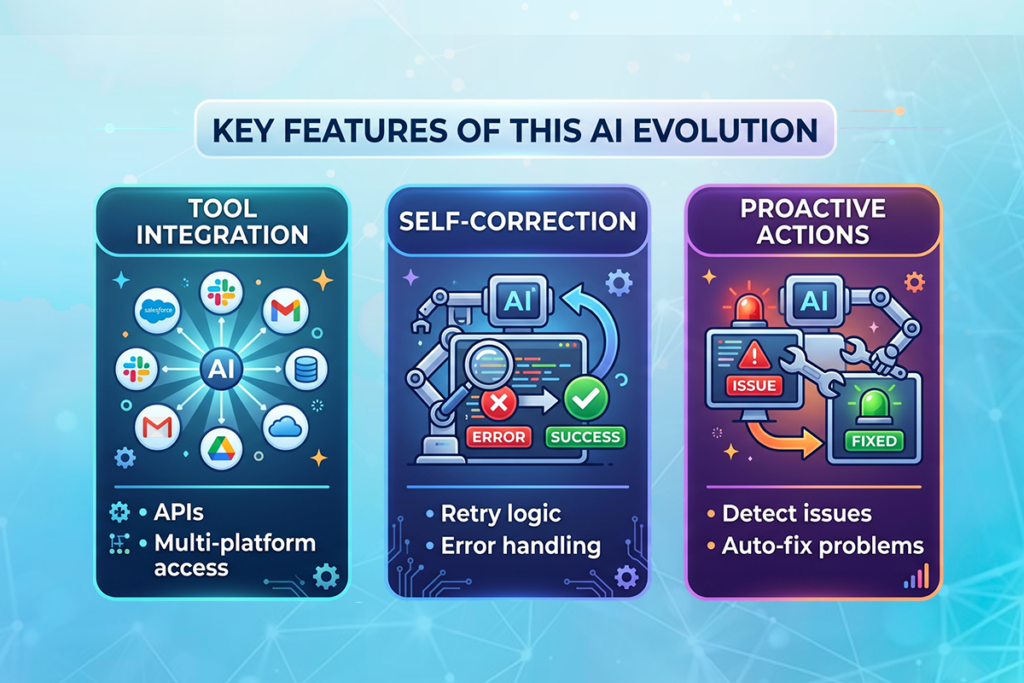
To truly dominate the software market, AI agents in SaaS rely on several core capabilities:
-
- Deep Tool Integration: They connect seamlessly to tools like Stripe, Salesforce, and Jira to perform tasks across different platforms simultaneously
- Self-Correction and Reasoning: If an API call fails during autonomous business operations, the agent automatically tries an alternative route or escalates to a human with full context
- Proactive Engagement: Advanced AI customer support automation anticipates issues before users even report them, sending automated fixes when backend anomalies are detected
Who Should Actually Use AI Agents in SaaS?
This workflow is no longer just a futuristic concept for massive tech giants. Here is who benefits most from AI agents in SaaS:
-
- Solo founders and bootstrapped startups can offer enterprise-level support 24/7 without burning cash on massive support teams
- Customer success managers can skip tedious ticket sorting and focus on preventing churn and driving account expansions
- Operations teams can cut overhead costs by adopting autonomous business operations for routine data syncing and internal reporting
- Digital agencies can build self-serve client portals where AI customer support automation handles immediate update requests instantly
Practical Examples of This Tech in Action
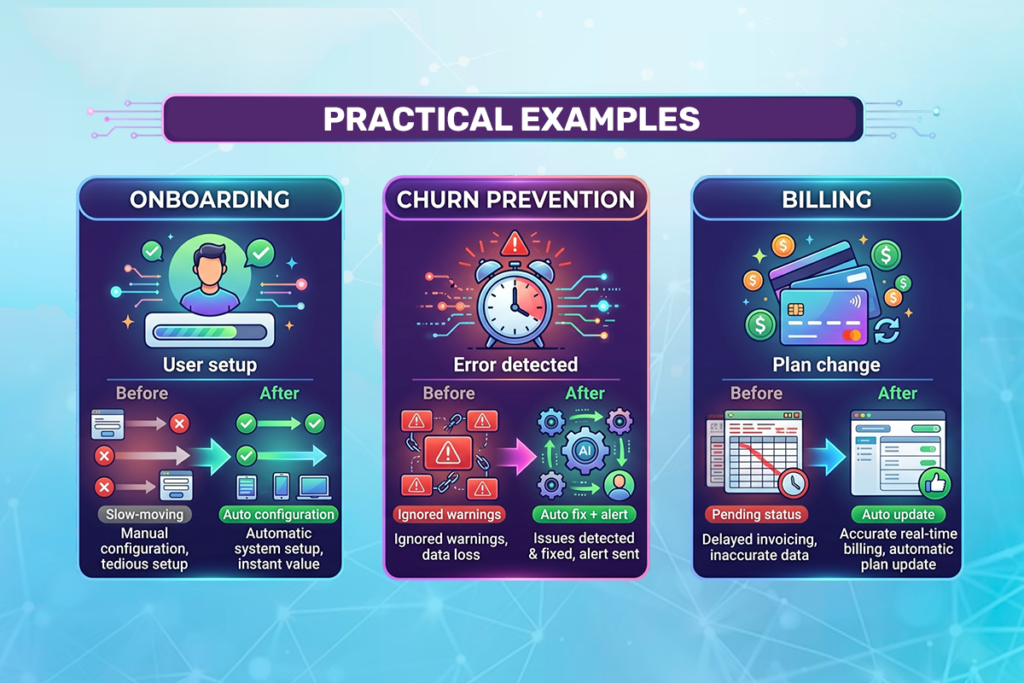
To prove the real-world value of AI agents in SaaS, let’s look at how they solve everyday friction points:
-
- Example 1 — Complex Onboarding: A new user struggles to configure their dashboard. Instead of sending a tutorial video, the agent asks for permission and configures the settings for them. This is next-level AI customer support automation.
- Example 2 — Proactive Churn Prevention: An agent detects a user hitting a specific error code repeatedly. It triggers autonomous business operations to apply a quick patch, then emails the user apologizing for the bug with a small discount code.
- Example 3 — Automated Billing Adjustments: A client wants to downgrade their subscription mid-month. The agent calculates the prorated amount, adjusts the Stripe subscription, and updates the internal database entirely on its own.
What Are the Real Limitations You Should Know?
This is where many hyped articles get it wrong. Here are the honest boundaries of AI agents in SaaS:
-
- Data silos ruin the experience. If your internal systems are not properly connected via APIs, the agent cannot execute tasks. Garbage in, garbage out
- Setup is technically demanding. Building safe autonomous business operations requires strict security protocols, OAuth configurations, and role-based access controls
- Complex human nuances are a challenge. For highly sensitive escalations or custom enterprise negotiations, AI customer support automation will struggle to match human empathy and flexibility
- Oversight is still mandatory. You cannot leave these agents completely unchecked; regular audits are required to ensure they are making the right operational decisions
What Will AI-Powered SaaS Look Like Next?
The era of static support tickets and manual data entry is rapidly ending. Here is where autonomous business operations are heading:
-
- The user-software boundary will blur further. We are moving toward unified “invisible interfaces” where users simply state what they want, and AI agents in SaaS configure the software to match
- Multi-agent collaboration is coming. Future iterations will feature specialized agents talking to each other. A support agent will hand off a complex bug directly to an engineering agent to write a patch
- Teams that resist this shift will fall behind. Competitors using advanced AI customer support automation will iterate significantly faster and offer a vastly superior user experience
The Final Takeaway for Your Business Operations
The historic divide between customer requests and backend execution is collapsing. Leveraging the new wave of AI agents in SaaS is a genuine step change for digital companies. It will not replace skilled engineers or empathetic success managers — but it removes the friction that slows them down. If your databases are well-organized and your team is ready for the initial technical setup, the long-term payoff of scalable AI customer support automation is undeniable. It is time to embrace autonomous business operations and start scaling your best ideas immediately.
Disclaimer
This article is for informational and educational purposes only and does not constitute technical, operational, or financial advice. The integration of AI agents, autonomous workflows, and automated customer support can vary significantly depending on your specific software architecture, data security requirements, and third-party tools. Always configure AI systems with strict permission guardrails, conduct thorough testing in a safe environment, and consult with qualified engineering and legal professionals before deploying autonomous features to your live user base.
What are AI agents in SaaS?
They are intelligent software programs that autonomously execute complex backend tasks and multi-step workflows within a SaaS platform.
How is AI customer support automation different from traditional chatbots?
Unlike rigid, script-based chatbots, AI automation reads intent, accesses databases securely, and resolves actual account or billing issues without human intervention.
What role do APIs play in autonomous business operations?
APIs are the connective tissue that allows AI agents to securely interact with external tools like Stripe, Jira, or Salesforce to complete actions.
Will AI customer support automation replace human support teams?
No, it handles routine and repetitive requests so human agents can focus on complex escalations, strategy, and high-level account management.
How do AI agents handle errors during a task?
Advanced AI agents possess self-correction capabilities; if a process fails, they can attempt alternative routes or instantly escalate the issue with full context to a human.
Are autonomous business operations secure?
Yes, provided they are built with strict role-based access controls and clear permission boundaries dictating what the AI can and cannot modify.
Can startups afford to use AI agents in SaaS?
Absolutely, AI agents allow solo founders and bootstrapped startups to provide 24/7, enterprise-level support without the massive overhead of a large support team.
Do these agents help with product development?
Yes, they proactively gather, tag, and categorize user feedback and feature requests, passing structured data directly to product teams.
Can an AI agent handle billing adjustments?
Yes, with the right permissions, an AI agent can calculate prorated amounts and update subscriptions in payment gateways automatically.
Why is human oversight still necessary for autonomous business operations?
Regular audits are required to ensure the AI remains aligned with business logic, security protocols, and brand voice, especially as systems scale.