Every few months, someone in a marketing meeting asks the same question. Should we move our messaging budget to RCS, or just double down on WhatsApp?
Fair question. Neither answer is wrong.
Both channels grew up a lot in 2026. RCS finally has real carrier backing across India. WhatsApp quietly changed its entire pricing model. And most businesses are still comparing the two using outdated numbers from a blog post written two years ago. So let’s actually sort through what’s true right now, and what each channel is genuinely good at.
Where RCS Stands in India, Right Now
RCS has stopped being a “someday” technology. It’s live.
All three major Indian telecom operators — Jio, Airtel, and Vi — now support RCS Business Messaging through Google’s Jibe infrastructure. Airtel was the last holdout, and for a good reason. The company argued encrypted RCS traffic could let spam slip past its filters, and it even pushed the regulator to bring OTT messaging platforms under formal anti-spam rules. That standoff ended in 2026 when Google agreed to route RCS traffic through Airtel’s AI-driven spam filter, clearing the last major blocker to nationwide adoption.
Here’s the part that actually matters for reach. Android runs on roughly 94% of Indian smartphones, and RCS ships switched on by default through Google Messages on nearly all of them. No app download. No account creation. The message just lands.
Adoption numbers back this up. RCS interactions in India grew 108% between H1 2025 and H1 2026, according to data cited by Infobip. Marketing and advertising was the fastest-growing use case, with a jump north of 2,900%. Financial services and fintech firms account for the bulk of current RCS traffic, which tells you a lot about who’s trusting it first.
And in September 2026, Jio became the first Indian operator to bring commercial RCS Business Messaging to iPhone users, striking what’s reportedly the first deal of its kind Apple has made anywhere in India. Vodafone Idea and Airtel are expected to follow, though pricing for their iOS rollouts hasn’t been made public yet. If that happens, RCS effectively becomes a single channel that reaches both Android and iPhone users natively — something WhatsApp already does, but RCS has never managed before.
Where WhatsApp Stands in India, Right Now
WhatsApp isn’t going anywhere either. It still commands roughly 500 million active users in India, which is about 40% of its entire global user base. That scale alone makes it hard to ignore.
But the pricing model changed underneath everyone’s feet. WhatsApp Business API moved from per-conversation billing to per-message billing on 1st July 2025. Under the old model, you paid once for a 24-hour conversation window and could send unlimited messages inside it. Under the new model, every template message gets billed individually, regardless of whether a window is already open.
As of 2026, Meta’s India rates sit around ₹0.86 per marketing message and roughly ₹0.115–0.145 per utility or authentication message, following a roughly 10% hike on marketing rates earlier in the year. Service messages — the free-form replies your team sends within a customer-initiated 24-hour window — remain free, with the first 1,000 per business number per month at no cost. The one truly free entry point left is the 72-hour window that opens when someone clicks a Facebook or Instagram ad straight into a WhatsApp chat.
These are Meta’s base rates. Your actual bill will run higher, since Business Solution Providers typically add a platform fee or markup of 10–30% on top.
Reach: The Single Biggest Difference
This is where the two channels genuinely diverge, and it’s worth being blunt about it.
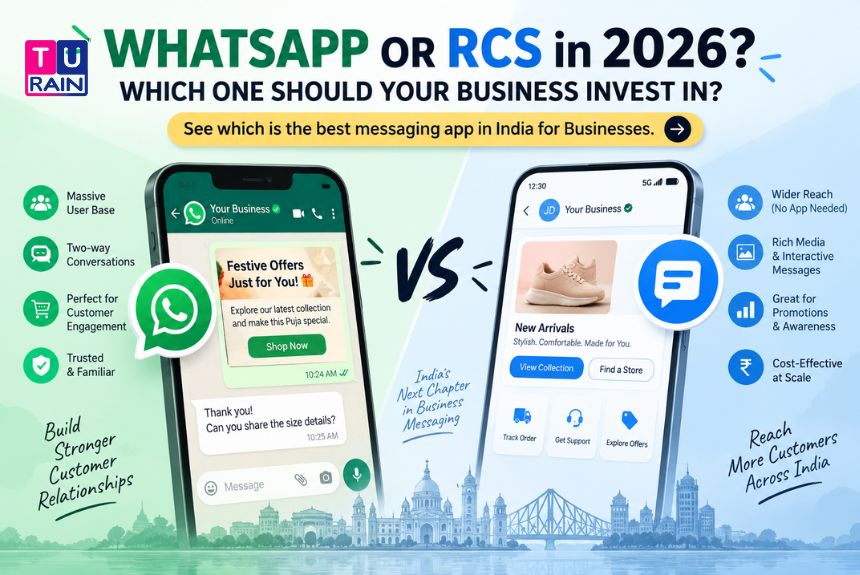
WhatsApp can only reach people who’ve already installed the app and opted in. That’s roughly 500 million people in India — a massive number, but still a subset. RCS, on the other hand, reaches anyone with a compatible Android phone on Jio, Airtel, or Vi, the moment Google Messages is their default app. No installation. No opt-in friction beyond the existing carrier connection.
For businesses trying to reach first-time digital users, Tier 2 and Tier 3 audiences, or customers who’ve simply never bothered installing WhatsApp Business chats from unfamiliar numbers, RCS has genuine structural reach that WhatsApp can’t match. For businesses whose entire customer base already lives inside WhatsApp — which describes a huge share of urban, tech-savvy India — that reach advantage barely matters in practice.
Rich Media and Interactive Features
Both channels have converged quite a bit here, so the differences are more about polish than raw capability.
WhatsApp supports images, videos, documents, location sharing, contact cards, list messages, reply buttons, and full product catalogs. Its Flows feature lets businesses build multi-step interactions — bookings, forms, surveys — entirely inside the chat window, without redirecting anyone to a website.
RCS supports rich cards, carousels, quick-reply buttons, high-resolution images, and — as 5G coverage matures through 2026 — increasingly reliable video delivery. GSMA’s Universal Profile 4.0, finalised in March 2026, pushed this further with richer text handling and video-led rich cards.
The practical difference is maturity, not capability. WhatsApp’s tools have been battle-tested by businesses for years. RCS’s toolkit is newer, and video delivery in particular is still described as “reliable from mid-2026 onward” rather than universally consistent today.
| Comparison Area | RCS / Google Messages | What It Means for Businesses | |
|---|---|---|---|
| Basic Messaging | Supports typing indicators, read receipts, message replies, editing and unsending messages | Supports typing indicators, read receipts, replies and message editing; the transcript also highlights scheduling and smart suggestions | Both provide modern messaging experiences, but individual messaging features differ |
| Rich Media | Supports photos, videos, GIFs, stickers, documents and other media | Supports photos, videos, GIFs and other rich content | Both go beyond traditional SMS and can support richer customer communication |
| Photo Editing | Offers built-in tools such as crop, rotate, text, stickers and drawing before sending | The transcript describes more limited photo-editing capabilities | WhatsApp provides more built-in flexibility when preparing visual content inside the app |
| Video Sharing | Supports HD video and additional video-sharing features | The transcript describes fewer in-app video features but some different sharing limits | Relevant for businesses using product demos or visual customer communication |
| Location Sharing | Supports current and live-location sharing | Transcript describes current-location sharing | Live location can be useful in certain service and delivery conversations |
| Group Communication | Offers groups plus additional management features and Communities | Provides group conversations but fewer group-management capabilities in the transcript | WhatsApp provides a broader set of community and group-management features |
| Chat Organization | Offers pinned chats, starred content and customizable chat lists | Supports chat pinning and other organizational features | WhatsApp’s lists can help organize different types of conversations |
| Search | Search can cover different conversation content and shared media types | Supports message search and filters | Both provide search, although the transcript found WhatsApp more useful for locating some shared content |
| Notifications | Provides detailed notification controls for individual and group conversations | Provides notification controls, including features such as bubbles | WhatsApp offers more granular in-app notification customization according to the transcript |
| Privacy Controls | Includes last-seen/online controls, disappearing messages, view-once media, group permissions and chat/app locking | Provides profile, blocking and archiving controls but fewer privacy options in the transcript | WhatsApp provides a broader range of user-level privacy controls |
| Business-Sensitive Conversations | The transcript emphasizes WhatsApp’s broader privacy controls; your blog separately discusses WhatsApp’s end-to-end encryption | Your blog notes that RCS Business Messaging has a different encryption model | Security requirements should be evaluated separately for sensitive business use cases |
| AI Features | Transcript describes Meta AI as deeply integrated into WhatsApp, including image and sticker generation | Google Messages integrates Gemini-related functionality, though some capabilities rely on other Google apps | AI experiences differ substantially and are evolving, so this shouldn’t be the sole platform-selection factor |
| Desktop/Web Access | Supports messaging through other devices/web | Google Messages also supports browser-based messaging | Both can support staff who need messaging access beyond a phone |
| Overall Feature Maturity | Transcript describes a broader feature set across sharing, groups, privacy, organization, AI and data management | Transcript highlights strengths such as scheduling, smart suggestions and some Google-integrated features | Feature breadth differs, but businesses should choose based on their actual communication use case rather than feature count alone |
Security and Trust
This is the one area where the gap is real, not cosmetic.
WhatsApp encrypts every message end-to-end using the Signal Protocol, by default, for every conversation. Not even Meta can read the message content in transit.
RCS Business Messages, by contrast, are encrypted in transit but not end-to-end. Google Messages does support end-to-end encryption for RCS conversations between two Google Messages users, and Apple has begun rolling out similar encryption for person-to-person RCS chats under Universal Profile 3.0. But RCS Business Messaging — the commercial, brand-to-customer layer — currently runs on transport-layer security only, across every major implementation, including Jio, Airtel, and Vi.
For anything sensitive — OTPs, financial alerts, health information — that distinction is worth taking seriously, not glossing over. RCS does offer verified sender profiles and carrier-level fraud filtering, which meaningfully reduces spoofing risk. But “encrypted in transit” and “end-to-end encrypted” are not the same guarantee, and regulated industries should treat them accordingly.
Delivery and Engagement
Numbers here vary by source and by industry, so treat any single figure with some caution. But a consistent pattern shows up across independent reports.
WhatsApp tends to produce strong response rates in markets where it’s the default communication habit — India and Brazil both get cited frequently in this context — largely because customers already check WhatsApp constantly and trust messages from verified business profiles. RCS response rates trail WhatsApp in most comparative studies, but comfortably outperform plain SMS, thanks to the branded sender identity and richer visual format.
One useful way to think about it: RCS wins on cold reach — reaching someone who has no prior relationship with your brand. WhatsApp wins on warm engagement — deepening a relationship with someone who already expects to hear from you there.
Pricing Snapshot for India (2026)
| Channel | Message Type | Approx. Rate (India, 2026) |
| WhatsApp Business API | Marketing | ~₹0.86 per message (Meta base rate) |
| WhatsApp Business API | Utility / Authentication | ~₹0.115–0.145 per message |
| WhatsApp Business API | Service (customer-initiated) | Free for first 1,000/month, then chargeable |
| RCS (via Jio, for example) | Marketing | ~₹0.27–0.30 per message |
| RCS (via Jio) | Transactional | ~₹0.25 per message |
| RCS (via Jio) | Authentication/OTP | ~₹0.11–0.16 per message |
| RCS (via Airtel) | General | ~₹0.11 per message |
Rates are Meta and carrier base prices before BSP or CPaaS platform markup, and are subject to change. Always confirm current rates directly with your provider before budgeting a campaign.
Read the table carefully, because the comparison isn’t as one-sided as it looks. RCS marketing messages currently cost less per message than WhatsApp marketing messages in most carrier pricing. But WhatsApp’s free service-message allowance and its 72-hour ad-entry window can offset that gap significantly for businesses running high volumes of customer-initiated conversations, rather than pure outbound marketing blasts.
Use Cases by Industry
Retail and E-commerce: Online shoppers naturally gravitate toward WhatsApp for quick order tracking and post-purchase support. It facilitates a very smooth two-way dialogue. RCS serves a completely different marketing purpose. Its dynamic carousels perfectly target fresh Android users for massive customer acquisition campaigns.
Healthcare: Patient privacy is completely non-negotiable. WhatsApp utilizes tight end-to-end encryption for sensitive diagnostic reports and prescription alerts. RCS remains highly effective for general awareness drives and simple appointment nudges. Medical centers simply need to keep highly sensitive clinical details off the unencrypted RCS network.
Education: Routine admission updates and pending fee alerts travel seamlessly across both platforms. RCS deploys engaging visual carousels to hook prospective students with virtual campus tours. On the flip side, WhatsApp remains the absolute gold standard for continuous, private chats between parents and school staff.
Finance and Fintech: RCS absolutely dominates the Indian financial sector. Verified sender profiles build immediate consumer trust for daily banking OTPs and urgent transaction alerts. WhatsApp handles all the heavy lifting for personalized account management and encrypted customer service inquiries.
So, Which One Should You Actually Use?
Honestly? Probably both. Treating this as an either-or decision is where most businesses go wrong.
Use RCS when you need broad reach into Android-first audiences, cold outreach to people who’ve never interacted with your brand, or cost-efficient promotional campaigns at scale — particularly in Tier 2 and Tier 3 markets where WhatsApp Business awareness is still lower than in metros.
Use WhatsApp when the conversation matters more than the reach — customer support threads, order servicing, anything involving sensitive personal or financial data, or any interaction where end-to-end encryption isn’t a nice-to-have but a requirement.
Most mature Indian businesses running messaging at scale in 2026 aren’t picking a side. They’re running RCS for top-of-funnel reach and WhatsApp for everything that happens once a real conversation starts, with SMS sitting quietly underneath both as the universal fallback when neither channel can deliver.
That’s not indecision. That’s just what the data currently supports.
Disclaimer
This article is for informational purposes only. The pricing, carrier capabilities, and platform features discussed reflect the Indian market landscape as of late 2026. Messaging rates are based on base platform costs and are subject to change. Actual costs will vary based on your chosen Business Solution Provider (BSP), CPaaS vendor markups, message volumes, and applicable taxes. Always verify current rates and encryption standards directly with your provider before deploying sensitive or high-volume campaigns.
Frequently Asked Questions (FAQs)
Which is the best messaging app in India for Indian businesses?
There isn't one messaging channel that fits every business use case. WhatsApp is suited to ongoing customer conversations and interactive customer journeys, while RCS can be useful for branded rich messaging and broader mobile messaging campaigns. Businesses should compare reach, pricing, security, customer behaviour and campaign objectives before choosing a channel.
What happened to WhatsApp's free 1,000 messages per month?
When Meta shifted from per-conversation to per-message billing in July 2025, the old allowance of 1,000 free conversations across all categories was removed. Under the 2026 rules, only the first 1,000 Service (customer-initiated) interactions per month are free. Marketing, Utility, and Authentication templates are billed from the very first message sent.
Is RCS Business Messaging truly encrypted?
Yes, but there is a crucial distinction. While person-to-person RCS chats are increasingly end-to-end encrypted, RCS Business Messaging (brand-to-consumer) is currently encrypted in transit (using TLS) across major Indian carriers. This prevents interception over the network, but it is not the same as WhatsApp's end-to-end Signal protocol encryption, which is why highly sensitive data (like diagnostic reports) is often still routed through WhatsApp.
Can I use the same business phone number for both WhatsApp and RCS?
Yes. You can use the same recognizable brand phone number for SMS, RCS, and your WhatsApp Business API. You will just need to register and verify the number appropriately with your CPaaS provider for RCS/SMS, and with your Meta BSP for WhatsApp.
Will iPhone users in India receive my RCS marketing campaigns?
Yes, this is changing rapidly. As of September 2026, Jio became the first Indian operator to enable commercial RCS delivery to iOS users, meaning iPhone users on their network will receive rich RCS messages rather than standard SMS fallbacks. Airtel and Vi are expected to roll out identical iOS support shortly, making RCS a true cross-platform channel.
If I run Facebook/Instagram Ads that click to WhatsApp, do I still pay for the marketing message?
No, and this is a massive advantage for WhatsApp. If a customer clicks a "Click-to-WhatsApp" (CTWA) ad on Facebook or Instagram and sends you a message, a 72-hour window opens. During those 72 hours, any messages you send to that customer—including promotional templates—are completely free of Meta's messaging charges (though you obviously paid for the ad itself).
Reference Links
- Meta’s Official Pricing Updates: WhatsApp Business Platform Pricing
- Google RCS Business Messaging: Google Jibe & RCS For Business
- RCS Global Standards: GSMA Universal Profile Specifications