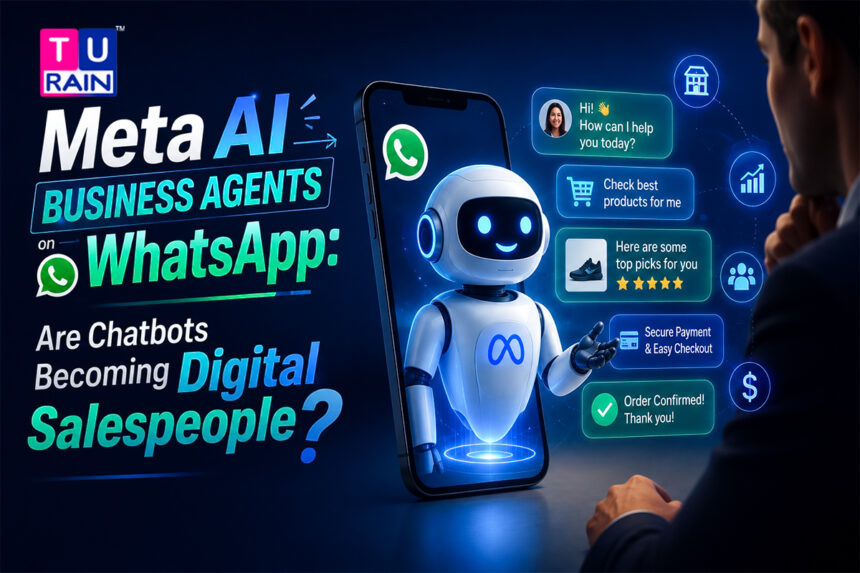
So you typed something like “does WhatsApp have an AI that can actually sell for me now” into Google, and landed here. Fair question. And the honest answer is: yes, mostly, with a few real limits worth knowing before you set expectations too high.
Meta rolled this out globally on 3rd June 2026, at its Conversations conference in London. It’s called Meta Business Agent, and it’s not the same old “reply with 1 for support, 2 for sales” bot you’ve been dodging for years. This one holds an actual conversation, checks your catalog, books appointments, and — depending on setup — walks a customer most of the way to checkout. Whether that makes it a “digital salesperson” is worth digging into properly, so let’s do that.
What Actually Launched, and When
Meta had been quietly testing this in India and Mexico for close to two years before going global. Both markets where WhatsApp isn’t just a messaging app — it’s basically the storefront. That testing window matters. It means this wasn’t a rushed feature; it was refined against real sales conversations in markets that already run business on WhatsApp by default.
The global launch covers WhatsApp, Instagram Direct, and Messenger. Meta says over a million businesses were already running some version of it before the wider rollout, and with more than three billion people on WhatsApp and over 200 million businesses using it to talk to customers, the reach here is hard to overstate.
Meta’s own framing is telling. They’re not calling this a support feature. They’re calling it AI that lets “every business show up for every customer, as if they had an infinite team behind them.” Big claim. Let’s see how much of it holds up.
What Is a Meta Business Agent, Exactly?
Strip away the marketing language, and it’s an AI system built directly into WhatsApp, Instagram, and Messenger that handles customer conversations on a business’s behalf — without a human typing the replies.
It can:
- Answer questions about your business, hours, location, and products
- Recommend items from your catalog based on what a customer describes
- Share pricing, discounts, payment, and shipping details
- Ask qualifying questions to understand what a lead actually wants
- Check calendar availability and book appointments
- Guide a customer toward checkout inside the same chat thread
- Hand off to a real person when the conversation needs one
You set it up from inside the WhatsApp Business app — Tools, then Meta Business Agent — and it trains itself on your existing content: catalog, website, FAQs, even past chat history. No code. No developer. Minutes, not weeks.
That last part is the real shift from what came before.
Chatbot vs. AI Agent: What’s Actually Different
Here’s where a lot of confusion sits, because “chatbot” and “AI agent” have been used interchangeably for years even though they’re not the same thing at all.
A traditional chatbot follows a script. Decision trees. If the customer says X, show button Y. It cannot handle a question it wasn’t explicitly programmed for, and it definitely cannot carry context from one part of a conversation to another. Ask it something slightly off-script, and you get the dreaded “I didn’t understand that, please try again.”
An AI agent works differently. It understands intent, holds context across the whole conversation, and can take multi-step actions rather than just displaying pre-written replies.
| Traditional Chatbot | Meta Business Agent (AI Agent) | |
| Conversation style | Decision-tree, scripted | Natural language, context-aware |
| Handles unscripted questions | No — breaks or loops | Yes — reasons through it |
| Multi-step actions | Rarely, and only if pre-built | Yes — check stock, book, guide to checkout |
| Learns from your content | Manual rule-building | Trains on catalog, site, FAQs automatically |
| Escalates to a human | Basic keyword trigger | Understands when a conversation needs a person |
| Setup | Often needs a developer | No-code, minutes |
That’s the real story behind “chatbots becoming digital salespeople.” It’s not that chatbots got smarter. It’s that they’ve been replaced by something built on a different foundation entirely — one that can actually reason through a sales conversation instead of just routing it.
Can It Really Complete a Sale?
Depends on your setup, but broadly — yes, closer to it than anything WhatsApp has offered before.
Say a customer messages a clothing store: “running shoes under ₹2,000, size 9.” A scripted bot would probably show a generic product menu and hope for the best. Meta Business Agent, connected to your Commerce Catalog, pulls matching products, shares them as cards inside the chat, and can keep the conversation going — sizing questions, colour preference, delivery timelines — right up to a purchase link or handoff to payment.
For service businesses, the pattern looks similar but ends in a booking instead of a cart. A salon customer asks about a haircut slot this weekend, the agent checks availability, asks a qualifying question or two, and locks in the appointment. No calls. No back-and-forth over “what times do you have.”
That’s the multi-step part people mean when they say this feels less like a chatbot and more like a salesperson. It’s not just answering. It’s moving the conversation forward toward an outcome.
Where It Still Falls Short
Worth being straight about this, because the marketing tends to gloss over it.
The self-serve version of Meta Business Agent — the one most small businesses will actually use — cannot read or write to external systems like a CRM, ERP, or Shopify backend. It works well for FAQ-style and catalog-based conversations, but it isn’t creating leads in your CRM or updating live inventory across systems on its own. For that level of integration, Meta does offer an Enterprise Platform — a separate, more advanced layer that connects to systems like Shopify and Zendesk — but as of mid-2026 that tier remains in limited access, with pricing still being finalised.
So if you’re a small business owner picturing full inventory sync and CRM automation out of the box, pump the brakes slightly. What you’re getting on the free, self-serve tier is genuinely strong for FAQs, product discovery, and lead qualification. Deep backend integration is a separate, bigger conversation.
What About Pricing?
Access has been free during a test window, and reports suggest that window runs through the end of July 2026, after which Meta shifts to usage-based billing — reportedly around $2 per million tokens, which works out to just a few cents for a simple exchange and closer to a quarter-dollar for a longer, sales-heavy conversation. Smaller businesses are expected to get a tiered path through WhatsApp Business Premium subscriptions, while larger enterprises get billed on actual usage rather than a flat fee. Treat the exact numbers as reported rather than gospel — Meta hasn’t published a definitive public pricing page for every tier yet, and this is worth double-checking against your WhatsApp Business app before you build a budget around it.
Who Should Actually Use This?
If you’re running a small shop, salon, clinic, or service business and you’re currently answering the same five questions forty times a day, this is close to a no-brainer. It’s free right now, takes minutes to set up, and covers the bulk of repetitive customer conversations without you touching a line of code.
If you’re a larger business already running CRM-integrated automation, this isn’t a replacement — it’s a first-response layer that can sit in front of your existing stack, handling the basic stuff so your team, or your custom-built agent, deals with what actually needs deeper system access.
The bigger picture here: WhatsApp just quietly stopped being “just messaging” for the businesses using this. Whether that makes every chatbot obsolete overnight is a separate question — but for the specific job of answering, qualifying, and nudging a customer toward a purchase, the gap between “bot” and “salesperson” just got noticeably smaller.
Turn WhatsApp Into Your 24/7 AI Sales Channel
Deploy intelligent WhatsApp Business API solutions with Turain Software. Automate customer support, qualify leads, recommend products and create seamless conversational commerce experiences.
Disclaimer
The information provided in this article is for educational and strategic planning purposes only. Features, capabilities, and pricing models for the Meta Business Agent are subject to frequent updates and regional rollout constraints by Meta. The estimated token costs reflect information available as of August 2026. Businesses must verify current rate cards, feature availability, and data privacy compliance directly through Meta's official documentation before integrating AI agents into their commercial workflows.
Frequently Asked Questions (FAQs)
1. Will the AI hallucinate or give my customers wrong information?
Because the Meta Business Agent trains specifically on the guardrails you provide (your catalog, your website, and your uploaded FAQs), the risk of it "hallucinating" or making up random facts is significantly lower than an open-ended AI like ChatGPT. However, it is crucial to keep your source material completely up to date so the AI doesn't confidently offer an expired discount.
2. Can I still jump in and talk to the customer myself if the AI gets stuck?
Yes. The system is designed with a "human handoff" feature. If a customer asks a highly complex question, becomes frustrated, or specifically requests to speak to a person, the AI will pause and route the chat to your regular WhatsApp Business inbox, allowing you or your team to seamlessly take over the thread.
3. Do I need to be a developer to connect my product catalog to the AI?
No. The Meta Business Agent is designed as a "no-code" tool for small businesses. You can link it directly to your existing WhatsApp Commerce Catalog from within the WhatsApp Business App settings. As long as your catalog is updated with correct prices and descriptions, the AI can read it and recommend products automatically.
4. What is a Meta Business Agent?
It's an AI system built into WhatsApp, Instagram, and Messenger that automatically handles customer conversations for a business — answering questions, recommending products, booking appointments, qualifying leads, and escalating to a human when needed.
5. Can an AI agent sell products on WhatsApp?
Yes, within limits. Connected to a business's Commerce Catalog, the agent can recommend products, answer pricing and shipping questions, and guide a customer to checkout inside the chat. Full backend automation — like live inventory sync with an external system — currently needs the separate Enterprise Platform, which is still in limited access.
6. What is the difference between a chatbot and an AI agent?
A chatbot follows a fixed script and breaks when a question falls outside it. An AI agent understands natural language, holds context across a conversation, and can take multi-step actions — like checking availability or moving toward a sale — rather than just displaying pre-written replies.
References & Further Reading
- Official Launch Details: Meta Newsroom: New AI Tools for Businesses at Conversations 2026
- Setting up AI Features: Meta Business Help Center: About AI on WhatsApp
- Managing Catalogs and Commerce: Meta for Business: WhatsApp Commerce Guide