Ashtami evening. A saree shop in Gariahat has forty pieces left in a fast-moving print. The owner wants them gone by tomorrow morning, before the crowd thins out and moves to the next pandal-hopping route.
He’s got two options sitting right there on his phone. SMS or WhatsApp.
When comparing WhatsApp vs SMS for offers, the right choice depends on more than whether the customer sees the message. For last-minute Puja promotions, response speed, visuals, interaction, reach and ease of action can all influence which channel works better.
Most shop owners pick whichever one they’ve always used, without really thinking about it. That’s a mistake during Puja week, when every offer is racing against a clock that’s ticking louder than usual. Here’s what actually separates the two channels, and why WhatsApp tends to win when the offer needs to move fast.
WhatsApp vs SMS Open Rates for Offers
Start with the numbers everyone quotes.
SMS has always been the reliable one. No app, no data connection, no smartphone required — it lands on every phone, and open rates typically sit somewhere between 90% and 98%, depending on which study you check. That’s genuinely impressive. Almost nobody ignores a text.
WhatsApp Business messages perform similarly well, often reported in the same 95–99% range across multiple industry sources, though the exact figure shifts depending on the report and the type of message. Some data puts WhatsApp broadcast messages lower — closer to 58–70% — when the message comes from an unfamiliar number without prior opt-in. Numbers vary quite a bit from source to source, so treat any single exact percentage with a pinch of salt.
Bottom line: for pure “did they see it,” SMS and WhatsApp are roughly neck and neck. That’s not where the real gap shows up.
Where WhatsApp Actually Pulls Ahead
Open rate tells you almost nothing about what happens next. And for a last-minute Puja offer, what happens next is the entire point.
This is where WhatsApp separates itself. Multiple industry reports — numerous independent market studies highlight this exact reality — consistently show WhatsApp’s click-through and conversion numbers running meaningfully higher than SMS. Reported ranges put WhatsApp click-through around 15–60% depending on message type, against roughly 5–10% for SMS. Conversion rates follow a similar pattern, with WhatsApp often landing between 45% and 60%, compared to SMS conversion typically sitting closer to 15–29%.
Response speed matters even more during a festive rush. Some reports cite average WhatsApp response times under 90 seconds for business messages, against several hours for SMS replies — largely because WhatsApp is built for two-way conversation, and SMS mostly isn’t.
Three reasons show up again and again for why this gap exists:
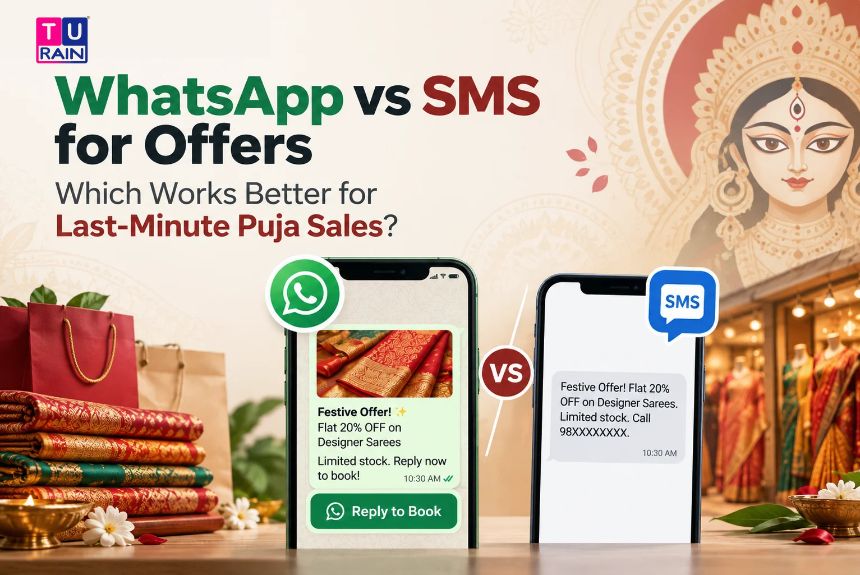
- Rich media. A WhatsApp message can carry the actual product photo, a price tag, and a “reply to book” button. SMS gets you 160 characters and, if you’re lucky, a link.
- Two-way conversation, built in. Someone can reply “yes, hold it for me” directly inside WhatsApp. SMS replies usually need a separate virtual number setup to even function properly.
- Context and trust. A WhatsApp message sits in the same inbox as messages from family and the pandal committee group. SMS inboxes, especially in India, have become so cluttered with promotional blasts that people scroll past without reading half of them.
Why This Matters More During Puja Specifically
A last-minute Puja offer isn’t a routine campaign. It’s got maybe an eight- to twelve-hour shelf life before the moment passes and the customer’s already elsewhere.
For a “48 pieces left, festive price till midnight” kind of message, an open three hours later is close to useless. What matters is speed of reply and whether the customer can act on the message right there, without switching apps or hunting for a phone number to call.
Survey data on Indian consumer behaviour backs this up directly. One widely cited industry report found that around 70% of users prefer reaching local grocery stores over WhatsApp for orders, and about 65% said the same for getting offers from local restaurants. Roughly 80% preferred WhatsApp for service requests like technician visits or warranty claims. These aren’t enterprise numbers from a Bangalore SaaS company — this is exactly the local-shop, festive-offer audience Puja marketing is aimed at.
What This Looks Like for a Local Shop
Picture a sweet shop near Kumartuli sitting on extra stock of a limited festive box, two days before Dashami.
An SMS blast might read: “20% off festive sweet boxes today only. Call 98XXXXXXXX.” Fine. Functional. But the customer has to remember to call, hope someone picks up, and describe what they want over a rushed phone conversation while background noise from five other customers competes for attention.
A WhatsApp message can do considerably more in the same moment — a photo of the actual box, the discounted price stated plainly, and a “Reply YES to reserve” prompt the customer can tap without even typing. The shop owner gets the reply instantly, in writing, with no back-and-forth confusion about what was actually ordered.
Same offer. Same urgency. Very different odds of it actually converting before the offer window closes.
The Practical Catch: Compliance Still Applies
None of this means SMS should be dropped entirely, or that WhatsApp works without any rules of its own.
SMS in India runs through TRAI’s DLT (Distributed Ledger Technology) registration framework — templates and sender IDs need to be registered in advance, and unregistered promotional SMS gets blocked outright, not just delayed. WhatsApp Business messaging, similarly, requires pre-approved message templates for anything sent outside a customer-initiated 24-hour conversation window. A last-minute offer built without an approved template ready to go simply won’t send when it’s needed most.
The practical implication for shop owners and small businesses: the time to sort out WhatsApp templates and DLT-registered sender IDs is well before Puja week begins, not on Saptami morning when the stock needs to move by evening.
SMS or WhatsApp for Business Offers: Which Should You Use?
Neither channel replaces the other completely, and treating this as an either-or fight misses the point a little.
SMS still has a role — it reaches people without data or WiFi, and it works fine for a simple one-line alert. But for anything that needs a fast decision, a visual, or an actual reply, WhatsApp is the stronger tool for last-minute festive offers. The data across nearly every industry benchmark points in the same direction: similar visibility, but meaningfully faster and higher-converting engagement once the message is opened.
For a business watching stock move hour by hour during Puja, that difference in response speed is often the whole game.
Choose the Right Festive Marketing Channels for Your Business
From timely SMS alerts to interactive WhatsApp offer messages, Turain helps businesses build communication campaigns around their audience, offer and campaign goals.
Disclaimer
Marketing Channel and Regulatory Notice: The data points regarding open rates, click-through rates, and conversion metrics for SMS and WhatsApp are drawn from aggregated third-party industry reports and are intended for illustrative and comparative purposes only. Individual campaign results will vary significantly based on audience quality, offer strength, and brand familiarity. Furthermore, businesses must strictly adhere to India’s telecom and data privacy regulations. SMS campaigns must be executed through TRAI’s DLT (Distributed Ledger Technology) framework. WhatsApp campaigns must comply with Meta's Business Messaging Policy and the Digital Personal Data Protection (DPDP) Act regarding explicit customer opt-ins. Using unauthorized bulk-sending tools on either platform can result in immediate and permanent service bans.
Figures on open rates, click-through rates, and conversion percentages are drawn from multiple industry benchmark reports (including Twilio, Esendex, and Meta-linked business messaging data) and vary meaningfully depending on methodology, market, and message type. Treat exact percentages as directional rather than fixed.
Frequently Asked Questions
Is WhatsApp actually better than SMS, or just newer and more popular?
Open rates for both are broadly comparable. The real advantage for WhatsApp lies in click-through rate, response speed, and two-way interaction — all of which matter more for time-sensitive offers than raw visibility does.
Do small local shops really need WhatsApp Business API, or is the free app enough?
The free WhatsApp Business App works fine for shops messaging a few hundred regular customers manually. Once broadcast volume goes beyond 256 contacts, or automation and multi-agent access become necessary, the Business API becomes the more practical option.
Can an unregistered number send promotional SMS during Puja?
No. TRAI's DLT framework requires sender ID and template registration in advance. Unregistered promotional SMS gets blocked at the network level, not delayed — so this needs to be sorted out well before the festive rush.
Is SMS still worth using at all?
Yes, particularly for OTPs, urgent one-line alerts, or reaching customers without a smartphone or data connection. It's just not the stronger choice for a rich, fast-converting festive offer.
Can I send a WhatsApp message to someone if they haven't saved my shop's number?
Yes, but only if you are using the paid WhatsApp Business Platform (API) and the customer has previously opted in to receive your messages. If you are using the free WhatsApp Business app's "Broadcast List" feature, the message will only be delivered to people who have mutually saved your shop's number in their phone's address book.
Is sending an offer on WhatsApp more expensive than sending an SMS?
Yes, generally speaking. While standard promotional SMS in India costs a fraction of a rupee per message (plus DLT registration costs), WhatsApp uses a conversation-based pricing model. A "Marketing" template on WhatsApp costs significantly more per delivered message. However, because WhatsApp often yields higher conversion rates, the Return on Investment (ROI) can still be higher despite the higher upfront cost.
What happens if I try to bypass DLT and send promotional SMS from my personal SIM card?
Telecom operators in India employ AI-driven spam filters. If you attempt to blast hundreds of promotional text messages from a standard 10-digit mobile number, the telecom provider will flag the activity as spam, block the messages from being delivered, and permanently block your SIM card under TRAI regulations.
Can I include a direct payment link in an SMS as I can in WhatsApp?
You can include a URL in an SMS, but doing so heavily increases the chance of the message being flagged as spam by the carrier or the user's phone (e.g., Truecaller or Android's native spam filter), especially given the rise of SMS phishing scams. WhatsApp is generally considered a more trusted environment for sharing UPI or payment gateway links.
Official Reference Links
- Telecom Regulatory Authority of India (TRAI) – DLT Guidelines: trai.gov.in
- WhatsApp API – Message Template Categories and Pricing: developers.facebook.com/docs/whatsapp/pricing
- Meta Business Help Center – Opt-In Policies: business.whatsapp.com/policy