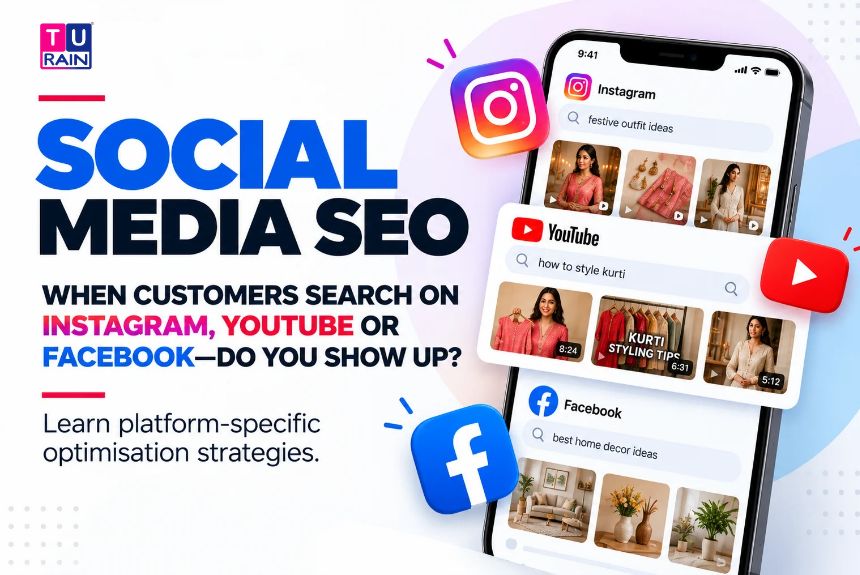
Open Instagram and type something into the search bar. Not a person’s name. A question.
That habit, multiplied across billions of users, is quietly rewriting what “search” even means.
Nearly 41% of consumers now start their product search on social platforms — roughly matching how many start on Google itself. Among Gen Z, the number skews even higher: 46% prefer social media over traditional search engines for discovery, against 35% for millennials. Put plainly, Instagram, YouTube, and Facebook aren’t just places people scroll anymore. They’re where people search. And if your brand’s content isn’t built for that kind of search, it simply doesn’t show up.
This guide breaks down what social media SEO actually looks like in 2026 — platform by platform, tactic by tactic.
Why Is Social Media Becoming a Search Engine?
A few things converged at once.
First, platforms got better at understanding intent, not just keywords. Instagram’s Explore tab increasingly behaves like a visual search engine — people type things like “outfit ideas for work” and expect genuinely relevant results, not just popular posts. Second, traditional search engines started pulling social content directly into their own results. TikTok videos show up in Google. So do Instagram posts and YouTube videos. The line between “social” and “search” has basically dissolved.
Third, and this matters for brands specifically: 60% of social searches are for product reviews, and 82% of people keep researching a product even after first discovering it on social media. This isn’t casual scrolling. It’s genuine purchase research, happening on a platform your brand may be treating as an afterthought.
How Does Instagram SEO Work in 2026?
Instagram’s algorithm reads your content almost the way Google reads a webpage. It scans your bio, your profile name, your captions — all of it — to figure out what your account is actually about.
That means keyword placement in captions isn’t optional anymore. It’s foundational.
How to use keywords in Instagram captions:
- Lead with the keyword or phrase your audience would actually type — not a clever pun, not a brand slogan
- Write the first line like it needs to answer a question, because increasingly, it does
- Use on-screen text in Reels for the same keyword — Instagram reads that too, and it reinforces relevance
- Keep your bio and profile name keyword-aware, not just brand-aware. A bakery named “Sweet Nothings” might consider working “Kolkata bakery” into the bio line, somewhere natural
- Add alt text to images manually. Most brands skip this. It’s a direct, underused signal
How to optimise Instagram content for search, beyond captions, comes down to consistency. Posting once and disappearing for three weeks tells the algorithm very little. Regular, keyword-aware posting — paired with genuine engagement — builds the kind of topical signal Instagram rewards with better Explore and search placement.
One honest caveat: Instagram’s search features are still evolving. It isn’t TikTok yet, in terms of search sophistication. But the trajectory is clear, and brands waiting for “proof” before optimising are simply giving competitors a head start.
YouTube SEO Strategy: Your Second Search Engine
YouTube isn’t adjacent to search. It is search — the second-largest search engine on the internet, processing north of 3 billion queries a month. Videos show up in 62% of Google results pages, and 80% of those video results pull from YouTube specifically.
So a real YouTube SEO strategy isn’t a side project. It’s core infrastructure.
What actually moves the needle for YouTube video search optimisation:
- Titles — front-load the keyword, keep it human. “How to Fix a Leaking Tap” beats “Tap Repair Tips | Ultimate Guide 2026” nine times out of ten
- Descriptions — the first two lines matter most, since that’s what shows before “read more.” Don’t waste them on a generic intro
- Tags — still useful, though less decisive than they were a few years back
- Transcripts — videos with transcripts rank higher for roughly 95% of their target keywords. This single tactic is wildly underused
- Chapters — they help viewers, and they help Google pull specific timestamps into search results
- Mobile-first thinking — over 70% of YouTube watch time happens on mobile, so vertical formats and Shorts deserve real strategic weight, not leftover budget
A video with a strong title and a transcript doesn’t just rank inside YouTube. It regularly outranks actual website pages on Google. That’s a strange, slightly unfair advantage — and most brands aren’t using it.
Facebook SEO: The Quiet Comeback
Facebook SEO sounds almost old-fashioned in 2026. It isn’t.
People still search Facebook directly — for local businesses, community groups, events, products. And Facebook’s own search system runs on keyword matching, engagement signals, and relevance, not unlike a miniature version of Google itself.
A few things carry real weight here:
- Page name — one of the strongest keyword signals Facebook uses. A vague, branded-only name gives up free visibility
- About section — most pages leave this half-filled. Writing it with natural keyword integration, rather than corporate copy-paste, is a genuine gap competitors aren’t closing
- Groups — consistently underused as an SEO asset. A well-named, well-described Facebook Group can rank for niche, long-tail queries in both Facebook search and Google
- Engagement — likes, comments, shares, and saves all signal value to Facebook’s ranking system, which then surfaces that content more in search
And Facebook content can genuinely land in Google results too — a post about, say, monsoon-proofing your car can show up right alongside traditional blog content for that exact query, provided it’s structured with intent in mind.
Comments, Reviews, and Why They’re Not Just Vanity Metrics
Here’s something brands consistently underestimate: comments and reviews aren’t just social proof. They’re search fuel.
Platforms treat comment activity as a freshness and relevance signal. A post with genuine back-and-forth in the comments tends to get read as more valuable than one with likes alone. Reviews work even harder — given that 60% of social searches are specifically review-driven, a product or service page without visible, recent reviews is quietly invisible to a huge chunk of searchers.
Brands that actively respond to comments and reviews — rather than letting them sit — reinforce both signals simultaneously. It’s not just good manners. It’s functional SEO.
Platform-Specific Content Strategy: The Quick Version
| Platform | Primary Search Signal | What to Prioritise |
| Bio, captions, alt text, on-screen text | Keyword-led captions, consistent posting, Reels with searchable hooks | |
| YouTube | Titles, descriptions, transcripts | Front-loaded titles, full transcripts, chapters, mobile-first formats |
| Page name, About section, Groups, engagement | Keyword-rich Page setup, active Groups, consistent community engagement |
No single platform replaces the others. Each one answers a slightly different kind of search intent, and treating them identically — same caption, same format, copy-pasted everywhere — undercuts all three at once.
Social Media SEO Strategies for Indian Businesses
For businesses operating in Indian markets, a few local nuances matter beyond the general playbook:
- Regional language keywords in captions — Hinglish and other code-mixed phrasing — often match how people actually search, more than pure English terms do
- Local landmarks, city names, and neighbourhood references in Instagram and Facebook bios help with discoverability for location-based searches, much like local SEO does for websites
- WhatsApp Business integration, linked visibly from Instagram and Facebook, supports the research-to-conversation pattern common among Indian shoppers
- Review culture runs strong on Google and Facebook alike in Indian markets — actively encouraging and responding to reviews carries outsized weight here
The Bottom Line
Social media didn’t quietly become a search engine. The landscape shifted dramatically right in front of everyone. Meanwhile, countless brands remained stuck in the past. They blindly chased vanity metrics and endless follower growth. The rules of digital discoverability have permanently changed. Today, social platforms highly prioritize genuine relevance above all else. Success requires sharp keywords and completely honest captions. It demands full video transcripts that lazy competitors usually skip. Furthermore, active comment sections are absolutely non-negotiable. This new reality does not mean tearing down an existing marketing strategy entirely. It just means treating platforms like Instagram, YouTube, and Facebook as massive search engines. Users actively hunt for answers there instead of just casually scrolling past.
Turn Social Media Discovery Into Business Opportunities
Publishing content is only half the challenge. Making it discoverable requires the right keywords, platform-specific optimisation and consistent execution. Explore how Turain‘s social media marketing and SEO services can support your brand’s digital growth.
Discover Turain’s Digital Marekting Services
Disclaimer
Platform Algorithm and Metrics Notice: This guide provides strategic recommendations based on search behavior trends and social media algorithm behaviors as of 2026. Because platforms like Instagram, YouTube, and Facebook utilize proprietary, machine-learning-driven algorithms, the exact weighting of search signals (such as captions, transcripts, and engagement velocity) changes continuously without public notice. The statistical data regarding consumer search habits is drawn from aggregated industry research for illustrative purposes. Businesses should continuously monitor their native platform analytics to adapt to ongoing algorithmic updates and shifting consumer behaviors.
Frequently Asked Questions
Should we go back and edit our old Instagram captions to include keywords?
Focus your energy forward. While editing a handful of your highest-performing, evergreen posts might yield minor visibility bumps, social algorithms heavily prioritize recency alongside relevance. It is vastly more effective to apply your new keyword strategy to fresh, consistent content than to spend hours retrofitting years-old posts that the platform has already archived from active discovery feeds.
Do hashtags still matter for social SEO, or should we only use natural keywords?
Hashtags still serve as broad categorization signals, but they are no longer the primary engine of discovery they were five years ago. Social platforms are now highly sophisticated at parsing natural language context. You should still use 3 to 5 highly relevant hashtags to signal broad categories, but prioritize weaving natural, long-tail keywords directly into your conversational captions, video scripts, and on-screen text.
How do we measure the success of Social SEO compared to traditional Google SEO?
Unlike Google Search Console, native social analytics rarely provide a neat, exportable list of exact search queries. To measure your impact, you must triangulate different metrics: track "Reach from Explore" on Instagram, monitor the "YouTube Search" traffic source in YouTube Studio, and watch for qualitative spikes in direct messages (DMs) or profile visits immediately following a keyword-optimized campaign.
Does TikTok require a completely different SEO strategy than Instagram?
While the core principles of keyword-rich captions and on-screen text overlap, TikTok acts much more aggressively as an active search engine than Instagram does. TikTok relies heavily on video speech recognition; meaning speaking your target keywords out loud within the first three seconds of the video is a primary ranking factor.
Official Reference Links
- Instagram Creator Hub – How Search Works: creators.instagram.com/blog/how-instagram-search-works
- YouTube Creator Academy – Search & Discovery: support.google.com/youtube/answer/10315809
- Meta Business Help Center – Optimizing Facebook Pages for Discovery: facebook.com/business/help