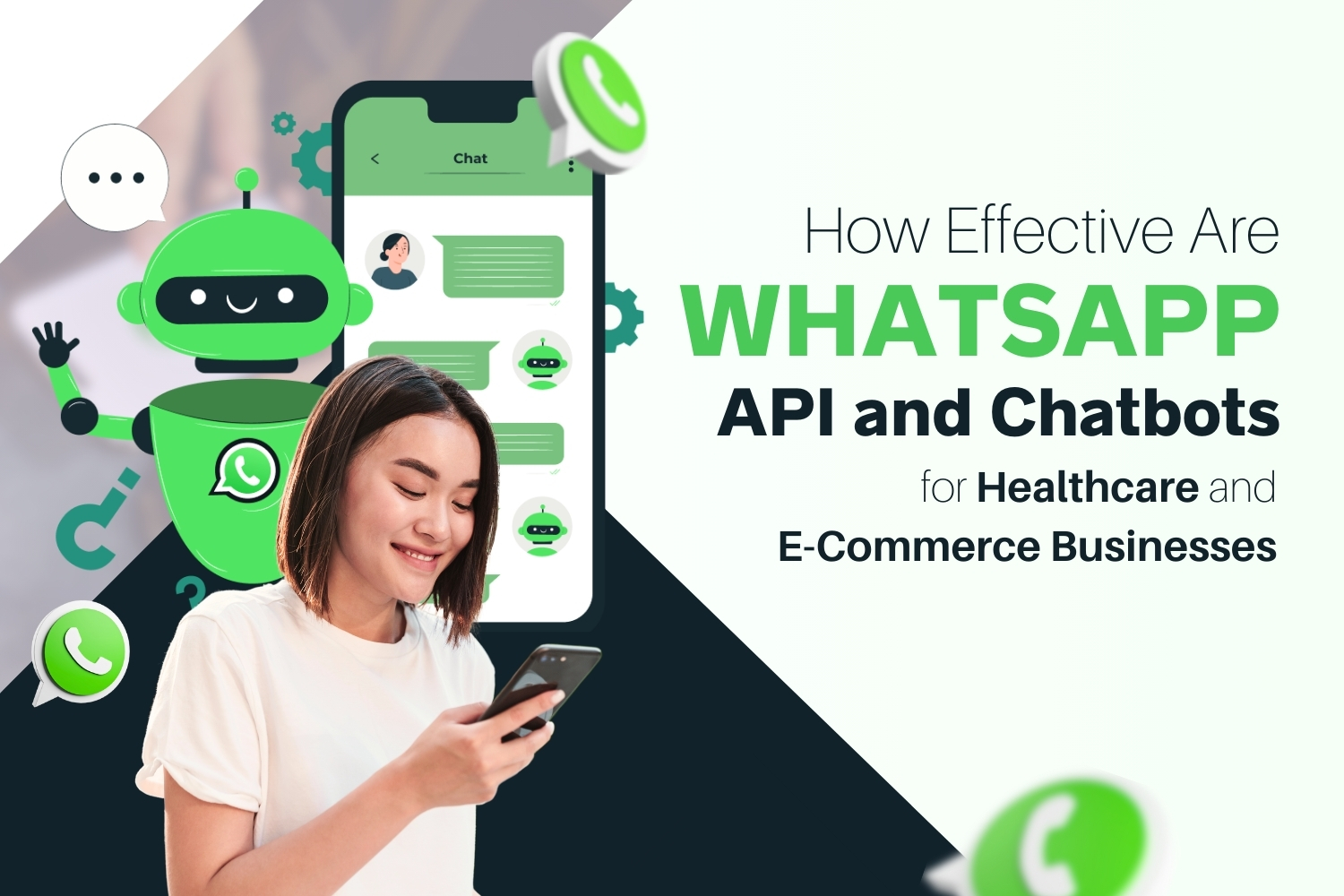
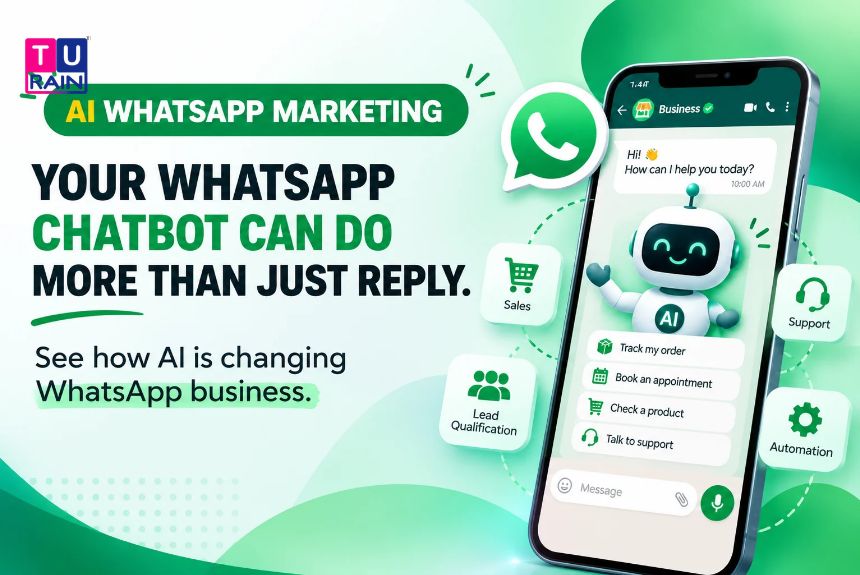
WhatsApp quietly underwent a massive evolution recently. It simply stopped being just a basic text messenger for commercial brands. Today, it acts as a full retail storefront, a customer service desk, and a dedicated sales team. Shoppers naturally open this same application constantly throughout the day. Meanwhile, artificial intelligence transitioned from a fun novelty into a primary conversational driver. Modern AI assistants and business agents go far beyond traditional chatbots.
AI WhatsApp marketing is changing how businesses manage customer conversations. From answering routine questions to qualifying leads and recommending products, AI-powered chatbots and business agents help brands automate specific sales and support tasks directly within WhatsApp.
Here’s what’s genuinely changed, what AI can and can’t do on WhatsApp right now, and how businesses are using it for support, sales, and everything in between.
First, a Correction Nobody Asked For, But Everyone Needs
Let’s clear up a misconception early, because it’s a big one.
Meta didn’t throw the door wide open for AI chatbots on WhatsApp. It actually did the opposite for a specific category of them.
Starting 15th October 2025 for new API users, and rolling out to all existing accounts by 15th January 2026, Meta began banning general-purpose, open-domain AI chatbots from the WhatsApp Business API. Third-party assistants like ChatGPT, Perplexity, Luzia, and Poke — the “ask me literally anything” kind — had to shut down their WhatsApp integrations. Meta’s own reasoning: the Business API was built for enterprise-to-customer service, not for open consumer chat that places heavy system load on the platform without generating business value.
What this means practically: if you’re running a WhatsApp AI assistant that just answers general trivia or holds open-ended conversations unrelated to your business, you’re not compliant. What’s still very much allowed, and actively encouraged, is AI built around specific business tasks — customer support, lead qualification, order tracking, appointment booking. Structured, purpose-driven automation. Not a chatbot pretending to be a search engine.
This distinction matters more than most blog posts on this topic let on. It’s the difference between a compliant WhatsApp chatbot for business and one that risks getting your API access suspended.
Meta’s Own Answer: The Business Agent
While banning general-purpose bots with one hand, Meta built its own AI agent with the other.
In June 2026, at its Conversations conference in London, Meta announced global availability of Meta Business Agent — an AI system designed to handle a customer conversation end to end, rather than function as a keyword-triggered chatbot flipping through decision trees. It works across WhatsApp, Messenger, and Instagram, and for larger businesses, Meta also rolled out a broader Business Agent Platform that connects to systems like Shopify and Zendesk, letting the agent actually take action — check an order, update a booking, process a return — not just describe how to do it.
There’s a genuine difference here worth sitting with. Older WhatsApp automation tools mostly matched keywords and served a pre-written reply. A business agent, by contrast, is meant to understand a messy, multi-intent message and actually resolve it, in the customer’s own language, without routing them through six menu options first.
Two things to know if you’re evaluating this for your own operation. First, these AI-driven replies only work for free within an open 24-hour customer service window — the period after a customer messages you first. Reach out to someone who hasn’t messaged you yet, and you’re still required to use a pre-approved template message, billed under marketing or utility categories, same as before. Second, Meta introduced pricing changes tied to this rollout, with updates to service, utility, and AI-conversation pricing landing on 1st August 2026 and again on 1st October 2026. If you’re budgeting for WhatsApp automation this year, check the current rate card before committing — it’s genuinely moved since last year.
What Is AI WhatsApp Marketing and How Does It Work?
Strip away the marketing language, and AI on WhatsApp is doing four jobs really well right now.
1. Automated Replies That Don’t Feel Automated
The old-school WhatsApp chatbot for business worked off rigid decision trees. Type 1 for sales, type 2 for support, then get stuck in a loop because your question didn’t fit any of the five options. Modern automated WhatsApp replies, powered by proper language models rather than keyword matching, can parse a full sentence, understand what’s actually being asked, and respond without forcing the customer into a menu.
A customer typing “hey, my order came but one earbud isn’t charging” doesn’t need to be told to “press 2 for product issues.” A well-built AI system reads that as a defective product report, checks the order, and offers a replacement or return — inside one message, inside one exchange.
2. Conversational Commerce
This specific feature sets WhatsApp miles apart from standard retail channels. Brands can directly list up to 500 products right inside the native catalog. Consumers can casually browse, inquire about details, and complete a full checkout without ever switching applications. Integrating artificial intelligence takes this convenience much further. A buyer can type out a highly specific, conversational request. They might ask for a nice skincare gift below two thousand rupees. The system immediately generates a perfectly tailored shortlist. It completely beats scrolling blindly through a standard website that treats every visitor exactly the same.
Native WhatsApp Pay checkout is currently supported in select markets, including India, Brazil, Mexico, and Indonesia, with third-party payment integrations covering the gap elsewhere.
3. Lead Qualification
This might be the single biggest behavioural shift. Instead of sending a prospect to a web form that half of them abandon, businesses now use WhatsApp Flows — structured, in-chat forms — paired with AI to ask a handful of qualifying questions right inside the conversation. Budget, timeline, product interest, whatever matters for that business.
Click-to-WhatsApp ads feed directly into this. A person clicks an ad on Instagram or Facebook, lands straight in a WhatsApp chat, and an AI-driven flow starts qualifying them immediately — often before a human on the sales team has even seen the lead. That 72-hour free messaging window that opens after a Click-to-WhatsApp ad click gives businesses real room to qualify and nurture without incurring per-message costs during that stretch.
Reported lead-volume and conversion gains from this approach vary wildly across vendor case studies — some claim triple-digit percentage jumps, others report far more modest gains — so treat any single number you see quoted online, including in this space, as anecdotal rather than an industry-wide guarantee. What is consistently true across independent reporting: WhatsApp’s open rates sit dramatically higher than email (commonly cited around 98%, against roughly 20% for email), and messages tend to get read within minutes, not days.
4. FAQs and Customer Support
The least glamorous use case is arguably the most valuable one. A massive portion of any daily support inbox looks exactly the same. The same handful of routine questions appear constantly. Consumers repeatedly ask for order updates, return guidelines, and exact shipping zones. Intelligent automation steps in to absorb this heavy, monotonous workload entirely. It instantly resolves these basic inquiries without tying up valuable staff. This frees up the real employees for much deeper work. The system only hands a conversation over to a live agent when the problem actually requires human empathy, nuanced judgment, or a rare rule exception. The smartest retail brands operate on a very simple, highly disciplined strategy. They deploy automated systems to handle every single predictable issue. Simultaneously, they ensure that any confusing, delicate, or emotionally charged complaint gets transferred to a human expert instantly. Not “eventually.” Fast.
The Four Message Categories You Still Need to Know
None of this AI capability changes WhatsApp’s underlying billing structure. Every business-initiated message still falls into one of four categories:
| Category | Typical Use |
| Marketing | Promotions, offers, re-engagement campaigns |
| Utility | Order updates, delivery changes, appointment reminders |
| Authentication | OTPs and identity verification |
| Service | Replies within the 24-hour window after a customer messages first |
AI-generated responses inside that 24-hour service window are generally the cheapest and least restrictive way to run automation. Anything reaching out cold still needs an approved template, and still gets billed under marketing or utility rates.
A Word on Compliance, Because This Space Moves Fast
If there’s one operational takeaway from everything above, it’s this: audit what you’re running, regularly. A WhatsApp AI assistant that was perfectly compliant eighteen months ago may not be today, given how quickly Meta has moved on policy this year alone. Before scaling any AI chatbot for sales or support, confirm it’s solving a defined business task — not functioning as an open-ended general assistant wearing a business logo.
Looking to set up compliant, business-specific AI automation on WhatsApp?
From automated customer support to lead qualification and personalized interactions, explore how AI-powered WhatsApp solutions can support your business.
Talk to Turain about what a properly scoped WhatsApp Business Agent setup looks like for your industry.
Disclaimer
Platform Policy & Pricing Notice: The information in this guide reflects the capabilities, policies, and pricing structures of the WhatsApp Business Platform as of late 2026. This includes the global rollout of the Meta Business Agent (announced in June 2026) and the updated API pricing models effective August and October 2026. Meta strictly enforces its Business Messaging Policy, particularly the January 2026 prohibition against open-domain, general-purpose AI chatbots. Businesses are solely responsible for ensuring their AI automation workflows are strictly task-oriented and compliant with current Meta guidelines and local data privacy laws.
Frequently Asked Questions
How can AI improve WhatsApp marketing?
By replacing generic broadcast messages with responsive, context-aware conversations — qualifying leads instantly, answering product questions in real time, and handling routine support without a human in the loop for every message.
What are the best WhatsApp chatbot features for businesses right now?
Native catalog integration, WhatsApp Flows for structured data capture, CRM syncing, multi-intent message parsing, and clean handoff logic to a human agent when a conversation exceeds the bot's scope.
How do I automate customer support on WhatsApp without breaking Meta's policy?
Keep the AI scoped to business-specific tasks — order status, returns, appointment changes, FAQs — rather than deploying it as an open-domain assistant. That distinction is exactly what separates a compliant setup from one at risk of suspension.
Can AI chatbots actually generate qualified leads on WhatsApp, not just capture clicks?
Yes, when paired with structured flows that ask real qualifying questions — budget, intent, timeline — rather than a blanket "how can we help you today?" that goes nowhere.
How do businesses use AI business agents on WhatsApp beyond simple replies?
Through platforms that connect the agent to backend systems like e-commerce platforms or helpdesks, so it can check real order data, update a booking, or process a return, not just describe the process to the customer.
What exactly triggers Meta to ban an AI chatbot under the 2026 rules?
Meta’s compliance engines actively flag "general-purpose AI assistants." If your WhatsApp chatbot is powered by an LLM that allows users to have open-ended conversations about unrelated topics (e.g., asking for a recipe on a clothing brand's number, or asking for code generation on a clinic's number), Meta considers this an abuse of platform resources. Your agent must explicitly restrict itself to your business domain—such as order tracking, catalog browsing, or ticketing.
Is the new Meta Business Agent completely free to use?
For small businesses using the standard WhatsApp Business App, the basic Meta Business Agent is free and runs natively within the app. However, for larger brands utilizing the enterprise-grade Meta Business Agent Platform via the API (which connects to external systems like Shopify or Zendesk), interactions are subject to the new token-based and conversation-based pricing structures introduced in August and October 2026.
Do I need a developer to set up a compliant WhatsApp AI agent?
If you are a small business using the standalone WhatsApp Business App, you can configure the native Meta Business Agent directly from the "Tools" menu in under 15 minutes by uploading your FAQs and catalog. However, if you are a larger operation looking to build advanced, multi-branch workflows on the API, you will need developer resources or a specialized Business Solution Provider (BSP) to integrate the agent with your CRM and payment gateways securely.
How does an AI agent handle WhatsApp’s 24-hour service window?
The 24-hour customer service window opens the moment a customer sends you a message. During this window, your AI agent can converse freely with the customer to resolve their issue, qualify them as a lead, or assist with checkout. Once that 24-hour window expires, the AI can no longer send free-form replies; any subsequent outreach must use a pre-approved, paid Meta template.
Official Reference Links
- Meta Business Help Center – About Meta Business Agent: facebook.com/business/help
- WhatsApp Business Messaging Policy: business.whatsapp.com/policy
- WhatsApp API Documentation – Conversation-Based Pricing: developers.facebook.com/docs/whatsapp/pricing