If you manage WhatsApp campaigns for clients, you’ve probably noticed the terminology getting messier lately.
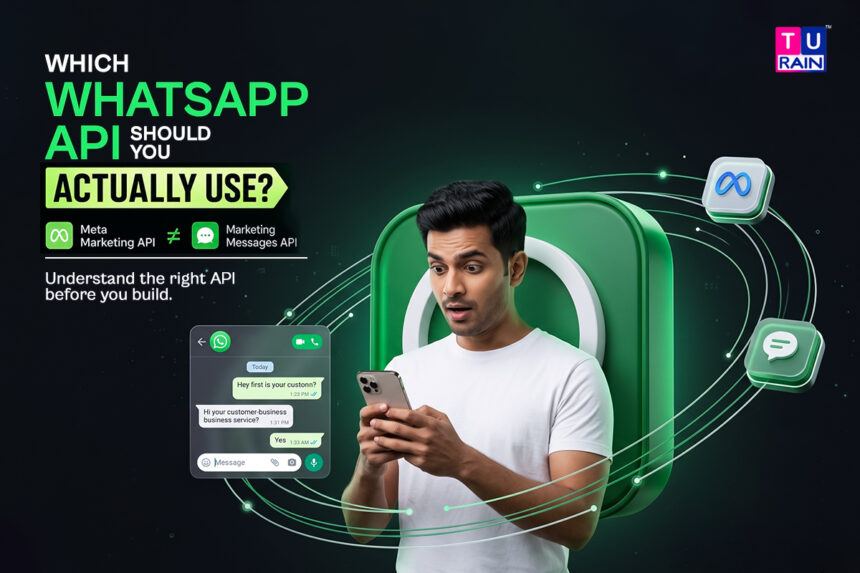
“WhatsApp Marketing API.” “Meta Marketing API.” “Marketing Messages API.” Three names, thrown around almost interchangeably in agency Slack channels and half the blog posts written about them. They are not the same thing. Confusing them is exactly how a developer ends up debugging a permissions error for an hour, only to realise they were hitting the wrong product entirely.
So let’s untangle this properly before getting into the practical guide.
Two Different APIs, One Confusing Name Overlap
There are genuinely two separate Meta products at play here, and agencies working at scale need to know which one they’re actually touching.
The Meta Marketing API is the advertising API — the same one that’s powered Facebook and Instagram ad creation for years. It handles ad accounts, campaigns, ad sets, creatives, and reporting. WhatsApp fits into this world through Click-to-WhatsApp (CTWA) ads — paid ads on Facebook or Instagram that open a WhatsApp conversation when someone taps them. Campaign creation, creative management, ad-account access, and performance reporting all run through this API’s existing endpoints.
The WhatsApp Marketing Messages (MM) API, sometimes called MM Lite, is a completely different animal. It’s a send-only API purpose-built for firing off bulk marketing template messages inside WhatsApp itself — no ad spend, no Ads Manager involved. It uses Meta’s delivery-optimization algorithms to figure out which recipients are actually likely to engage, rather than blasting a list uniformly.
Same company, overlapping vocabulary, different infrastructure. Worth remembering before you start reading API docs.
What’s Actually New Here
Click-to-WhatsApp ads through the Marketing API aren’t new — they’ve existed for a while. What’s shifted is Meta’s clear push toward consolidating marketing-message delivery. The company has signalled that the Marketing Messages API will likely become the exclusive path for marketing template sends by later in 2026, with standard Cloud API support for that category gradually phased out. If your agency still routes bulk marketing templates through the regular Cloud API, that’s worth flagging internally now, not next quarter.
For developers and agencies, this means two workstreams to get comfortable with: managing WhatsApp ad campaigns through the Marketing API, and managing WhatsApp marketing message sends through the newer MM API. Let’s take them one at a time.
Managing WhatsApp Ad Campaigns via the Marketing API
If your work involves running paid ads that click into WhatsApp conversations, this is where campaign creation, ad-account access, and reporting actually live.
Campaign Creation
You start by posting to your ad account’s campaigns endpoint:
POST /act_<AD_ACCOUNT_ID>/campaigns
A basic request needs a name, an objective, and status. Click-to-WhatsApp ads support six campaign objectives — Awareness, Traffic, Engagement, Leads, App Promotion, and Sales — so pick the one that actually matches what you’re optimising for, not just the one that sounds closest to “engagement.” That distinction affects how Meta’s delivery algorithm spends your budget.
Ad Sets and Targeting
Once the campaign exists, ad sets handle budget, schedule, audience targeting, and placement. This is standard Marketing API territory — nothing WhatsApp-specific changes here structurally, though you’ll set the message destination to WhatsApp rather than Messenger or Instagram.
Creative Management
Creatives get built and attached at the ad level:
POST /act_<AD_ACCOUNT_ID>/ads
with a creative_id pointing to an ad creative object. For Click-to-WhatsApp specifically, your creative also needs a pre-filled conversation opener — the message a user sends the moment they tap through. Something like “Hi, I’d like more information about [product]” works. It’s a small detail agencies routinely underestimate, but it does double duty: it gives the user confidence to start chatting, and it hands your sales team or chatbot useful context the instant the conversation begins.
Reporting and Attribution
Standard ad insights endpoints cover impressions, clicks, and spend. For anything beyond that — actual purchase attribution from a WhatsApp conversation — most agencies pair CTWA campaigns with Meta’s Conversions API (CAPI). Once that’s connected, purchase data flows back into Ads Manager automatically, without extra manual tagging. It’s a meaningfully better setup than trying to reconcile WhatsApp conversation logs against ad spend by hand, which is still how some smaller agencies do it, painfully.
What You’ll Need Before Any of This Works
None of the above runs without a few prerequisites in place first:
- A Facebook Page linked to your WhatsApp Business number — you cannot link WhatsApp to a personal profile
- An ad account inside Meta Business Manager, with a valid payment method and admin permissions
- A verified WhatsApp number, correctly associated with both the Page and Business Manager
- For anything beyond small-scale, manual sending: the WhatsApp Business API (not just the consumer app), since that’s what unlocks automation, chatbot integration, and Meta-approved templates
Skip any of these, and campaign creation will either fail outright or get flagged during ad review.
Where the Marketing Messages (MM) API Fits In
Separately from ad campaigns, if your agency is sending bulk promotional template messages — re-engagement pushes, seasonal offers, product announcements — directly to an existing contact list, that’s MM API territory, not Marketing API territory.
A few things distinguish it from a standard Cloud API send:
- Optimised delivery. Instead of sending uniformly, Meta’s algorithm prioritises recipients more likely to engage, which tends to improve open and conversion rates on high-volume sends.
- Configurable TTL. Message time-to-live can be set anywhere from 12 hours to 30 days, instead of the Cloud API’s fixed expiry.
- Richer formats. Support for GIF headers and Android deep links, which the standard Cloud API doesn’t offer for marketing templates.
- Shared infrastructure. Templates, permissions, and webhook formats stay consistent with the Cloud API you’re likely already using for utility and service messages — this is a send path, not a whole new integration to build from scratch.
Onboarding runs through the App Dashboard: WhatsApp → Quickstart → the marketing messages module → accept the terms of service. There’s also a programmatic route via Embedded Signup or the Intent API, if you’re onboarding clients at scale and don’t want to click through the dashboard for each one.
One honest caveat, since accuracy matters more than polish here: documentation around this API has had inconsistencies. At least one developer has publicly noted that older reference material mentioned an enrollment endpoint that never actually existed in the current docs. If something in a tutorial or an old forum post doesn’t match what you’re seeing in Meta’s live documentation, trust the live docs. Not the tutorial.
Practical Guidance for Agencies Managing Multiple Clients
A few habits worth building in, especially if you’re running this across several client accounts rather than one:
- Keep ad-campaign work and marketing-message work in separate mental buckets, even though both eventually route through the same WhatsApp number. Mixing up which system handles which client request is the single most common source of agency confusion here.
- Track Meta’s 2026 phase-out timeline for Cloud API marketing sends. If a client is still on that path, migrating to the MM API before the cutover isn’t optional — it’s scheduling.
- Set up Conversions API early, not after a client asks why their ad reporting looks incomplete. Retrofitting attribution is more annoying than building it in from the start.
- Document which onboarding route you used per client — dashboard vs. Embedded Signup — since troubleshooting access issues later goes faster when you’re not guessing how the integration was originally set up.
Build smarter WhatsApp Business workflows with automation, better customer communication, and campaign strategies built for evolving messaging costs.
Explore Turain’s WhatsApp Business Solutions
Disclaimer
Developer Notice: This guide is for informational and educational purposes only and reflects the Meta Marketing API and WhatsApp Business Platform architecture as of August 2026. Meta frequently updates its API endpoints, rate limits, onboarding protocols, and deprecation timelines. The code snippets and routing logic provided are illustrative. Always consult the official Meta for Developers documentation and test in a sandbox environment before deploying changes to client production accounts.
This guide reflects Meta's Marketing API and Marketing Messages API documentation as of August 2026. Both products continue to evolve, and Meta has signalled further consolidation of marketing-message delivery through the MM API later in the year — check developers.facebook.com directly before shipping anything to production.
Frequently Asked Questions
Do we still need to manage user opt-ins if the MM API algorithm targets the users?
Absolutely. The Marketing Messages (MM) API optimizes who among your list receives the message based on engagement probability, but it does not bypass Meta's strict consent rules. You must still collect active, compliant opt-ins from users before sending them marketing templates, regardless of the API endpoint you use.
How does billing differ between Click-to-WhatsApp (CTWA) ads and the MM API?
They are billed through entirely different structures. CTWA ads are billed through your Meta Ads Manager based on ad impressions or clicks, just like a standard Facebook ad. The MM API, however, bills on a per-conversation basis according to WhatsApp's standard Marketing template pricing for the user's country.
What happens to our Cloud API marketing templates if we don't migrate to the MM API?
Meta has signaled that standard Cloud API endpoints will eventually phase out support for bulk marketing template sends in favor of the MM API infrastructure. If an agency fails to migrate their workflows by Meta's final cutoff date (expected later in 2026), standard marketing template deployment calls will likely return API errors, halting client campaign delivery.
Are there different rate limits for the Marketing Messages API?
Yes. While the standard Cloud API has its own messaging limits based on your phone number's tier (e.g., 1K, 10K, 100K/day), the MM API uses Meta’s internal optimization delivery pacing. You are still bound by your number's overall messaging limits, but the MM API manages the actual send velocity to maximize engagement and prevent spam flagging.
What is the WhatsApp Marketing API?
“WhatsApp Marketing API” is commonly used as a broad term for Meta's WhatsApp marketing capabilities, but it does not refer to one single Meta product. In practice, businesses and developers may be referring to the Marketing Messages API for WhatsApp, the Meta Marketing API used for Click-to-WhatsApp advertising, or the WhatsApp Cloud API used for broader business messaging.
The right API depends on whether you are running WhatsApp advertising campaigns, sending marketing messages directly to customers, or managing broader WhatsApp business communication.
Can agencies create WhatsApp campaigns through the Meta API?
Yes. Click-to-WhatsApp ad campaigns are created the same way any Marketing API campaign is — through the ad account's campaigns endpoint, followed by ad sets and creatives, with WhatsApp set as the message destination. This requires a linked Business Manager, ad account, and verified WhatsApp number.
How do you track WhatsApp campaign performance?
Standard ad metrics — impressions, clicks, spend — come through the Marketing API's insights endpoints. For deeper attribution, like tracking actual purchases that originate from a WhatsApp conversation, pairing the campaign with Meta's Conversions API gives a more complete picture inside Ads Manager, without manual reconciliation.
Official Reference Links
- Meta Marketing API Documentation: developers.facebook.com/docs/marketing-apis
- WhatsApp Business Platform (Cloud API): developers.facebook.com/docs/whatsapp/cloud-api
- Meta Conversions API (CAPI) Integration: developers.facebook.com/docs/marketing-api/conversions-api
- WhatsApp Business Messaging Policy: business.whatsapp.com/policy