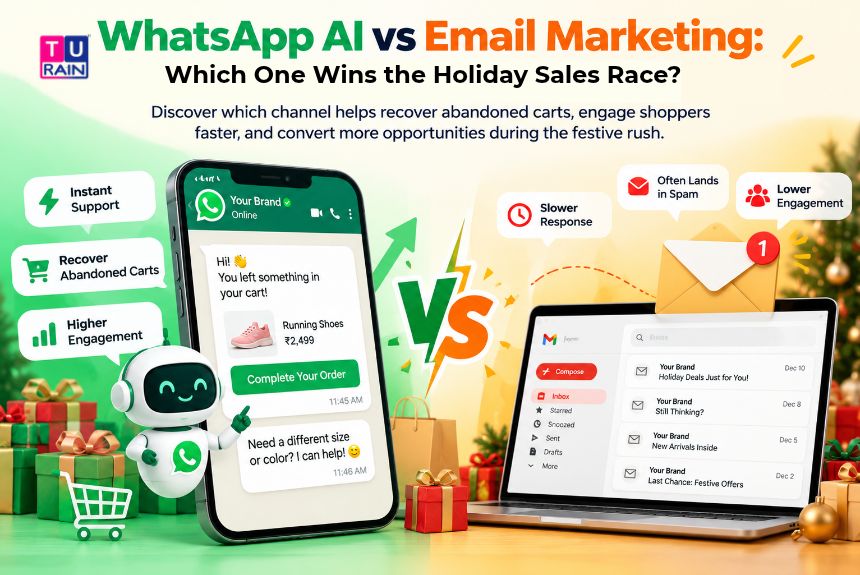
Festive shopping brings a flood of customer enquiries, abandoned carts and last-minute buying decisions. But when every minute counts, can traditional email marketing keep up with customers who expect instant answers?
That’s where the debate around WhatsApp AI vs Email Marketing gets interesting. While email remains useful for newsletters, detailed promotions and order confirmations, WhatsApp AI automation enables businesses to respond to enquiries, assist shoppers and support purchases through real-time conversations.
For e-commerce businesses handling holiday shopping surges, the real question isn’t whether email is outdated. It’s which communication channel works best for customer support, abandoned-cart recovery and timely promotional campaigns—and when combining both makes more sense.
WhatsApp AI vs Email Marketing: What’s the Difference?
Holiday shoppers don’t always have the patience to scroll through overflowing inboxes. Sometimes, they want an answer right now! That’s where WhatsApp AI vs Email Marketing becomes a critical comparison for growing e-commerce businesses.
Traditional email marketing works well for detailed newsletters, promotional campaigns and order confirmations. WhatsApp AI automation, on the other hand, brings customer interactions into a real-time conversation. Shoppers can ask questions, check product availability and receive relevant assistance without waiting for a lengthy email exchange.
But here’s the catch: neither channel is a universal winner. Email is valuable for detailed communication, while WhatsApp AI can be particularly useful when customers need quick, interactive support. The smartest festive marketing strategy often involves using both channels where they work best.
How Smart Messaging Conquers the Holiday Frenzy
Recent data highlights that buyer interaction expands seamlessly when fueled by AI automation. Today’s cutting-edge AI automation tools completely eliminate the need for bloated service departments or clunky website forms. Rather, they leverage lightning-fast chatting features to independently handle and settle overwhelming seasonal traffic.
Here is exactly how these modern retail messaging setups operate right now:
- The Hook: A central interactive bot assesses shopper behaviors and effortlessly secures a jaw-dropping 98% read rate.
- The Quick Solver: This framework tackles incoming questions directly, navigates various merchandise inquiries, and methodically closes help desk tickets with zero staff involvement.
- The Basket Rescuer: Ultimately, the machine monitors left-behind products, decodes buyer motivation, and locks in impressive 25% to 40% recovery numbers. In fact, a few machine-led marketing pushes have remarkably blasted past 150x return on investment.
Cracking the Code of Real-Time Conversational Commerce
One-dimensional blast emails belong in the past. The real magic driving today’s smart messaging lies in its incredible power to converse with countless buyers all at once. To hit these astronomical numbers, sophisticated setups lean on hyper-fast reply cycles.
Rather than sitting around for hours expecting an inbox response, your buyers tap straight into instant chat screens. This empowers them to seamlessly window-shop, question, bargain, and buy several goods simultaneously. Should a requested shoe size be out of stock, the bot immediately shifts gears. It registers the shortage and instantly pitches a fresh alternative. As a result, these machine-guided chat cycles flawlessly replicate top-tier retail floor assistance. More importantly, though, they function at a velocity and volume that leaves mortal teams in the dust. Frankly, no traditional service squad could ever rival this level of productivity.
Why This Matters for Store Owners and Marketers
This massive evolution goes way past those clunky early-web bots. It is currently revolutionizing how actual companies navigate their busiest months. For brand creators, help desk leads, and growth strategists, AI automation utilities will fundamentally overhaul the entire holiday shopping sprint.
- Immediate Assistance: Smart bots actively settle thousands of buyer complaints. They juggle numerous refund claims concurrently. Best of all, they provide completed solutions entirely off the clock.
- Lightning Deals: Promotional departments aggressively utilize these platforms to push urgent discounts around the clock. They blast out massive sales events. Furthermore, they lock in purchases instantly, long before rival brands even get a foot in the door.
- Parcel Monitoring: Digital retailers effortlessly launch bots to deliver comprehensive transit updates. These virtual assistants autonomously trigger huge waves of courier-linked alerts. In essence, they transform boring freight metrics into clickable map URLs and immediate double-blue-ticks.
When Should Businesses Use WhatsApp and Email Together?
Why force customers to choose between two communication channels when both can play an important role?
A smart omnichannel marketing strategy allows businesses to use email for detailed festive catalogues, newsletters and planned promotions, while WhatsApp AI supports immediate enquiries, eligible cart reminders and timely order updates.
For example, a shopper might discover a festive offer through email, ask a product-related question on WhatsApp and later receive their order confirmation through email. Each interaction serves a different purpose while contributing to a connected shopping experience.
Instead of replacing email entirely, businesses can combine WhatsApp AI automation and Email Marketing to create a more responsive and convenient customer journey.
Get Ready for the Next Era of Shopper Assistance
The hurdle to launching top-tier WhatsApp vs Email Support has officially vanished. Any crew wielding these technologies can now execute chat-based initiatives that previously demanded massive phone banks. Companies continuing to depend on cluttered inboxes to hand-process vital issues are guaranteed to slip backward. Likewise, brands merely clinging to generic web forms face total obsolescence. Now is the moment to ruthlessly evaluate your existing procedures. Begin weaving these self-driving engines into your everyday tasks right now. Welcome the rapid transition from lagging email threads to dynamic conversational commerce, and watch your automated messaging exponentially grow your brand.
Ready to Make Holiday Customer Communication More Responsive?
From festive enquiries to timely customer updates, explore how Turain‘s WhatsApp Business API and automation solutions can support more connected customer conversations.
Talk to Our WhatsApp Solutions Team
Disclaimer
Marketing Metrics & Platform Compliance Notice: The performance metrics cited in this article, including 98% read rates, 25% to 40% abandoned cart recovery rates, and specific ROI multipliers, are based on aggregated industry averages for WhatsApp Business API deployments during peak e-commerce seasons. Individual brand results will vary significantly based on offer quality, audience segmentation, and backend API integration. Businesses implementing WhatsApp AI automation must comply with Meta's Business Messaging Policies, which mandate explicit customer opt-in consent prior to sending promotional or cart recovery messages. Additionally, all customer data processing must align with India's Digital Personal Data Protection (DPDP) Act, 2023.
Frequently Asked Questions
Should we completely stop sending marketing emails during the holiday season?
No. The best strategy is omnichannel. Email remains highly effective for long-form content, detailed monthly newsletters, and digital receipts. However, for time-sensitive actions like flash sales, abandoned cart recovery, and urgent customer support, WhatsApp AI vastly outperforms email due to its immediacy and native push notifications.
Is WhatsApp AI more expensive to run than bulk email marketing?
On a per-message basis, yes. Sending a bulk email costs fractions of a paisa, whereas Meta charges a conversational fee for WhatsApp Business API templates. However, because WhatsApp conversion and open rates are exponentially higher than email, the overall Return on Investment (ROI) and Customer Acquisition Cost (CAC) often make WhatsApp the more profitable channel during peak holiday surges.
Will my customers view WhatsApp promotional messages as spam?
Unlike email, where businesses frequently buy unverified lists and blast millions of cold contacts, WhatsApp strictly enforces quality ratings. You can only message users who have explicitly opted in. As long as you pair your promotional messages with high-value utility—like real-time shipping alerts or instant customer support—customers generally view WhatsApp engagement as a premium service rather than spam.
How does the WhatsApp bot know an item is out of stock in real-time?
The AI chatbot does not operate in isolation; it is connected directly to your e-commerce backend (e.g., Shopify, WooCommerce, Magento) via API webhooks. When a customer requests a specific product, the bot queries your live inventory database in milliseconds. If the item is out of stock, the bot's logic automatically triggers a recommendation for the next best alternative.
Official Reference Links
- Meta Business Help Center – WhatsApp Opt-in and Quality Guidelines: business.whatsapp.com/policy
- Meta for Developers – Conversational Commerce & API Integration: developers.facebook.com/docs/whatsapp
- Ministry of Electronics and Information Technology – DPDP Act Framework: meity.gov.in/data-protection-framework