Durga Puja season does strange things to a customer’s phone.
Discount banners pile up. Catalogs flood in. Half of it never even gets opened, because by the time a customer notices the notification, three more have landed on top of it.
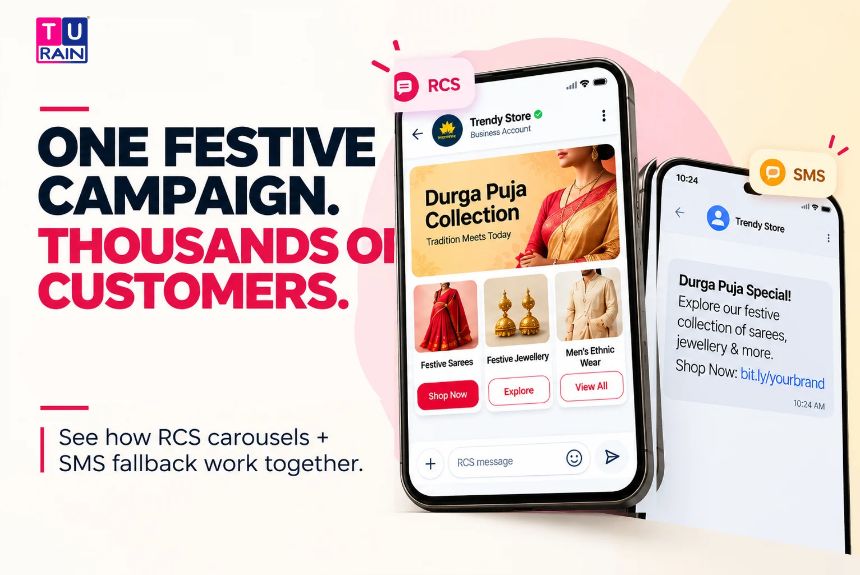
RCS carousels exist precisely to cut through that pile. But here’s the catch nobody mentions in the glossy case studies: RCS alone can’t guarantee delivery. Not every phone supports it. Not every carrier does, either. So the real playbook isn’t “send RCS.”The most effective messaging strategy follows a very strict rule. Push the rich RCS format first. If the network rejects it, seamlessly drop down to a basic SMS backup. This exact dual-channel architecture drives the following guide. It explores engaging carousel mechanics step by step. It decodes the underlying fallback logic completely. Most importantly, it reveals how to connect both systems for maximum reliability. This setup guarantees that a massive Durga Puja promotional campaign actually reaches every single phone number on the master list. No contact gets left behind.
Why RCS-First, and Not RCS-Only
Let’s deal with reach first, because that’s where most festive campaigns quietly lose customers without anyone noticing.
In India, RCS Business Messaging now runs across all three major carriers — Jio, Airtel, and Vodafone Idea — through Google’s RCS framework. Jio moved early. Vi followed. Airtel joined more recently, partnering with Google to bring RCS to its network. Apple has also opened the door on iPhones, through a tie-up with Jio specifically, though iPhone support elsewhere still depends on which carrier a customer is on.
Sounds like full coverage. It isn’t, quite.
- Effective reach across Indian smartphones currently sits somewhere around 60–70%, factoring in device compatibility, carrier rollout, and whether a customer’s Google Messages app is RCS-enabled
- A meaningful chunk of customers are still on basic 4G Android devices with RCS disabled by default, or on carriers where the rollout is partial
- Even on a supported device, a weak data connection at the exact moment of send can cause an RCS message to simply sit undelivered
That gap is not a flaw in RCS. It’s just physics. Rich cards, carousels, and branded sender badges all need a working data session to render. SMS doesn’t. It rides the same signal strength GSM calls use, so it gets through in situations where RCS quietly can’t.
Which is exactly why an RCS-first strategy, not an RCS-only one, is the only version of this that holds up during a festive rush.
How RCS Carousels Actually Work
Before building the fallback layer, it helps to know what you’re actually sending. A carousel isn’t one image with a caption — it’s a structured object with real technical limits, and festive catalogs tend to bump against every one of them.
- A carousel holds between 2 and 10 cards, each scrollable horizontally within the same message thread
- Every card supports an image or video, a title (up to 200 characters), and a description (up to 2,000 characters) — though for a product catalog, shorter is almost always better for actual readability
- Each card can carry up to 4 suggested actions — buttons like “Buy Now,” “View Size Chart,” or “Track Order” — with an outer limit of 11 suggestions across the whole carousel
- Suggestion button text is capped at 25 characters, so “Shop the Collection” won’t fit — “Shop Now” will
- Recommended image resolution is roughly 1440×720 for a horizontal card layout, with file size ideally kept under 2MB so load times stay fast on average data speeds
- The entire message payload — images, text, metadata combined — is capped around 250KB, which matters a lot once you’re sending five or six product cards with full-resolution images
- All cards in a single carousel render at the same height, scaled to match the tallest card, so mixing a tall saree shot with a flat product-only image can look oddly cropped if you’re not careful
For a Durga Puja catalog, the practical translation looks like this: pick your five or six hero products, keep images consistent in orientation, write descriptions a customer can scan in under three seconds, and put your strongest call-to-action — not a generic “Explore” — on every card.
The Fallback Mechanism, Explained Properly
This is the part that actually makes “guaranteed delivery” a real claim instead of a marketing phrase.
Here’s roughly how it works under the hood, across most business messaging APIs:
- Before sending, the platform runs a capability check against the recipient’s number — essentially asking, “is this device and carrier combination RCS-ready right now?”
- If the check comes back positive, the RCS carousel gets sent as the primary message
- If the check fails, or the device simply isn’t RCS-capable, the system routes the message to SMS instead — automatically, with no manual intervention needed
- Some platforms also support per-message fallback, where a plain-text SMS version (capped at 1,600 characters) is bundled alongside the RCS payload from the start, so if the RCS send doesn’t get a delivery receipt within a set time window, the SMS version fires without any extra API call
- Delivery receipts matter here more than people realize — the system isn’t just checking “can this device technically receive RCS,” it’s often also watching whether the RCS message actually got delivered within a defined timeout, and triggering fallback if it didn’t
The net effect: your customer gets the rich, branded, carousel version if their phone and carrier allow it, and a plain but functional SMS version if it doesn’t. Either way, the message lands. That’s the “100% delivery” promise, and it’s a legitimate one — provided the fallback logic is actually configured, not just assumed.
Building the Festive Playbook, Step by Step
- Segment your list by device and carrier capability first. Most CPaaS providers offer a bulk capability-lookup API that flags which numbers on your list are RCS-ready before you even build the campaign. Don’t skip this — it tells you roughly what share of your audience sees the carousel versus the SMS fallback.
- Design the carousel around festive urgency, not generic branding. A “Puja Edition — Ends in 3 Days” card with a visible discount outperforms a plain catalog browse card, almost every time.
- Write a genuinely useful SMS fallback copy, not an afterthought. Since a chunk of your audience will see this version instead of the carousel, it needs its own working link and a clear, single call-to-action — not just “check out our new RCS message” with no content.
- Set a sensible fallback timeout. Too short, and you risk double-sending both RCS and SMS to a customer whose connection was just briefly slow. Too long, and customers on non-RCS devices wait unnecessarily before getting the SMS at all. Most platforms default somewhere in the range of a few seconds to a couple of minutes — test this against your own audience’s typical network conditions.
- Register and verify your sender identity before the festive rush begins. RCS verified branding (business name, logo, verification badge) takes time to approve through the CPaaS provider and Google’s review process. Starting this in July for an October Puja campaign is not early. It’s on time.
- Keep DLT registration current for the SMS leg. India’s Distributed Ledger Technology framework for commercial SMS still applies to your fallback messages, regardless of how advanced the RCS side of the campaign is. A carousel means nothing if the fallback SMS gets blocked for template non-compliance.
- Monitor delivery split in real time during the campaign, not just after. If your RCS delivery rate is unexpectedly low on a particular carrier, that’s often a capability-check or network issue worth catching mid-campaign, not post-mortem.
A Realistic Example
Picture a mid-sized apparel brand running a Durga Puja collection drop across a 50,000-number customer list.
Roughly 32,000 of those numbers check out as RCS-capable. They get the full carousel — six outfit cards, a “Shop the Collection” button on each, a festive banner card up front showing the new arrivals.
The remaining 18,000 don’t pass the capability check, or their RCS delivery attempt times out. They get a fallback SMS instead: “Puja Collection is live. Up to 40% off, ends Oct 15. Shop now: [link].” Not glamorous. But it lands, and it converts, because it still gets the core offer across.
Nobody on that list is left wondering why a competitor’s message arrived and the brand’s didn’t.
Yes, this blog is highly publishable. It provides a technically accurate, grounded breakdown of RCS fallback logic, which is exactly the level of detail marketing teams need but rarely get from generic vendor pitches. The specific technical constraints you included—like the 250KB payload cap and the 25-character button limits—add immense credibility and practical value for campaign managers.
Planning an RCS Campaign for Your Business?
From RCS carousels and capability checks to SMS fallback and campaign monitoring, Turain can help businesses build a messaging setup designed for reliable customer communication.
Talk to Turain‘s Messaging Team
Disclaimer
Telecommunications & Regulatory Notice: The technical specifications, carrier deployment statuses, and API routing logic detailed in this guide reflect the Indian telecommunications landscape as of late 2026. RCS Business Messaging (RBM) capabilities and cross-platform carrier integrations are subject to ongoing network updates. Furthermore, all commercial messaging in India—including the SMS fallback layer described in this strategy—must strictly comply with the Telecom Regulatory Authority of India (TRAI) regulations, mandating active Distributed Ledger Technology (DLT) registration for all sender IDs and SMS message templates.
Frequently Asked Questions
Am I billed twice if an RCS message fails and the SMS fallback triggers?
It depends on your CPaaS provider's billing architecture, but generally, no. Most API providers only charge for the successful delivery channel. If the pre-send capability check determines the number is not RCS-ready, you are only billed for the standard SMS. If an RCS failover timeout occurs after attempting a send, you are typically refunded for the failed RCS attempt and billed only for the delivered SMS.
Can I track whether a customer bought from the RCS carousel or the fallback SMS?
Yes. You should configure your API payload to use distinct tracking parameters. For the RCS carousel, embed UTM parameters or unique deep links directly into the "Suggested Action" buttons (e.g., ?source=rcs_puja). For the SMS fallback, use a uniquely trackable short URL (e.g., ?source=sms_fallback). This allows your analytics dashboard to cleanly separate conversion rates by the final delivery channel.
If an iPhone user hasn't updated to iOS 18, what happens to the RCS carousel?
If the recipient is using an older iOS version (or an Indian carrier that hasn't fully rolled out Apple RCS profiles), the pre-send capability check will register the device as non-RCS compatible. The CPaaS platform will automatically bypass the RCS attempt entirely and route your promotional text directly to their standard SMS inbox.
Do I need a separate DLT template for the RCS message?
No. TRAI’s DLT framework currently governs traditional SMS and voice traffic. RCS Business Messaging follows Google and carrier-specific brand verification processes (RBM agent approval). However, your fallback SMS copy must be strictly mapped to an approved DLT template, meaning you still have to navigate the DLT portal for the safety-net portion of your campaign.
Does RCS cost more than plain SMS?
Generally yes, though the gap has narrowed. Reported India pricing for RCS messages has ranged roughly ₹0.11 to ₹0.30 depending on the carrier and message category, while bulk SMS typically runs lower per message. Factor both costs into a festive budget, since a meaningful share of sends will still route through SMS fallback.
Will the fallback SMS look completely different from the RCS carousel?
Yes, by necessity. SMS is plain text with a 1,600-character cap for fallback messages specifically. Treat it as its own creative, not a stripped-down copy-paste of the carousel description.
Does fallback happen instantly, or is there a delay?
It depends on configuration. Capability-check-based routing can decide before sending at all, with no visible delay. Timeout-based fallback, where the system waits for an RCS delivery receipt before triggering SMS, introduces a short delay — usually seconds, sometimes longer depending on how the timeout is set.
Do I need separate DLT registration for the SMS fallback leg in India?
Yes. The SMS fallback is still a commercial SMS under Indian telecom regulations, and needs its own approved template registered through the DLT framework, independent of RCS sender verification.
Is Apple's RCS support reliable enough to plan around for this festive season?
Partially. Apple has enabled RCS messaging on iPhones through carrier partnerships, starting with Jio in India, but coverage still depends on which carrier the recipient is on. Build your capability checks to treat iPhone reach as a bonus layer, not a guaranteed one, until broader carrier support is confirmed.
Official Reference Links
- Google Business Communications – RCS Rich Card Specifications: developers.google.com/business-communications/rcs-business-messaging
- Telecom Regulatory Authority of India (TRAI) – DLT Guidelines: trai.gov.in
- GSMA – RCS Universal Profile Standards: gsma.com/solutions-and-impact/technologies/networks/rcs