For most of 2026, “ChatGPT ads” sounded like a phrase marketers filed away for later. Something to keep an eye on, not something to budget for.
That’s changing fast.
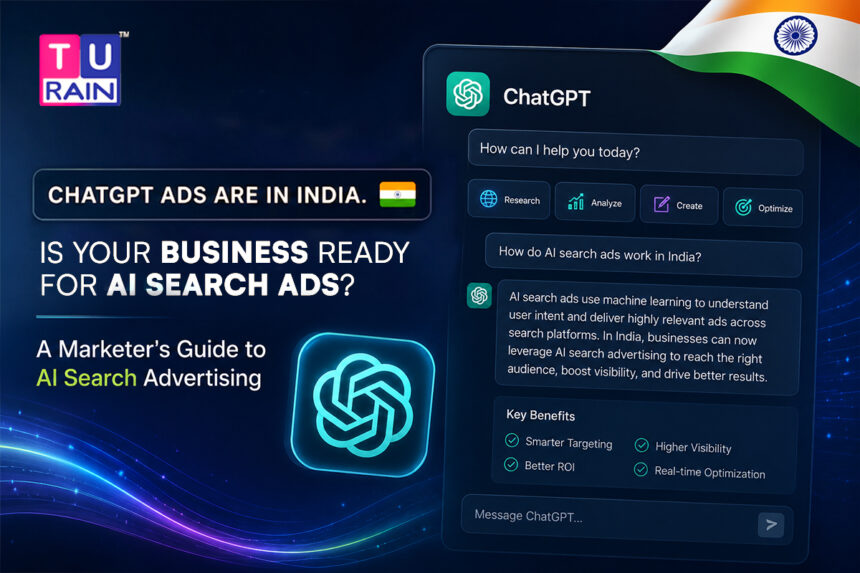
What started as a quiet US pilot in February has turned into a genuine ad platform — with bidding, product feeds, conversion tracking, and now, a real footprint in India. ChatGPT ads in India are becoming particularly relevant for brands, ecommerce businesses and performance marketers exploring new opportunities in AI search advertising. If you run performance campaigns for a living, this is worth understanding properly, not skimming past.
How We Got Here
OpenAI began testing ads inside ChatGPT with US users in February 2026, on the free and lower-cost Go tiers only. Paid Plus, Pro, Business, and Enterprise users stayed ad-free — that hasn’t changed since.
The early pricing was steep by design. Reports point to a $60 CPM launch price and a $200,000 minimum spend, which effectively limited access to large enterprise advertisers. That barrier didn’t last. By May 5, 2026, OpenAI opened a self-serve Ads Manager and dropped the minimum spend entirely. CPMs reportedly eased down into the $25–$60 range, and cost-per-click settled somewhere around $3 to $5, depending on category — finance and legal running several times higher than ecommerce, which tracks with how most auction-based ad platforms behave.
Then came the feature rollout. Product feed campaigns launched in mid-May, letting retailers generate ads in bulk straight from their catalog instead of building each one by hand. By early August, OpenAI added optimized cost-per-click (oCPC) bidding in beta, dynamic URL parameters for attribution, and — the update getting the most attention — a multi-product carousel format that places several items side by side beneath a single response.
None of this reads like an experiment anymore. It reads like a company building toward Google and Meta’s territory, deliberately and quickly.
How Do ChatGPT Ads in India Work?
This is the part that matters most for Indian marketers right now. ChatGPT ads in India open another advertising channel for brands looking beyond conventional search and social campaigns.
OpenAI began showing ads to Indian users on August 27, 2026 — targeting the free tier and the ₹399/month Go plan. More than 50 brands are reported to be live in the opening cohort, with WPP and Omnicom named as OpenAI’s first agency partners for the market, covering strategy, creative, measurement, and brand safety.
Self-serve access is expected to open on September 4, with daily budgets starting as low as ₹725. That’s a meaningfully low entry point — low enough that smaller Indian businesses, not just agency-backed enterprise brands, should be able to test the channel without a huge upfront commitment.
A few operating rules worth knowing before you plan anything:
- Ads only appear on Free and Go tier accounts — Plus, Pro, Business, Enterprise, and Education users won’t see them
- Ads are restricted to users 18 and older, and won’t show to accounts that self-identify or are predicted to be under 18
- Ads won’t appear alongside sensitive or regulated topics, including mental health and political content
- OpenAI says the ad system doesn’t influence how ChatGPT generates its actual response — the ad sits below the answer, not inside it
- Advertisers get aggregate performance data — impressions, clicks — not access to individual user conversations
India is reportedly one of ChatGPT’s largest markets by weekly active users, so this isn’t a minor regional test. It’s a serious commercial push, timed alongside broader plans OpenAI has for revenue diversification ahead of an expected future IPO.
ChatGPT Ads vs Google Search Ads: How Is AI Search Advertising Different?
This is where the “how will this actually work for me” question gets interesting, and where a lot of the confusion comes from.
ChatGPT ads Versus Google Search Ads: Google shows ads based on a typed query — a moment of explicit, narrow intent. ChatGPT ads, by contrast, are surfaced from an ongoing conversation, which tends to carry more context than a search box ever could. The trade-off shows up in the numbers. Industry trackers have reported ChatGPT ad click-through rates sitting well below Google Search’s typical benchmarks — some analyses put it at roughly seven to ten times lower. But the same reports suggest conversion quality on ChatGPT is running noticeably higher, around 1.5 times, on the clicks that do happen. Fewer clicks, but each one reportedly means more.
Versus Google Shopping and product-feed advertising: The new ChatGPT product carousel plays a similar role to a Shopping ad grid — multiple products, side by side, tied to a catalog feed. The difference is where it sits. A Shopping result answers a search query directly. A ChatGPT carousel shows up after the assistant has already answered a question, as a next-step suggestion rather than the primary result.
Versus social advertising (Meta, Instagram): Social ads interrupt attention during a scroll — a fundamentally passive moment. ChatGPT ads appear during active, self-directed research, closer to how someone behaves while comparison-shopping than while browsing a feed. That distinction is likely why early cost-per-click figures for ChatGPT sit in a comparable range to competitive Google Search verticals, rather than the far cheaper CPMs typical of social platforms.
None of these comparisons are settled science yet. Formats are still emerging, and OpenAI has said explicitly that it plans to keep expanding ad types, targeting options, and buying models. Treat current benchmarks as a starting point, not a permanent baseline.
What This Means If You’re Planning a Campaign
A few practical takeaways, based on what’s confirmed so far:
- Bidding is still evolving. CPC has been the default model since ChatGPT ads first opened up, and oCPC — optimizing for conversions while still paying per click — is currently in beta. Expect more bidding options to roll out over the coming months.
- Product feed quality matters early. For ecommerce brands, clean product titles, accurate attributes, and strong images reportedly have a direct effect on ad relevance and auction performance, much like they do on Google Shopping.
- Conversion tracking needs attention before you scale spend. Dynamic URL parameters and expanded measurement integrations were only added in early August, so attribution tooling is newer and less mature than what Google or Meta advertisers are used to.
- Category matters more than average CPC. High-intent, high-consideration categories — B2B software, financial services, professional services, premium ecommerce — appear to be seeing the strongest early fit, since ChatGPT conversations in these categories tend to reflect genuine research intent rather than casual browsing.
- Self-serve access lowers the barrier to testing. With India’s daily minimum reportedly set at ₹725, there’s little reason for interested brands to wait on the sidelines once self-serve access opens.
Ready to explore the next phase of performance marketing?
Build a data-driven advertising strategy across search, social and emerging AI-powered channels to reach customers at high-intent moments.
Explore Turain’s Digital Marketing Services
Disclaimer
Platform & Pricing Variability: This article is for informational purposes and reflects the reported status of OpenAI’s ChatGPT advertising platform as of late August 2026. Ad platform features, pricing minimums, cost-per-click (CPC) averages, and regional availability are subject to rapid change. OpenAI’s algorithms and ad placement rules are still evolving. Advertisers should verify all current specifications, data privacy policies, and billing requirements directly through the official OpenAI Ads Manager before allocating budget.

Ad formats, pricing, and availability referenced here are based on reporting current as of late August 2026 and are expected to keep evolving as OpenAI expands ChatGPT Ads. Marketers planning campaigns should confirm current terms directly through OpenAI's official Ads Manager documentation before committing budget.
Frequently Asked Questions
How much does it cost to run ChatGPT ads in India?
The cost of ChatGPT ads in India can vary depending on the campaign type, bidding model, industry and competition. Advertisers should therefore evaluate more than the cost per click when planning a budget. For performance campaigns, metrics such as conversion rate, cost per acquisition, lead quality and revenue can provide a clearer picture of whether ChatGPT advertising is delivering value compared with established paid channels.
How does conversion attribution work on ChatGPT ads?
Unlike Google and Meta, which have mature pixel and server-side API ecosystems, ChatGPT currently relies heavily on dynamic URL parameters (UTMs) introduced in August 2026. You will need to track post-click behavior, revenue, and conversions directly within your own analytics platform (like Google Analytics 4 or Adobe Analytics) rather than relying on an in-platform ChatGPT tracking pixel.
Do ChatGPT ads scrape or train on my proprietary product feed data?
OpenAI has explicitly stated that advertiser data, including product catalogs and conversion parameters routed through the Ads Manager, is siloed from its consumer LLM training models. However, advertisers should review their specific self-serve or enterprise agreements to understand exactly how campaign data is handled, stored, and retained.
Are there brand safety controls to prevent ads from appearing next to controversial AI outputs?
Yes. OpenAI restricts ads from appearing alongside sensitive topics, including political, explicit, or mental health-related prompts. Initial agency partnerships (such as those with WPP and Omnicom) are heavily focused on establishing strict brand safety guardrails, though advertisers using the self-serve platform should still actively monitor placement reports as the system matures.
Does ChatGPT have advertisements?
Yes. OpenAI began testing ads with US users in February 2026 and has since expanded to 38 countries, including India, where ads went live on August 27, 2026. Ads only appear for logged-in users on the Free and Go tiers.
How can businesses start running ChatGPT ads in India?
Businesses planning to run ChatGPT ads in India should first define their campaign objective, target audience and budget before setting up a campaign through the available advertising platform. Brands should also prepare relevant ad creatives, conversion-ready landing pages and accurate tracking before spending. Ecommerce businesses should additionally keep their product feeds updated with clear titles, accurate attributes and strong product images. Since ChatGPT advertising is still evolving, advertisers should verify the latest campaign requirements, formats and availability before launching.
How are ChatGPT ads different from Google Ads?
Google Ads respond to a typed search query. ChatGPT ads are surfaced from conversational context and appear below an AI-generated answer, not alongside a results page. Reported click-through rates run lower than Google Search, but conversion quality has reportedly trended higher on the clicks that occur.
Can ecommerce brands advertise products in ChatGPT?
Yes. OpenAI launched product feed campaigns in May 2026, letting retailers generate ads directly from their catalog, and introduced a multi-product carousel format in August 2026 that displays several items in a single ad placement.
Reference Links for Further Reading
- OpenAI Business & Enterprise Privacy Guidelines: openai.com/enterprise-privacy
- Interactive Advertising Bureau (IAB) – Guidelines for Generative AI Advertising: iab.com/guidelines/ai-advertising
- Search Engine Land – AI & Search Marketing Updates: searchengineland.com/category/sem