Something shifted in social media over the last few weeks, and most brands haven’t caught up yet.
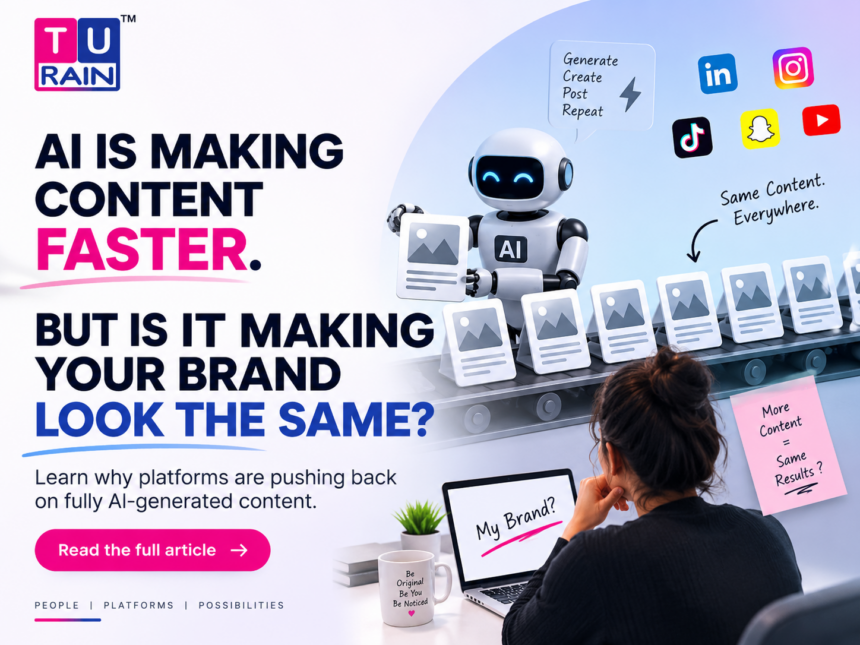
Two platforms, almost back-to-back, drew a hard line around fully AI-generated content. Not AI-assisted. Not AI-edited. Fully generated, start to finish, with barely a human fingerprint on it. Snapchat did it quietly through an algorithm change. LinkedIn did it more visibly, with an actual button. Different platforms, different methods, same underlying message: content made entirely by a machine isn’t earning the same reach anymore.
If your brand leans on AI for social content — and honestly, most do now — this is worth understanding properly, not just skimming past.
What Snapchat Actually Changed
On 31st July 2026, Snap announced that wholly AI-generated videos would no longer be eligible for recommendation on Spotlight, its short-form video discovery feed. Not banned. Not deleted. Just quietly cut off from the recommendation system that helps a video travel beyond a creator’s existing followers.
That distinction matters more than it sounds.
A creator can still post a fully synthetic video on Snapchat. Nobody’s stopping them. But without access to Spotlight’s discovery engine, that video isn’t going anywhere. It sits with the handful of people who already follow the account, and that’s it. No algorithmic push, no viral spike, no random stranger stumbling onto it at 2 AM. For creators and brands who rely on Spotlight specifically for reach, that’s a real cost, even without an outright ban.
Snap framed the decision around protecting “authentic creativity from real people,” and pointed to unique Spotlight contributors growing more than 120% year-on-year as evidence that real, human-made content was already gaining ground before this policy even existed. Worth noting, though — that figure came from Snap itself, not an independent audit.
Here’s the part brands often miss: AI-assisted content isn’t affected. Videos enhanced or edited using Snapchat’s own AI creative tools stay eligible for recommendation, and they’ll carry a transparency indicator showing AI involvement. So Snap isn’t rejecting AI as a tool. It’s rejecting AI as the entire creator.
This wasn’t a sudden move, either. Snap had already signalled the direction back in April 2026, saying it wanted to show users fewer synthetic videos and widely syndicated posts. July’s announcement just turned that stated preference into an actual, enforceable rule.
What LinkedIn Is Testing
LinkedIn took a different route. Rather than quietly adjusting an algorithm, it gave users an actual reporting button.
Starting in late July and early August 2026, LinkedIn began testing a “Seems like AI slop” option, tucked into the same three-dot menu where you’d normally report spam or harassment. Users can flag a post or comment that feels inauthentic or machine-written, and that flag feeds LinkedIn’s detection systems directly.
There’s a second layer to this that’s arguably more interesting for anyone posting regularly. LinkedIn is also testing a private notification system — if enough people flag your content as AI slop, you’ll see that feedback quietly in your own post analytics dashboard. Not a public callout. Just a private signal that your writing might be coming across as inauthentic or overly automated.
LinkedIn’s Chief Product Officer, Hari Srinivasan, drew a clear distinction here: AI use and “slop” aren’t treated as the same thing. Someone refining their own thoughts with an AI tool isn’t the target. Content that reads as hollow, generic, or entirely machine-produced is. As Srinivasan put it, the platform wants people to know when their writing “sounds inauthentic” — not to punish anyone for touching AI at all.
LinkedIn backed this up with a genuinely notable move: it’s removing its own “enhance your post” AI writing feature — the one it had actively promoted for a while — and replacing it with a lighter proofreading tool that fixes grammar without rewriting your voice. That’s the platform admitting, in a roundabout way, that it helped create the exact problem it’s now trying to fix.
The scale of that problem is worth sitting with. A study from AI detection company Pangram found that more than 40% of long-form LinkedIn posts were likely fully AI-generated — the highest share among all major social platforms it analysed. LinkedIn has genuinely earned its reputation as the place where every third post starts with “In today’s rapidly evolving world…”
Early results, according to LinkedIn, are already showing an effect — the company reported a meaningful drop in views on flagged content within weeks of testing the feature.
Why This Is Happening Now
Neither platform is acting in isolation. This is a pattern, not a coincidence.
AI writing and video tools made content production nearly free. That sounds great until you realize what “nearly free” does to a feed — it floods it. Faster than any platform can genuinely improve on quality, it simply increases volume, and volume without originality is exactly what people mean when they say “AI slop.” Generic motivational posts. Vague career advice dressed up as wisdom. Videos with that oddly smooth, slightly-off AI texture that everyone can now spot instantly, whether they can name why or not.
Platforms make money from engagement and time spent. Both of those depend on people actually wanting to be there. A feed full of interchangeable AI content erodes that faster than almost anything else — faster, even, than spam, because spam is obviously fake and gets filtered hard. Slop is sneakier. It looks like content. It just isn’t worth anyone’s attention.
So the platforms are protecting their own product, really. Authenticity isn’t a moral stance here so much as a retention strategy.
What This Means for Brands
This is the part that actually matters for anyone running a content calendar.
Brands don’t need to abandon AI. That’s not what’s being asked of anyone, on either platform. What’s being penalized specifically is content with no human fingerprint anywhere in it — no original observation, no real voice, no evidence a person actually made a choice about what to say or show.
A few practical shifts make sense here:
- Use AI for drafts, not final output. Let it handle the first pass, structure, or research. A human should still be the one deciding tone, adding a real example, and editing the final version so it doesn’t read like everyone else’s AI output.
- Keep AI tools native to the platform where possible. Snap explicitly kept its own AI creative tools eligible for recommendation. Third-party, fully synthetic content is what’s getting cut off — not AI assistance broadly.
- Disclose, don’t hide. Both platforms are moving toward transparency indicators rather than blanket bans. Brands that get ahead of this — labelling AI involvement honestly — will likely fare better than brands trying to sneak fully synthetic content past detection systems that are only getting sharper.
- Audit your own content for “sameness.” If your last ten LinkedIn posts could be shuffled between competitors without anyone noticing, that’s the actual problem these platforms are targeting. It’s not really about which tool you used. It’s about whether anything you posted needed a human at all.
- Protect your reach on Snapchat specifically by keeping a human visibly in the loop — face, voice, personal narration, something that isn’t reproducible by a prompt alone.
A Simple Cross-Platform Rule of Thumb
If a stranger could not tell your brand made this content, versus any other brand running the same AI prompt, that’s the signal to rework it. Reach and credibility are both increasingly tied to a single, unglamorous requirement: did a person actually show up in this content, even briefly?
Platforms aren’t asking brands to give up efficiency. They’re asking for evidence that a real person was still involved in the decision that got published.
Disclaimer
Platform Policy & AI Tools Disclaimer: This guide is for informational purposes and reflects the stated policies and beta features of social media platforms (including Snapchat and LinkedIn) as of August 2026. Social platforms rapidly update their algorithms, AI detection thresholds, and content moderation guidelines. The definition of "AI-assisted" versus "wholly generated" may shift as platform-native AI tools evolve. Brands and creators should regularly review the official creator guidelines and terms of service for each platform they utilize before deploying AI-generated assets at scale.
Frequently Asked Questions
If I use ChatGPT to write a LinkedIn post and then heavily edit it, will it still be flagged as "slop"?
Unlikely, provided the editing is substantial. LinkedIn's "slop" reporting and detection mechanisms target the hallmarks of unedited AI generation (e.g., rigid structures, repetitive phrasing, lack of personal anecdote). If you inject genuine human perspective, unique data, and brand voice, the content ceases to be "wholly AI-generated" and is much less likely to trigger algorithmic suppression or user flags.
Will using Canva's AI image generator get my post penalized?
Generally, no. Platforms are primarily targeting mass-produced, low-effort synthetic media designed to spam discovery feeds. Using an AI tool to generate a background or enhance a graphic for a thoughtful, human-led post falls under "AI-assisted" creation, which platforms are currently tolerating (or actively encouraging via their own native tools).
How does LinkedIn detect AI content internally?
While LinkedIn has not open-sourced its exact detection models, it relies on a hybrid approach: automated linguistic analysis (identifying the predictable token sequences and sentence structures common to Large Language Models) paired with the new crowd-sourced user reporting ("Seems like AI slop" flags) to train its suppression algorithms.
Does AI-generated content get less reach on social media?
Increasingly, yes — specifically content that's wholly AI-generated with no human editing or input. Snapchat has formally excluded such videos from its Spotlight recommendation system, and LinkedIn is actively testing tools to reduce the reach of AI-generated posts flagged by users. AI-assisted content, where a human still shapes the final output, generally isn't affected the same way.
What is AI slop?
"AI slop" refers to low-quality, mass-produced, largely generic content created by AI tools with little human oversight — think interchangeable motivational posts, vague thought-leadership pieces, or videos with a synthetic, slightly off quality. It's less about the tool used and more about the absence of originality or human judgment in the final piece.
How can brands use AI while maintaining authenticity?
Use AI to support the process — drafting, structuring, editing — rather than letting it own the final output entirely. Add real examples, a genuine voice, and visible human involvement (face, narration, personal perspective) where the platform rewards it. Disclose AI use where platforms provide the option, rather than trying to pass fully synthetic content off as organic.
Reference Links for Further Reading
- LinkedIn Official Blog (Product Updates): blog.linkedin.com
- Snapchat Creator Hub – Spotlight Guidelines: creators.snap.com/spotlight
- Pangram – AI Content Detection Research: pangramlabs.com