
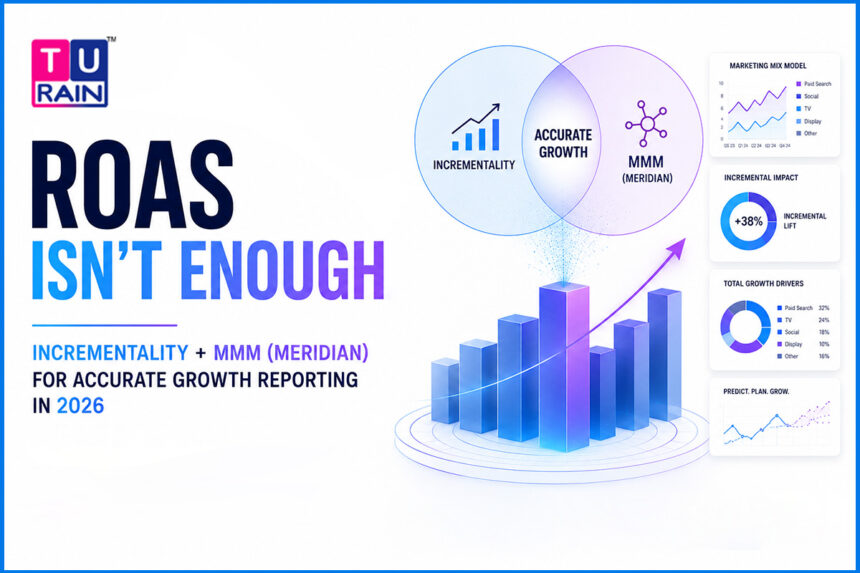
Are You Still Letting Ad Platforms Grade Their Own Homework?
You spend heavily on Meta and Google Ads every month. You log into the dashboard, and the platform proudly reports an incredible Return on Ad Spend (ROAS). You scale the budget aggressively based on those numbers. Yet, at the end of the month, your actual bank account does not reflect that supposed massive growth. Sound familiar? The usual way of judging paid marketing—leaning only on platform-reported attribution and last‑click ROAS—is painfully incomplete once a brand starts to scale. ROAS still has value as a quick efficiency signal, but on its own, it ignores profit, retention, and how much of your demand would have arrived without any ads at all. In the complex, privacy-restricted digital landscape of 2026, blindly trusting the ad networks is a massive financial risk. You cannot afford to waste budget buying conversions that would have naturally happened anyway. That is exactly why taking marketing mix modeling 2026 seriously—using tools like Google’s Meridian when they fit your stage—is no longer a luxury for brands that spend heavily on media. We are moving entirely away from basic attribution and stepping directly into the era of deep incrementality measurement.
What Exactly Is Wrong With Traditional ROAS?
The biggest flaw in modern digital advertising is surprisingly simple. ROAS only measures correlation, absolutely not causation. Standard ad platforms actively claim credit for every single person who clicked an ad and later bought something. However, they completely fail to ask the most critical business question: “Would this specific customer have purchased even if they never saw the ad?”
Here is what relying purely on ROAS does to your business today:
- It actively rewards ad networks. They get credit for targeting your existing, loyal customers. This happens instead of actually acquiring new ones.
- It completely hides the harsh reality of cannibalization. You end up paying for branded search clicks. Those clicks come from people already looking for your website.
- It makes true, accurate growth analytics nearly impossible. As a result, finance teams stop trusting the numbers. They begin to severely distrust marketing reports.
- It also ignores key external factors. Seasonality is left out of the picture. Pricing changes do not get proper weight. Broader economic trends are overlooked, too. Yet those forces actually drive real consumer behavior.
This is precisely why smart brands are aggressively shifting toward holistic marketing mix modeling in 2026. It is a fundamental evolution in how you must prove actual business impact.
Why Meridian and Marketing Mix Modeling Matter So Much Now
The gap between reported ad platform performance and actual cash flow has never been wider. Implementing Google’s newly open-sourced Meridian framework directly attacks that massive gap.
- It removes the pixel-tracking barrier. Because third-party cookies are unreliable, marketing mix modeling 2026 completely skips individual user tracking and relies purely on aggregated, privacy-safe data.
- It preserves your testing budget. Meridian is built to pull your real incrementality tests directly into the model, so it can constantly recalibrate and tighten its view of what your marketing is actually adding on top of baseline demand.
- It accelerates your resource allocation. The sheer processing power behind modern MMM suggests the absolute most profitable way to distribute your next budget cycle across all active media channels.
Using this advanced level of modeling fundamentally shifts your marketing department from a simple cost center into a highly predictable revenue engine.
How Does True Incrementality Measurement Actually Work?
The biggest complaint about traditional MMM was that it was too slow and backward-looking. The magic of modern incrementality measurement lies in its continuous, active testing. Here is exactly how the modern process flows:
Step 1 — The Holdout Test: You intentionally stop showing ads to a specific geographic region or a randomized control group of users. You then carefully measure the baseline sales from that exact group.
Step 2 — The Active Campaign: You run your standard advertising to the remaining audience.
Step 3 — Lift Calculation: You rigidly compare the revenue from the active group against the revenue from the holdout group. The pure difference between the two is your true incremental lift.
Step 4 — Meridian Calibration: You take those proven test results and feed them directly into your open-source Meridian model. The algorithm learns exactly what a “true” conversion looks like and adjusts your future forecasts.
Important note: True incrementality measurement heavily requires strict discipline. When you first switch from basic ROAS to Incremental ROAS (iROAS), your reported numbers will initially look much worse. This is completely normal. You are finally seeing the real, uninflated truth.
What Are the Key Features of This Analytical Playbook?
To truly master your budgeting, your accurate growth analytics must rely on several core principles:
- Unified Data Ingestion: You cannot run MMM on dirty spreadsheets. You must strictly feed the model clean sales data, accurate ad spend, and clear external variables.
- Continuous Calibration: You must stop treating MMM as a once-a-year consultant report. Let Meridian constantly update its predictions based on your ongoing incrementality tests.
- Cross-Channel Focus: Let the system analyze everything together. Give it your TV spend, your Google Ads data, and your Meta budget, and let it map the complex interactions between them.
Who Should Actually Use This Meridian Framework?
This robust workflow is no longer heavily restricted to massive Fortune 500 companies with limitless data science budgets. Here is exactly who benefits most from accurate growth analytics:
- Scaled D2C brands can finally understand why their profit margins are shrinking even when their Meta dashboard claims a 4x ROAS.
- B2B SaaS companies can skip the endless multi-touch attribution debates and focus purely on measuring which channels actually drive long-term pipeline.
- Digital agencies can boldly prove their true worth by showing clients exactly how much incremental revenue their specific campaigns actively generated.
- Performance marketers can finally stop worrying about iOS signal loss and let aggregate modeling handle the heavy statistical lifting.
Practical Examples of This Tech in Action
To easily prove the real-world value of modern marketing mix modeling 2026, let’s look closely at how it solves everyday friction points:
Example 1 — The E-commerce Reality Check: An online store is spending 60,000 bucks a day on branded search terms because Google claims a 10x ROAS. They run strict incrementality measurement and discover 90% of those users would have clicked the organic link anyway. They successfully reallocated that budget to YouTube Demand Gen, heavily increasing net new sales.
Example 2 — The B2B Scale Fix: A software company is getting hundreds of leads from LinkedIn, but attribution software cannot track the long sales cycle. They implement an open-source Meridian model, and the data clearly proves that LinkedIn spend directly correlates with a 30% pipeline increase three months later.
Example 3 — The Agency Trust Builder: A marketing agency constantly fights with clients over which platform deserves credit for a sale. Instead of arguing over pixels, they use accurate growth analytics to show the holistic lift across the entire business, easily saving the client relationship and securing a larger budget.
What Are the Real Limitations You Should Know?
This is precisely where many hyped analytics gurus get it wrong. Here are the deeply honest boundaries of this modern playbook:
- Bad data ruins the model. If your offline sales records are broken or missing, Meridian absolutely cannot magically save you. Clean inputs are mandatory.
- Setup is highly technical. Building a proper data pipeline for accurate growth analytics heavily requires Python knowledge, data warehousing, and basic statistical understanding.
- You lose instant gratification. For highly impulsive marketers who want to check ROI every two hours, pure marketing mix modeling 2026 feels frustratingly slow, as it requires weeks of data to find true correlations.
- Testing requires sacrifice. Running valid holdout tests means you actively choose to lose potential sales in your control group to gain statistical clarity.
The Final Takeaway for Your Analytics Strategy
The historic reliance on deterministic pixel tracking and basic dashboard ROAS is rapidly collapsing. Leveraging the powerful new combination of Google Meridian and strict incrementality measurement is a genuine step change for businesses of all sizes. It absolutely will not replace brilliant, creative, or strong offers—but it firmly removes the massive financial blind spots that actively destroy profitability. If your data warehouse is properly organized and your team is ready to face the hard truth about their ad performance, the long-term payoff of accurate growth analytics is undeniably massive. It is time to stop blindly trusting the platforms, run your first holdout test, and start measuring true business growth immediately.
Disclaimer
This blog is for informational and educational purposes only and does not constitute financial, analytical, or strategic advice. Tools like Meridian, marketing mix modeling 2026 frameworks, and incrementality measurement methods may behave differently depending on your data quality, channel mix, and business model. Always validate model outputs against your own financial statements, run properly designed experiments, and consult qualified analytics, data science, or finance professionals before basing major budget or growth decisions on MMM or incrementality results.
Reference links for this blog
- Google Think – Meridian: The future of marketing mix modelling is now
https://business.google.com/uk/think/measurement/meridian-marketing-mix-model/[business.google] - Google Ads & Commerce Blog – Meridian is now available to everyone
https://blog.google/products/ads-commerce/meridian-marketing-mix-model-open-to-everyone/[blog] - Google for Developers – About Meridian (documentation)
https://developers.google.com/meridian/docs/basics/about-the-project[developers.google] - Finance Yahoo / Google – Google Brings Marketing Mix Modeling to the Masses (Scenario Planner)
https://finance.yahoo.com/news/google-brings-marketing-mix-modeling-131552753.html[finance.yahoo] - Skai – Incrementality Measurement: The Key to Proving True Marketing ROI
https://skai.io/blog/incrementality-measurement/[skai] - Saras Analytics – Why Chasing ROAS in 2026 Can Hurt Profitability
https://www.sarasanalytics.com/blog/why-chasing-roas-can-hurt-profitability[sarasanalytics] - Saras Analytics – ROAS Is Not Profitability and Here Is What Contribution Margin Reveals
https://www.sarasanalytics.com/blog/roas-vs-contribution-margin-profitability-revealed[sarasanalytics] - AmQuest / Education – Incrementality Testing: True ROI, Conversion Lift & Incremental ROAS
https://amquesteducation.com/incrementality-testing/[amquesteducation] - SegmentStream – Incrementality Measurement Guide (2026)
https://segmentstream.com/blog/articles/incrementality-measurement-guide[segmentstream]
FAQs about ROAS, Incrementality & Meridian in 2026
1. Why isn’t ROAS enough in 2026?
Because ROAS ignores costs, organic demand, and retention, it stops explaining profitability once brands scale and channels get more complex.
2. What is incrementality measurement in marketing?
It quantifies the extra conversions or revenue caused by a campaign versus what would have happened without it.
3. How is incremental ROAS different from normal ROAS?
Incremental ROAS only uses incremental revenue from lift tests, giving a truer picture of efficiency than platform‑reported ROAS.
4. What is marketing mix modeling 2026 in simple terms?
It is a statistical model that uses historical, aggregated data to show how different channels, spend levels, and external factors drive sales over time.
5. What is Google Meridian exactly?
Meridian is Google’s open‑source marketing mix modeling framework built to help brands run modern MMM with calibration, experimentation inputs, and budget recommendations.
6. Do I need to be a data scientist to use Meridian?
Not necessarily, as Google is rolling out no‑code Scenario Planner interfaces to make Meridian insights accessible to non‑technical marketers.
7. How do incrementality tests usually work?
They compare a test group exposed to marketing with a holdout/control group that is not, then measure the difference in outcomes.
8. Can incrementality testing work without cookies?
Yes, because it relies on test vs. control outcomes at an aggregate level, not on user‑level tracking.
9. What data do I need for accurate growth analytics?
You need clean revenue/sales data, reliable channel spend, clear experiment results, and context like seasonality or promotions.
10. Is MMM only for very large enterprises?
Historically, yes, but tools like Meridian are pushing MMM into the mainstream, including mid‑market brands.
11. How often should a marketing mix model be updated?
Modern MMM is designed to refresh frequently, incorporating new data and incrementality tests rather than being run once a year.
12. What is the main benefit of marketing mix modeling 2026?
It helps you reallocate budgets toward channels and tactics that truly move revenue, not just look good in platform reports.
13. How does MMM handle search and performance media now?
Newer frameworks like Meridian explicitly model search demand, reach/frequency, and incrementality, which older MMMs often missed.
14. Why does chasing ROAS sometimes hurt profit?
Because ROAS can push spend into discounted, low‑margin, or cannibalized sales that look good in‑platform but weaken contribution margin.
15. Should I stop looking at ROAS altogether?
No, ROAS is still useful as a directional metric, but major decisions should be anchored in incrementality and profit‑based analytics.