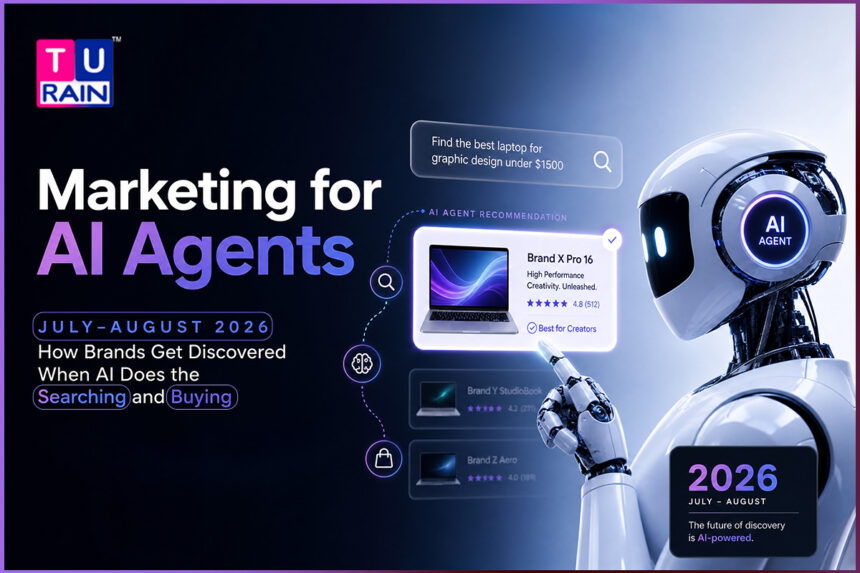
Are You Still Optimizing Only for Human Eyes?
You spend weeks creating beautiful landing pages. You write highly engaging copy designed to persuade human readers. You meticulously build your content strategy around what actual people might click. Still, despite that heavy effort, your inbound leads are mysteriously dropping. That frustrating reality is definitely not a random traffic glitch. Rather, it is the direct result of a massive shift in how the internet actually works heading into the second half of 2026. Today, traditional search engine volume is actively dropping as market share rapidly shifts toward intelligent chatbots and autonomous systems. So, if your brand is missing from those AI responses, you are literally losing deals before a prospect ever visits your website.
To survive this immediate shift, a completely new approach is required. Brands must actively adapt to AI-driven marketing. At the same time, technical foundations must prioritize strict AI search optimization. Because, increasingly, the actual entity doing the discovering, comparing, and even purchasing is no longer a human at all. That is exactly why understanding brand discovery by AI agents is the ultimate competitive advantage for 2026.
What Exactly Is Changing in Search and Discovery?
The biggest structural shift in the modern internet is shockingly simple. Search is absolutely no longer just a static list of blue links. Instead, search is now handled by intelligent agents that actively understand context, process complex requests, and aggressively filter out irrelevant noise. Consequently, optimizing only for traditional keyword density is completely dead.
Because of that profound change, the brand with the most backlinks does not automatically win anymore. Instead, the brand with the clearest, most structured data wins consistently. Similarly, the brand that large language models (LLMs) deeply trust wins. And, crucially, the brand that seamlessly answers multi-step queries wins. That is precisely why modern AI-driven marketing is definitely not about simple keyword stuffing. Rather, it is entirely about deep semantic understanding.
Here is exactly what the new discovery reality looks like in daily practice:
- Autonomous agents evaluate content heavily by its machine readability, deep context, and structured data markup, not just catchy headlines.
- Highly “persuasive” but vague sales copy often loses badly, while deeply informative, factual, and easily parsed content often wins.
- Real pipeline growth is increasingly driven directly by your “Share of Model,” meaning how frequently an AI actively recommends your brand over competitors.
- Because intelligent crawlers now act on behalf of users, AI search optimization inevitably becomes a massive necessity, forcing teams to restructure how their websites communicate with machines.
Why AI Search Optimization Is a Requirement Now (Not a Concept)
Consumer search habits keep evolving incredibly fast. Meanwhile, their patience for manual research keeps shrinking rapidly. So, inevitably, if your website structure remains completely static, your overall visibility usually drops. And, conversely, if your technical data lacks clarity, algorithmic trust usually drops too. That exact tension forcefully pushes modern marketing teams toward aggressively adopting AI search optimization.
But naturally, there is a very right way to implement it. And, dangerously, there is a very lazy way to fake it. The right method definitely makes your brand highly recommended. The lazy method simply makes you invisible to the machines.
Here is how to use AI search optimization to get real leverage, not just to check a box:
- Instantly restructure your core website data using advanced schema markup so LLMs can easily parse your exact pricing, features, and target audience.
- Quickly create dense, informative FAQ sections that directly answer complex, conversational queries, and then carefully keep them updated with real-time data.
- Easily convert your dense long-form content into highly digestible, semantically clear formats that AI agents can instantly summarize for their human users.
- Always keep your factual messaging highly consistent across all platforms, while still aggressively optimizing for entity convergence and deep semantic clarity.
Also, you must actively avoid the most common optimization mistakes:
- Do not ever flood your product pages with incredibly generic buzzwords that sound technically correct but severely confuse the parsing algorithms.
- Do not falsely assume that traditional SEO tactics will automatically secure your brand discovery by AI agents without requiring new, specific technical adjustments.
- Do not carelessly let your website load slowly, because AI agents absolutely do not wait for sluggish pages to render before moving to a competitor.
- Do not rigidly ignore voice search or conversational query intent, because that obvious oversight strongly signals low relevance to modern LLMs.
In short, smart AI search optimization should powerfully amplify your machine readability. It definitely should not just cater to outdated search algorithms.
The Culture Shifts B2B and SaaS Brands Still Miss
Digital buying behavior always moves significantly faster than traditional sales playbooks. That dynamic has always been generally true. Now, however, the shift toward autonomous buying is absolutely brutal. By mid-2026, modern buyers definitely do not want to manually compare ten different software tools. Instead, they strongly prefer delegating that tedious research directly to an AI agent. They genuinely want the AI to read the documentation, compare the APIs, and simply present the best option.
That certainly does not mean humans are entirely out of the loop. It also absolutely does not mean awkwardly stripping all emotion from your brand identity. Rather, it means deeply understanding exactly how an AI interprets your value proposition before the human ever sees it. Then, consequently, it means consistently showing up with highly structured, factual data that perfectly fits that exact evaluation process.
Here are the key shifts powerfully shaping modern AI-driven marketing:
- Machine logic heavily beats emotional fluff, so clear feature lists and real, verified integrations consistently outperform absolutely perfect, poetic copywriting.
- Practical API interoperability easily beats isolated ecosystems, so transparent documentation and open protocols consistently earn significantly more AI recommendations.
- Deep predictive intent beats reactive tracking, so anticipating what an AI agent will search for next matters significantly more than tracking past clicks.
- Real-time responsiveness beats delayed nurturing, so instant conversational answers matter significantly more than forcing users into a slow, multi-day email sequence.
This is exactly why adapting to brand discovery by AI agents quickly becomes your strategic foundation. It predictably creates a highly repeatable way to earn algorithmic trust. It also successfully builds reliable visibility that does not depend entirely on a human typing a specific phrase.
The AI-First Growth System (How It Actually Works)
True AI-driven marketing is absolutely not just adding an AI chatbot to your homepage and calling it a day. It is, instead, a continuous technical loop. It is a powerful data-structuring loop. It is also an endless semantic loop. And, most importantly, it is a compounding algorithmic trust loop.
When that specific loop is built strongly, intelligent agents actually help carry your product to the right buyers. The AI naturally recommends you. It eagerly cites your data. It constantly includes you in its comparison summaries. And, incredibly, it even proactively initiates the buying process for the user, entirely without human prompting.
Here is a simple AI-first loop that consistently works across various digital industries:
- Step 1: Pick a very clear semantic entity. Choose exactly what specific category your product belongs to. Make it instantly obvious to any crawler exactly what your brand is.
- Step 2: Consistently publish content that aggressively earns AI citations. Provide deep facts. Simplify technical complexity. Compare tools fairly with objective data. Document every single integration clearly.
- Step 3: Actively structure your data on purpose. Use strict schema markup. Provide real-time APIs. Make your pricing totally transparent. Then, crucially, ensure the data is instantly accessible.
- Step 4: Deliberately monitor your “Share of Model.” Smoothly track how often major LLMs mention your brand. Identify exactly where the AI gets confused about your offer, and then fix that exact page.
- Step 5: Quickly turn those AI blind spots into fresh content updates. Use your AI search gaps directly as your upcoming technical content calendar. Use AI search optimization to rapidly speed up the data structuring process.
- Step 6: Publicly verify your authority. Secure high-quality mentions from deeply trusted, authoritative sites. Because LLMs trust consensus, that external verification strongly reinforces your brand discovery by AI agents.
Because of its deep structural nature, this system is incredibly powerful. It definitely works for a B2B SaaS founder actively building a robust sales pipeline. It also works beautifully for performance marketers actively shifting away from traditional paid search. And, naturally, it works for scaling agencies actively building future-proof visibility for their clients.
What’s Changed Since Spring 2026: Agentic Commerce Went Live
The single biggest shift since March is that AI agents can now actually complete purchases, not just recommend products, and the infrastructure behind that shift matured fast.
- Salesforce’s Agentforce Commerce agents went generally available on July 6, 2026. The Shopper Agent, Buyer Agent, and Merchant Agent now integrate natively with ChatGPT, Google Search’s AI Mode, and the Gemini app, meaning AI agents can guide a shopper from discovery all the way through checkout inside tools people already use.
- Two competing protocols now decide who gets found. OpenAI’s Agentic Commerce Protocol (ACP), which powers ChatGPT’s Instant Checkout via Stripe, has been live since September 2025 and reaches roughly 900 million weekly ChatGPT users; Google announced its own Universal Commerce Protocol (UCP) in January 2026, backed by Walmart, Target, Shopify, and more than 20 other retail partners.
- AI referral traffic is compounding quickly. Traffic to U.S. retail sites referred by AI platforms grew roughly 393% year over year in the first quarter of 2026, and AI-referred shoppers convert at meaningfully higher rates than traditional traffic, even though the absolute volume is still small.
- The economics are turning real. Industry estimates put AI-platform-driven retail spending at roughly $20.9 billion in 2026, while longer-range projections suggest agentic channels could redirect $3–5 trillion in global retail spend by 2030.
- Checkout is settling back onto merchant turf. Rather than transactions completing entirely inside a chat window, the emerging model has agents handle discovery and comparison while checkout happens on the merchant’s own site or app, keeping the brand as merchant of record.
- One agent ecosystem is not enough. Brands now need to think about maintaining structured product data across multiple agent ecosystems at once — Amazon’s own assistant, OpenAI’s ACP, and Google’s UCP among them — because feed structures, checkout flows, and attribution all differ by protocol.
What to Publish in July and August 2026 (Formats That Match AI Behavior)
Visual formats and emotional hooks are certainly not the entire strategy anymore. Still, specific data formats matter immensely. They ultimately decide exactly how an LLM parses your core ideas. They also heavily decide whether your product gets recommended or quickly skipped by the autonomous agent.
Here are the content formats that perfectly align with successful brand discovery by AI agents:
- Highly structured specification pages: Just clear, factual data points per page. A very fast loading time. Highly clear schema tags. A very simple, machine-readable hierarchy.
- Direct objective comparisons: Step-by-step feature frameworks, handy integration checklists, deep technical breakdowns, and completely transparent pricing tables.
- Hard data proof posts: Verified case study statistics, real performance results with deep context, and “here is exactly how the API connects” explainers.
- Conversational Q&A hubs: Very simple, direct answers to complex queries, anticipating exactly what an AI agent might need to summarize for a user.
- Honest, fluff-free documentation: Definitely not fake marketing spin. Definitely not empty corporate jargon. Just incredibly clean technical writing, recently tested use cases, and highly accurate capabilities.
- Agent-ready product feeds: For anything sellable, a clean, structured product feed that is compatible with the commerce protocol your buyers’ agents actually use, not just a human-facing product page.
Use smart AI search optimization to easily verify these exact formats. However, you must keep the underlying data highly consistent. Also, you must keep the main technical points incredibly sharp. Then, finally, keep the site architecture very clean.
Who Should Use This Approach?
This highly technical strategy is certainly not just for massive enterprise tech giants. It is, in fact, for absolutely anyone who desperately needs consistent visibility in a machine-driven world. It is also highly effective for anyone who actively sells a digital product, a complex service, or even a specialized B2B solution.
- SaaS founders: Rapidly build algorithmic credibility with deeply structured data and consistent, machine-readable product documentation that LLMs easily digest.
- Performance marketers: Safely test new semantic signals and fresh conversational answers organically, then aggressively scale the proven AI citations to protect the pipeline.
- Agency owners: Confidently sell a proven visibility system, not just a generic SEO package, because securing brand discovery by AI agents matters significantly more than mere keyword rankings.
- E-commerce brands: Powerfully drive high-intent automated purchases by deliberately making product catalogs seamlessly interoperable with AI shopping assistants and agentic commerce protocols like ACP and UCP, through strict AI-driven marketing.
- B2B sales teams: Easily turn complex product education into highly accessible, instant answers that AI agents can use to confidently recommend the solution to a human buyer.
Practical Examples (So This Feels Real)
Example 1 — A SaaS launch successfully using AI search optimization: A software founder completely rewrites their pricing and features page. Then, that single page quickly gets heavily tagged with advanced structured data. With aggressive AI search optimization, the parsing by major LLMs happens significantly faster. Because of that increased machine readability, the product starts appearing in AI comparison tables. And because the generated AI summaries perfectly answer real user queries, casual AI searches quickly turn into booked demo calls.
Example 2 — An e-commerce brand successfully securing brand discovery by AI agents: A specialized retailer completely stops hiding their inventory details behind slow, script-heavy pages. Instead, they regularly publish real-time, API-accessible product feeds compatible with agentic commerce protocols. They frequently update very simple, semantic product descriptions. With that genuine focus on brand discovery by AI agents, autonomous shopping agents start actively pulling their products. As a direct result, automated referral traffic becomes incredibly steady. And, predictably, that steady traffic becomes highly consistent, high-intent sales.
Example 3 — An agency effectively aligning with AI-driven marketing: A B2B marketing agency repeatedly notices its clients losing pipeline to AI chatbots. So, they quickly built a highly targeted “Share of Model” auditing system. Each specific audit clearly identifies exactly where the LLMs fail to recommend the client. Consequently, the entire strategy pivots toward extreme semantic clarity and entity building. AI recommendations increase dramatically. Client revenue increases significantly, too. That approach works beautifully because it perfectly matches exactly how modern buying behavior operates inside current AI-driven marketing ecosystems.
The Real Limitations (So Expectations Stay Real)
This exact system definitely works. Still, it is absolutely not instant magic. And, frankly, it is definitely not a cheap, overnight fix.
- AI search optimization absolutely cannot fix a genuinely inferior product. If the core software is highly unstable or poorly reviewed, structuring the data simply makes that bad reputation much easier for the AI to find and report.
- Securing brand discovery by AI agents definitely takes serious technical time. Algorithmic trust compounds rather slowly, but it ultimately compounds incredibly strongly once the data is clear.
- Blindly ignoring human readers is highly risky. Without genuine emotional resonance for the final human decision-maker, it quickly makes a serious brand look deeply robotic and ultimately unappealing.
- Campaign attribution gets increasingly messy. Real AI referral impact often simply shows up as untrackable direct website traffic, and people saying “ChatGPT told me to use this,” not perfectly clean, click-by-click analytics dashboards.
- The protocol landscape is still fragmenting. Building for one agentic commerce protocol does not automatically make you visible on the others, so multi-protocol coverage takes real, ongoing engineering time.
These limits are definitely not deal-breakers. Instead, they are simply the new rules of the internet. Learn the actual rules. Then, just build intelligently inside them.
The Final Takeaway for the Second Half of 2026
Winning consistently through the second half of 2026 is absolutely not about optimizing entirely for outdated search engines. It is, instead, entirely about building a highly predictable, machine-readable engine. Use strategic AI search optimization to rapidly structure your data and easily secure algorithmic trust. Embrace genuine AI-driven marketing to reliably earn consistent visibility and secure repeat recommendations from autonomous systems. And, above all else, deeply build around the undeniable reality of brand discovery by AI agents: the machines are now doing the searching and, increasingly, the buying, so you must aggressively ensure they find exactly what you want them to see.
Disclaimer
This blog is for informational and educational purposes only and does not constitute technical, legal, or strategic advice. The behavior of AI agents, search models, and recommendation systems can change rapidly as platforms update their algorithms and training data. Always validate your AI search optimization and AI-driven marketing strategies with your own testing, monitor performance over time, and consult with qualified technical SEO and data professionals before making major product, infrastructure, or budget decisions.
Reference Links for This Blog
- Velocity Consultancy — From Search Engines to AI Agents: Redefining Brand Discovery in 2026 — https://www.velocityconsultancy.com/from-search-engines-to-ai-agents-redefining-brand-discovery-in-2026/
- MarTech — How AI agents will reshape every part of marketing in 2026 — https://martech.org/how-ai-agents-will-reshape-every-part-of-marketing-in-2026/
- Search Engine Land — The future of search visibility: What 6 SEO leaders predict for 2026 — https://searchengineland.com/ai-search-visibility-seo-predictions-2026-468042
- Marketri — Why Your Marketing Budget Must Include AI Search Optimization — https://marketri.com/resources/why-your-marketing-budget-must-include-ai-search-optimization/
- The Smarketers — 5 Ways AI Agents Change B2B Marketing in 2026 — https://thesmarketers.com/blogs/ai-agents-b2b-marketing/
- Salesforce — As AI Agents Transform Commerce, Salesforce Unleashes Its Biggest Agentforce Commerce Release Yet — https://www.salesforce.com/news/stories/agentforce-commerce-announcement/
- Opascope — AI Shopping Assistant Guide 2026: Agentic Commerce Protocols — https://opascope.com/insights/ai-shopping-assistant-guide-2026-agentic-commerce-protocols/
FAQs About Marketing for AI Agents in 2026
1. What is AI-driven marketing in 2026?
It is a marketing approach built to communicate clearly with AI agents as well as humans, so machines can understand, compare, and recommend your brand.
2. What does AI search optimization mean?
AI search optimization focuses on structuring content so large language models and AI assistants can parse, trust, and surface it in conversational answers.
3. How is brand discovery by AI agents different from traditional SEO?
Instead of only ranking in blue-link results, your brand must now appear in AI-generated summaries, comparisons, and recommendations.
4. Why are structured data and schema so important now?
They give AI models explicit, machine-readable signals about your products, pricing, and features, improving inclusion in their responses.
5. Will backlinks still matter in an AI-first world?
Yes, but mainly as trust signals that feed into models' training and ranking, rather than as the only primary SEO lever.
6. How do AI agents "decide" which brands to recommend?
They weigh clarity, consistency, authority, and relevance in your content and cross-check it with other trusted sources.
7. What types of brands benefit most from AI-driven marketing?
SaaS platforms, B2B solutions, and complex products that require explanation benefit strongly from being machine-readable and easy to compare.
8. Is AI search optimization only technical SEO?
No, it combines technical structure with clear, factual, question-driven content that matches how people talk to AI tools.
9. How can small businesses prepare for brand discovery by AI agents?
They can clarify positioning, add basic schema, publish strong FAQs, and keep information consistent across all platforms.
10. Does AI-driven marketing replace human-focused brand building?
No, it complements it by making sure AI agents can find and understand your brand before handing the decision back to humans.
11. How do you measure your presence inside AI assistants?
You track references, test prompts, and monitor traffic and leads where users explicitly mention AI tools as the source.
12. Can paid ads influence AI agent recommendations?
Directly, no; but strong performance data and brand authority from multiple channels can indirectly improve model perceptions.
13. What content formats help AI understand your offer?
Specification pages, comparison tables, case studies, and Q&A hubs with clear headings and structured data help the most.
14. How often should AI-focused content be updated?
Regularly, because outdated pricing, features, or integrations reduce trust and may cause AI agents to skip your brand.
15. Is this shift to AI agents permanent or temporary?
Experts expect AI assistants to become a permanent, central layer in how people search and buy, not a short-term trend.
16. What is agentic commerce, and is it live yet?
Yes. As of July 2026, AI agents such as Salesforce's Agentforce Commerce agents can guide shoppers from product discovery through checkout inside tools like ChatGPT and Google Search.
17. What is the difference between ACP and UCP?
ACP is OpenAI's Agentic Commerce Protocol behind ChatGPT's Instant Checkout, while UCP is Google's Universal Commerce Protocol announced in January 2026 with retail partners including Walmart, Target, and Shopify; both let AI agents discover and transact with merchant catalogs, but through different technical rails.
18. Does agentic commerce mean brands lose control of checkout?
Not necessarily. The current model increasingly keeps checkout on the merchant's own site or app, with the AI agent handling discovery and comparison rather than the entire transaction.