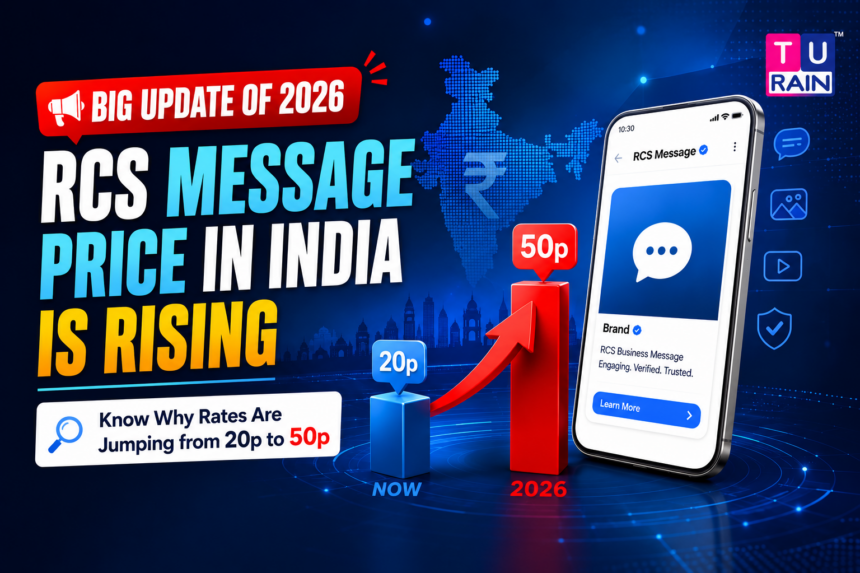
The RCS message price in India is changing. Some businesses that previously received quotes of around 20–30 paise per message are now seeing rates closer to 40–50 paise for certain promotional campaigns.
However, this does not mean that every RCS message in India now costs 50 paise. There is no single universal rate. The final price can vary according to the telecom operator, message type, provider agreement, monthly volume, campaign configuration and applicable taxes.
For marketers and businesses planning high-volume campaigns, understanding these variables is essential. This guide explains why the RCS message price in India is increasing, how promotional and transactional pricing can differ, and how businesses can manage their messaging budgets more effectively.
Quick answer: Why is the RCS message price in India increasing?
The price can rise when carrier charges, provider costs, campaign requirements or commercial agreements change. Rich media, verified business onboarding, campaign dashboards, analytics, API support and fallback routing may also influence the final quotation. Because providers and operators do not all follow one public retail rate, businesses should treat 20–50 paise as an indicative range—not a fixed national tariff.
What determines the current RCS message price in India?
RCS pricing is different from a simple, universal rate card. The amount a business pays may depend on several connected factors:
- The destination network and its commercial terms
- Whether the use case is OTP, transactional or promotional
- The type and configuration of the RCS agent
- Monthly campaign volume
- Provider platform and support charges
- Rich-media and interactive campaign requirements
- SMS or other fallback routing
- Taxes and additional managed services
Google recognises separate RCS for Business use cases, including OTP, transactional and promotional messaging. Each use case has its own business rules, and availability can vary by country. These categories should not automatically be treated as proof of one industry-wide retail price.
Key factors affecting RCS message pricing in India
1. Carrier and market-based pricing
RCS for Business pricing is influenced by mobile-network operators and commercial agreements within each market. This means the Google RCS message price is not necessarily identical across every provider, operator or campaign.
When underlying carrier costs or partner agreements change, aggregators and RCS providers may revise their customer-facing rates. This is one reason different businesses can receive different quotations for apparently similar campaigns.
2. Promotional RCS pricing versus transactional RCS pricing
RCS campaigns are organised according to their purpose.
Transactional RCS pricing generally applies to necessary updates related to an existing service or transaction, such as:
- Order confirmations
- Payment receipts
- Shipping updates
- Appointment reminders
- Account alerts
Promotional RCS pricing applies to campaigns intended to drive awareness, engagement or sales, including:
- Offers and discounts
- Product launches
- Abandoned-cart reminders
- Rich promotional cards
- Interactive product carousels
Promotional campaigns may require richer creative assets, interactive journeys and additional campaign management. The price quoted by a provider may therefore differ from a simple transactional alert. Businesses should ask for separate quotations based on the actual use case rather than assuming one flat RCS price.
3. Provider platform and infrastructure costs
An RCS provider does more than pass a message from a business to an operator. A managed platform may include:
- Verified business-profile onboarding
- RCS agent creation and approval support
- Campaign dashboards
- Delivery and engagement analytics
- API access and uptime support
- Audience and campaign management
- Compliance and reputation monitoring
- SMS fallback routing
These services influence the final retail price. A quotation based only on the lowest per-message figure may not include the operational support needed to run a reliable campaign.
4. Campaign volume and commercial slabs
Monthly volume can significantly affect the price offered to a business. An enterprise sending several million messages may receive different commercial terms from a company sending a smaller campaign.
When comparing providers, ask whether the quotation changes according to:
- Committed monthly volume
- Delivered or submitted messages
- Transactional or promotional use case
- Setup and onboarding charges
- Platform subscription costs
- Fallback-message charges
- GST and other applicable fees
This provides a more accurate comparison than evaluating the headline price alone.
5. Rich media and campaign complexity
RCS supports images, videos, rich cards, carousels, suggested replies and action buttons. These features make campaigns more interactive than conventional text messaging.
The presence of rich media does not prove that network bandwidth alone caused a particular price increase. However, campaign complexity can affect provider-side creative support, hosting, testing, automation and management costs. Businesses should therefore confirm what is included in a quoted rate.
Indicative RCS messaging rates in India
The following figures reflect the market ranges discussed in this article. They are not an official or universal tariff.
| Message category | Earlier indicative range | Current indicative retail range | Important note |
|---|---|---|---|
| Transactional RCS | ₹0.10–₹0.15 | ₹0.15–₹0.25 | May vary by operator, provider and volume |
| Promotional RCS | ₹0.20–₹0.30 | ₹0.40–₹0.50+ | Rich campaigns and managed services may affect the quote |
Pricing disclaimer: These rates are indicative market estimates as of September 2026 and may change without notice. Actual pricing can vary by telecom operator, RCS provider, message type, monthly volume, campaign configuration, fallback requirements and taxes. Request a current quotation before finalising a campaign budget.
RCS versus WhatsApp pricing: Which offers better value?
There is no universal winner based on price alone. WhatsApp Business Platform rates depend on the message category, destination market and current Meta rate card. Additional provider or platform charges may also apply. RCS pricing depends on operator agreements, message configuration, provider terms and volume.
When comparing RCS versus WhatsApp pricing, businesses should examine:
- The cost per delivered message
- Audience reach and device compatibility
- Need for a separate app
- Branding and verified-sender experience
- Rich-media and interaction requirements
- Clicks, conversions and cost per result
- Fallback and delivery strategy
RCS can be valuable for businesses that want interactive branded communication inside a compatible device’s messaging experience. WhatsApp may be more appropriate when customers already use the app heavily or when the planned journey depends on WhatsApp-specific capabilities. The better option is the one that generates the strongest result for the complete campaign cost.
RCS versus SMS cost: Is the higher price justified?
SMS is widely supported and effective for short, urgent text communication. RCS offers a richer experience through branded profiles, images, carousels, buttons, suggested replies and engagement signals.
Therefore, an RCS versus SMS cost comparison should not stop at the price per message. Businesses should also compare:
- Delivery rate
- Read and engagement data
- Click-through rate
- Conversion rate
- Cost per lead or sale
- Fallback performance
For a simple alert, SMS may remain the practical option. For a product showcase or interactive promotional journey, RCS may provide more value even when its per-message price is higher.
How to control RCS campaign costs
Businesses can manage rising RCS costs by improving campaign planning rather than simply choosing the lowest advertised rate.
- Separate transactional and promotional traffic. Match every message to the correct use case.
- Use rich media where it adds value. Do not add complex creative elements to messages that only require a short update.
- Negotiate based on realistic volume. Ask for slabs that reflect expected monthly usage.
- Review fallback costs. Confirm how and when unsupported RCS messages fall back to SMS.
- Measure results beyond delivery. Track clicks, replies, conversions and cost per outcome.
- Protect sender reputation. Follow consent, timing and frequency requirements to reduce complaints and wasted sends.
- Request a complete commercial breakdown. Confirm setup, platform, support, fallback and tax charges before comparing providers.
Choosing an RCS service provider in India
The right RCS service provider in India should offer more than a low per-message quotation. Businesses should evaluate onboarding assistance, campaign management, analytics, API reliability, compliance support and fallback capabilities.
Turain Software provides CPaaS and customer-engagement solutions for businesses managing high-volume communication campaigns. Turain’s RCS Business Messaging platform in India supports branded, interactive messaging, campaign management and fallback planning according to business requirements.
Turain can help businesses assess:
- Transactional and promotional campaign requirements
- Expected monthly message volume
- RCS agent and sender onboarding
- API and dashboard needs
- SMS fallback strategy
- Volume-based commercial options
The verdict: Is RCS still worth considering in 2026?
Yes—when it is matched to the right use case and measured against business outcomes. A higher per-message quote does not automatically make RCS expensive, just as a lower rate does not guarantee a successful campaign.
Businesses should compare the total campaign cost with delivery, engagement, conversions and customer experience. The most effective strategy may combine RCS, SMS and WhatsApp rather than forcing every communication through a single channel.
Planning a high-volume campaign? Speak with Turain Software to request a current, volume-based RCS quotation based on your message category, campaign size and fallback requirements.
Frequently asked questions about RCS message pricing in India
What is the current RCS message price in India?
There is no single fixed RCS price across India. The amount can vary by operator, provider, message type, campaign volume and service package. Some market quotations discussed in 2026 range from approximately 15–25 paise for certain transactional campaigns and 40–50 paise or more for certain promotional campaigns. These are indicative figures, not a universal tariff.
Why is the RCS message price in India increasing?
RCS prices may increase because of changes in carrier agreements, provider costs, campaign requirements, platform services and commercial volume slabs. Rich-media management, verified business onboarding, analytics, API support and fallback routing may also affect the final quotation.
What are the main factors affecting RCS message pricing in India?
The main factors include the destination operator, use case, message configuration, monthly volume, provider agreement, platform features, fallback routing, managed support and applicable taxes.
Is promotional RCS pricing higher than transactional RCS pricing?
It can be, depending on the provider and campaign configuration. Promotional campaigns may involve rich cards, carousels, action buttons and additional campaign management. Ask the provider for separate promotional and transactional quotations because there is no single industry-wide retail rate.
What is the difference between promotional and transactional RCS messages?
Transactional messages provide necessary information about an existing service or transaction, such as payment confirmations or shipping updates. Promotional messages are designed to increase awareness, engagement or sales through offers, product information and marketing campaigns.
Is RCS cheaper than WhatsApp Business messaging?
Not in every situation. RCS and WhatsApp follow different commercial models, and their rates vary according to message type, destination, provider and volume. Compare the complete cost per delivered message and the cost per business result rather than relying on a single advertised rate.
Is RCS more expensive than SMS?
RCS may cost more than SMS for rich or interactive campaigns, while simpler RCS formats may be closer to SMS pricing in some commercial arrangements. RCS also provides branding, interactive features and engagement data that standard SMS does not offer.
How can I get an accurate RCS price for my business?
Share your use case, monthly volume, target audience, media requirements, API needs and fallback strategy with the provider. Turain Software can then prepare a customised quotation based on the campaign's actual requirements.
References
- Google RCS for Business use cases and rules: https://developers.google.com/business-communications/rcs-business-messaging/guides/learn/agent-use-cases
- Meta WhatsApp Business Platform pricing: https://developers.facebook.com/documentation/business-messaging/whatsapp/pricing